Ecuador’s hijacked gold mining supply chain: risk and traceability notes for project teams
Reviewed by Tom Sullivan
First reported on MINING.com
30 Second Briefing
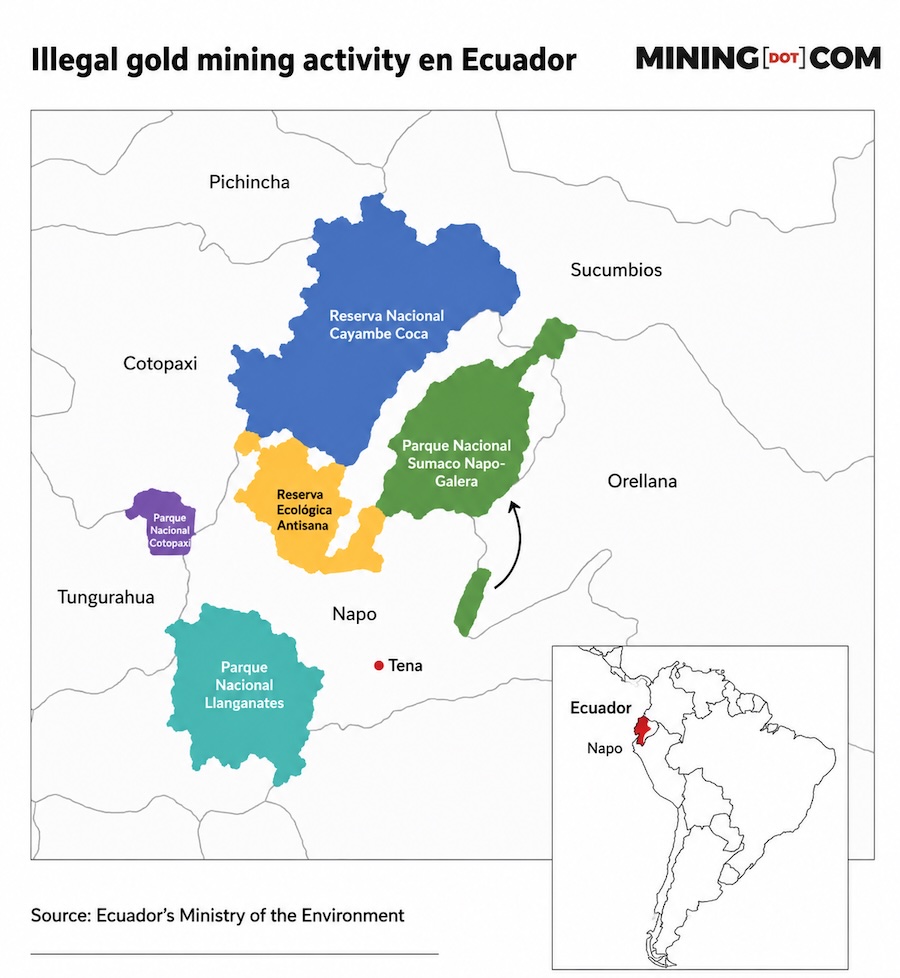
Ecuador has classified illegal gold mining as a national security threat after gangs such as Los Lobos infiltrated the full value chain, blending illicit ore with legal production and exporting via Guayaquil and Puerto Bolívar. GI-TOC estimates illegal sites have surged from fewer than 60 before 2018 to more than 600 by 2024, with complaints rising 58% to 393 cases in 2025 and activity concentrated in Napo’s protected areas. The 2026–2029 plan includes tighter logistics controls, nationwide monitoring by 2027, and mineral traceability for all ore to ports and plants by 2028–2029.
Technical Brief
- National Security Plan 2026–2029 formally reclassifies illegal mining from environmental/regulatory issue to strategic security threat.
- Los Lobos is identified as the dominant group controlling illegal mining from extraction through export logistics.
- GI-TOC notes Los Lobos-linked flows routed specifically via Guayaquil and Puerto Bolívar export terminals.
- Government links illegal mining operations to stolen diesel networks powering heavy mining equipment at clandestine sites.
- Ambush killing 11 soldiers during an Amazon enforcement operation has triggered escalated military involvement at mine sites.
- Border Commandos, a FARC dissident faction, are reported operating alongside local gangs in Amazonian mining zones.
- Trade data show 19.2 t gold exports in 2022 versus over 27 t doré in 2023, indicating rapid volume growth.
- Security plan targets dismantling 88% of organised crime structures by 2029, implying sustained multi-year operations around mining corridors.
Our Take
With doré gold exports exceeding 27 tonnes in 2023 against 19.2 tonnes of recorded gold exports in 2022, the scale of the export channel suggests that even modest leakage from hijacked supply chains could materially distort official trade data and complicate source-verification for refiners and downstream buyers.
The National Security Plan’s goal of disrupting 88% of organised crime structures by 2029 signals a multi‑year period of heightened enforcement in Ecuador, which operators and contractors in the gold and silver space should treat as a planning assumption for access, permitting timelines, and community relations work in the Amazon and Napo regions.
Prepared by collating external sources, AI-assisted tools, and Geomechanics.io’s proprietary mining database, then reviewed for technical accuracy & edited by our geotechnical team.
Related Articles


Related Industries & Products
Mining
Geotechnical software solutions for mining operations including CMRR analysis, hydrogeological testing, and data management.
CMRR-io
Streamline coal mine roof stability assessments with our cloud-based CMRR software featuring automated calculations, multi-scenario analysis, and collaborative workflows.
HYDROGEO-io
Comprehensive hydrogeological testing platform for managing, analysing, and reporting on packer tests, lugeon values, and hydraulic conductivity assessments.
GEODB-io
Centralised geotechnical data management solution for storing, accessing, and analysing all your site investigation and material testing data.