Denison’s Phoenix ISR uranium mine: design, capex and schedule notes for engineers
Reviewed by Joe Ashwell
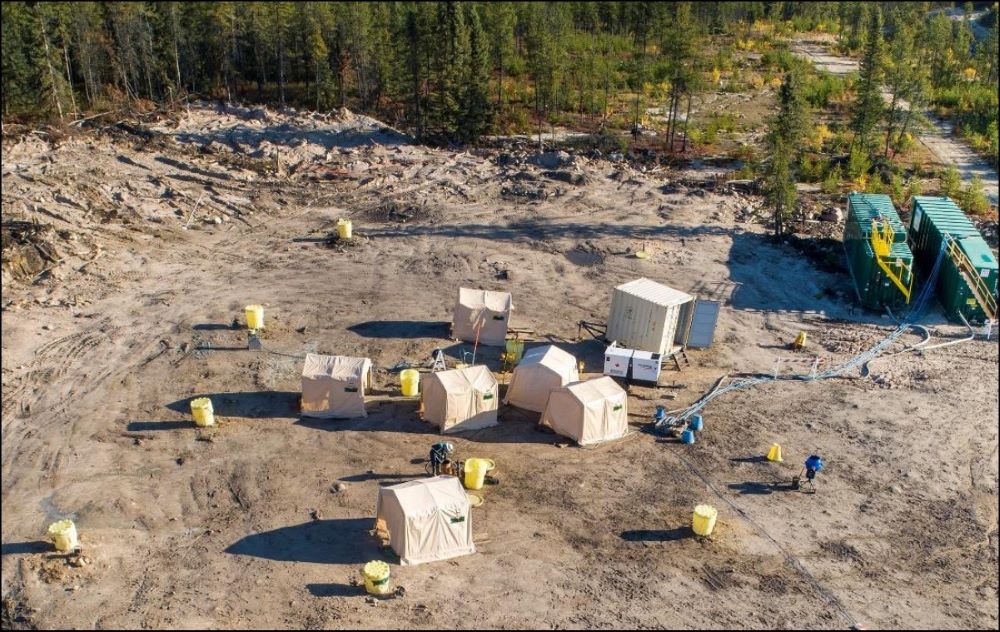
First reported on MINING.com
30 Second Briefing
Denison Mines has started full construction of the C$700 million Phoenix in-situ recovery uranium project in northern Saskatchewan, installing the first perimeter freeze wall after completing more than 20% of civil works and nearly all ground preparation for the processing plant and wellfield. The Athabasca Basin’s first commercial ISR mine is targeting mid-2028 first production, peak output of about 9 million lb U3O8 per year over a 10-year mine plan, drawing on 56.7 million lb of proven and probable reserves grading 11.7% U3O8. Key infrastructure includes a new 138 kV SaskPower transmission line, on-site concrete batch plant, quarry, expanded 400-person camp and an airstrip under preparation, with engineering about 90% complete.
Technical Brief
- First perimeter freeze wall is being installed to hydraulically isolate the initial ISR mining zone.
- Over 20% of civil works are complete, with nearly all plant and wellfield ground prep finished.
- Concrete pours for processing plant and main power transformer foundations are scheduled to start next month.
- A concrete batch plant and nearby quarry are on site, supplying aggregate and ready-mix for foundations.
- SaskPower’s 138 kV transmission line to Phoenix is complete, enabling grid power for construction and operations.
- Temporary camp capacity has been expanded to nearly 400 personnel, with an airstrip currently under preparation.
- Engineering is ~90% complete, with 95% of main design packages already issued for construction.
- 2023 feasibility (updated 2024) reports post-tax NPV8 of C$1.57 billion and 73% IRR.
- Average all-in operating cost is estimated at C$18.41/lb U3O8 over the 10-year mine plan.
- Denison controls 95% of Wheeler River (90% direct, 5% via JCU), enabling shared infrastructure with the Gryphon underground project.
Our Take
With Phoenix’s post-tax NPV of C$1.57 billion against a C$700 million capex and a 73% IRR, Denison Mines sits at the very top end of project economics in our uranium coverage, which is likely to pressure higher-cost Athabasca Basin developments to rethink sequencing or scale.
Denison’s C$418 million cash position plus C$216 million of U3O8 inventory at Phoenix gives it unusually strong pre-production liquidity compared with other uranium developers in our database, reducing reliance on dilutive equity or high-cost debt during the two-year build.
The 138 kV SaskPower line highlighted in the January 2026 related piece, combined with Phoenix’s ISR design, positions this Athabasca Basin project to market itself as a relatively low-carbon uranium source at a time when around 30 countries are targeting a tripling of nuclear capacity by 2050.
Prepared by collating external sources, AI-assisted tools, and Geomechanics.io’s proprietary mining database, then reviewed for technical accuracy & edited by our geotechnical team.
Related Articles


Related Industries & Products
Mining
Geotechnical software solutions for mining operations including CMRR analysis, hydrogeological testing, and data management.
Construction
Quality control software for construction companies with material testing, batch tracking, and compliance management.
CMRR-io
Streamline coal mine roof stability assessments with our cloud-based CMRR software featuring automated calculations, multi-scenario analysis, and collaborative workflows.
HYDROGEO-io
Comprehensive hydrogeological testing platform for managing, analysing, and reporting on packer tests, lugeon values, and hydraulic conductivity assessments.
GEODB-io
Centralised geotechnical data management solution for storing, accessing, and analysing all your site investigation and material testing data.