Conveyor belt transition design: practical loading zone lessons for mine engineers
Reviewed by Tom Sullivan
First reported on Australian Mining
30 Second Briefing
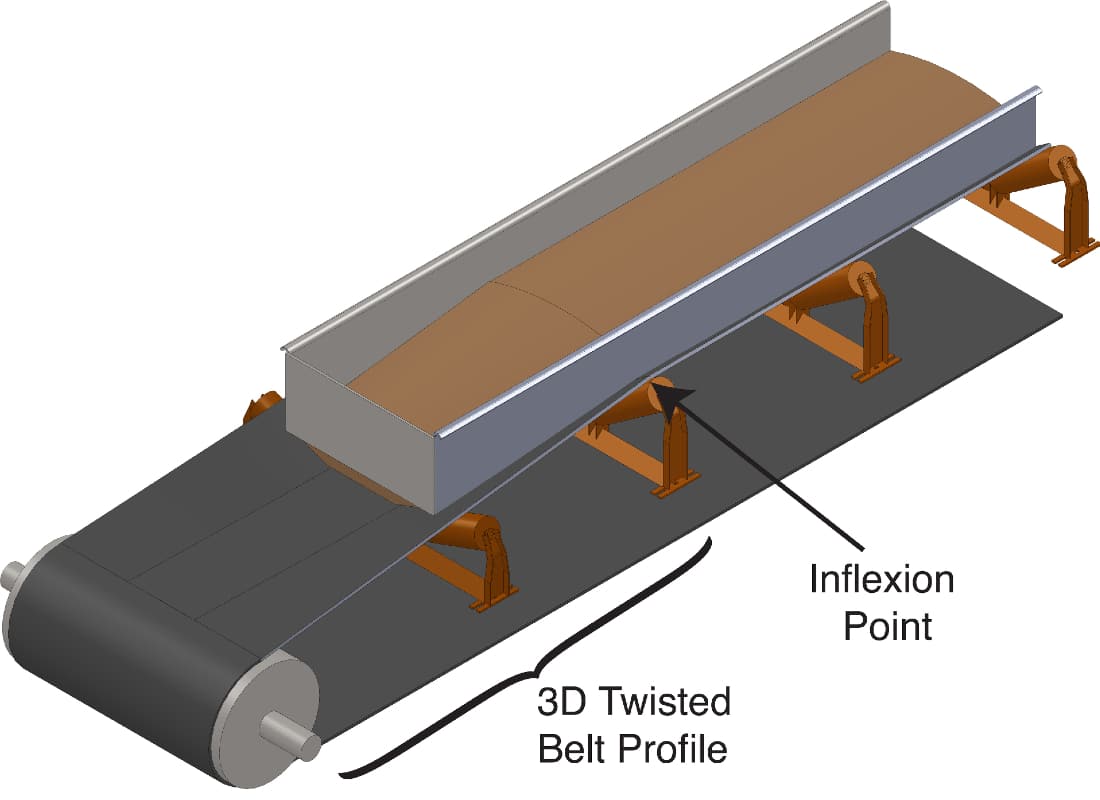
Rising conveyor belt speeds and tonnages without corresponding redesign are causing excessive dust, spillage and broken idlers where material is loaded on transition zones rather than on a fully troughed, stabilised belt. Todd Swinderman of Martin Engineering critiques the conventional practice of loading over changing idler angles, where belt flexure, mistracking and poor sealing at the inflection point accelerate wear on idlers, skirt rubber and belt edges. He advocates designing loading points on flat or fully formed trough sections with correctly sized impact beds, closely spaced idlers and controlled transfer chute geometry to manage impact and containment.
Technical Brief
- Martin Engineering identifies the belt “inflection point” as the critical location for impact and sealing failure.
- Swinderman notes that transition zones often combine maximum belt flexure, idler load and sealing demand in the same short length.
- Poorly designed transitions can force idler frames out of alignment, aggravating mistracking and accelerating bearing and shell fatigue.
- Inadequate impact support under chutes increases localised belt sag, opening gaps under skirting and driving fugitive dust generation.
- The paper stresses matching transition length to belt stiffness and carcass construction, not just nominal belt width.
- Swinderman links uncontrolled loading turbulence to higher carryback, requiring more frequent clean-up and exposing crews to manual handling risks.
- He argues that idler and skirt failures in transition areas are often misdiagnosed as “maintenance issues” rather than design non-compliance.
- For similar high-tonnage upgrades, he recommends re-checking transition geometry as a formal safety-critical design step, not an afterthought.
Our Take
Martin Engineering’s recent focus on passive dust control retrofits and wear liners in our database suggests its conveyor belt transition guidance is part of a broader push to reduce fugitive material and dust-related safety incidents at Australian operations without major structural rebuilds.
The acquisition of Australian conveyor specialist ConveyorTech Pty Ltd (CVT) positions Martin Engineering to embed its transition design principles directly into locally manufactured belt cleaners and components, which is likely to make compliance with best-practice transition geometry easier for brownfield projects in Australia.
Prepared by collating external sources, AI-assisted tools, and Geomechanics.io’s proprietary mining database, then reviewed for technical accuracy & edited by our geotechnical team.
Related Articles



Related Industries & Products
Mining
Geotechnical software solutions for mining operations including CMRR analysis, hydrogeological testing, and data management.
Construction
Quality control software for construction companies with material testing, batch tracking, and compliance management.
CMRR-io
Streamline coal mine roof stability assessments with our cloud-based CMRR software featuring automated calculations, multi-scenario analysis, and collaborative workflows.
HYDROGEO-io
Comprehensive hydrogeological testing platform for managing, analysing, and reporting on packer tests, lugeon values, and hydraulic conductivity assessments.
GEODB-io
Centralised geotechnical data management solution for storing, accessing, and analysing all your site investigation and material testing data.