Cerrejón closure push on Glencore: transition and risk takeaways for mine planners
Reviewed by Tom Sullivan
First reported on MINING.com
30 Second Briefing
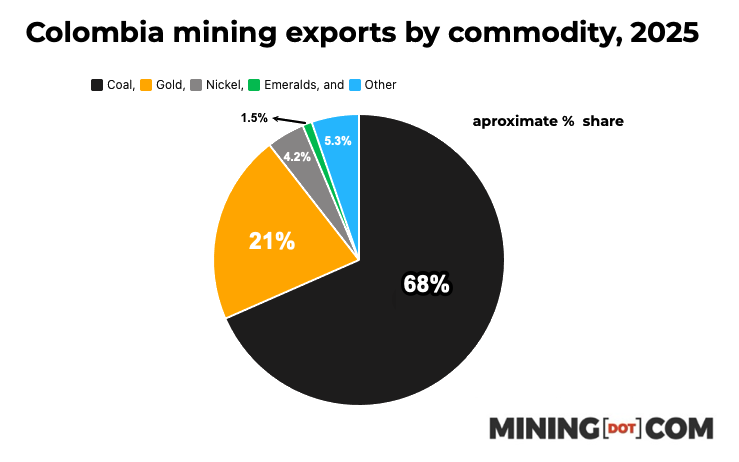
Colombia is pressing Glencore to start detailed closure and transition planning for the Cerrejón complex, a 16.8‑million‑tonne‑per‑year open‑pit coal mine with a 150 km dedicated railway and Caribbean export port whose concession runs to 2034. A GEM consultancy report warns that abrupt, politically driven curtailment could destabilise La Guajira’s coal‑dependent economy, which currently relies on more than 12,000 mine‑related jobs, about $166 million a year in royalties and roughly $86 million in local procurement. GEM proposes a “managed transition compact” with ring‑fenced closure and retraining funds, supplier‑conversion schemes, environmental assurance financing and long‑term reuse plans for rail and port infrastructure.
Technical Brief
- Government pressure is driven by concern that waiting close to the 2034 concession expiry compresses transition timelines.
- GEM frames the risk as “managed transition vs unmanaged shock”, stressing sequencing of closure, finance and replacement industries.
- Report warns politically driven curtailment without new industries could destabilise municipal budgets and social programmes in La Guajira.
- Cited international failures include Cobre Panamá, Blyvooruitzicht and Kabwe, where abrupt shutdowns left contamination and fiscal stress.
- Environmental critics focus on Cerrejón’s historic water use, coal dust emissions and displacement of Indigenous Wayuu communities.
- Proposed “managed transition compact” would ring‑fence funds for worker retraining, supplier conversion and environmental assurance.
- Long‑term reuse of the dedicated rail, port and logistics assets is flagged as a core transition design decision.
Our Take
Glencore features heavily across recent Latin American coverage in our database, from coal in Colombia to copper opportunities in Argentina and political risk in Peru, signalling that its regional portfolio is increasingly exposed to shifting government expectations on both decarbonisation and fiscal terms.
The Cerrejón complex’s estimated $166 million in annual royalties and $86 million in local procurement spend mean any accelerated closure in La Guajira would create a sizeable fiscal and supply-chain gap, giving Bogotá strong incentives to push for a phased transition rather than a hard stop before the 2034 concession end.
With Colombia already under scrutiny for underground coal safety after the La Ciscuda explosion, pressure on Glencore over Cerrejón’s closure plan is likely to extend beyond rehabilitation to include how remaining years of operation address worker safety and community risk in a high-profile coal province.
Prepared by collating external sources, AI-assisted tools, and Geomechanics.io’s proprietary mining database, then reviewed for technical accuracy & edited by our geotechnical team.
Related Articles

Related Industries & Products
Mining
Geotechnical software solutions for mining operations including CMRR analysis, hydrogeological testing, and data management.
Construction
Quality control software for construction companies with material testing, batch tracking, and compliance management.
CMRR-io
Streamline coal mine roof stability assessments with our cloud-based CMRR software featuring automated calculations, multi-scenario analysis, and collaborative workflows.
HYDROGEO-io
Comprehensive hydrogeological testing platform for managing, analysing, and reporting on packer tests, lugeon values, and hydraulic conductivity assessments.
GEODB-io
Centralised geotechnical data management solution for storing, accessing, and analysing all your site investigation and material testing data.