Geomechanics.io

  • Free Tools
Sign UpLog In

Geomechanics.io

Geomechanics, Streamlined.

© 2026 Geomechanics.io. All rights reserved.

Geomechanics.io

CMRR-ioGEODB-ioHYDROGEO-ioQCDB-ioFree Tools & CalculatorsBlogLatest Industry News

Industries

MiningConstructionTunnelling

Company

Terms of UsePrivacy PolicyLinkedIn
    AllGeotechnicalMiningInfrastructureMaterialsHazardsEnvironmentalSoftwarePolicy
    Projects
    Contract Award

    Budimex CPK deep foundations: piling strategy and risks for ground engineers

    April 2, 2026|

    Reviewed by Tom Sullivan

    Budimex CPK deep foundations: piling strategy and risks for ground engineers

    First reported on New Civil Engineer

    30 Second Briefing

    Budimex has been selected as preferred contractor for deep foundation works on the passenger terminal of Poland’s planned Centralny Port Komunikacyjny (CPK), part of the £27bn Port Polska hub between Warsaw and Łódź. The package will focus on large-scale piling and ground improvement for the main terminal superstructure, a critical early works phase on the greenfield site’s challenging alluvial and glacial deposits. Geotechnical contractors and designers will be watching for CPK’s chosen pile types, installation methods and monitoring regimes, which are likely to set benchmarks for subsequent airside and rail interfaces.

    Technical Brief

    • Preferred contractor status indicates Budimex now enters negotiation on price, programme and risk allocation.
    • Contract award will likely define geotechnical data ownership and sharing protocols for subsequent CPK work packages.
    • Early foundation design decisions are expected to influence future standard details for other Port Polska structures.

    Our Take

    With 21 geotechnical stories in recent coverage but very few tied to single greenfield hubs of this magnitude, this award positions Budimex as a go-to regional player for complex ground engineering, which may strengthen its hand in bidding for subsequent CPK or rail-related foundation packages.

    Geotechnical Software for Modern Teams

    Centralise site data, logs, and lab results with GEODB-io, CMRR-io, and HYDROGEO-io.

    No credit card required.

    • Save and export unlimited calculations
    • Advanced data visualisation
    • Generate professional PDF reports
    • Cloud storage for all your projects

    Prepared by collating external sources, AI-assisted tools, and Geomechanics.io’s proprietary mining database, then reviewed for technical accuracy & edited by our geotechnical team.

    Related Articles
    Europe’s deepest offshore breakwater: geotechnical design lessons for engineers
    Geotechnical
    11 days ago

    Europe’s deepest offshore breakwater: geotechnical design lessons for engineers

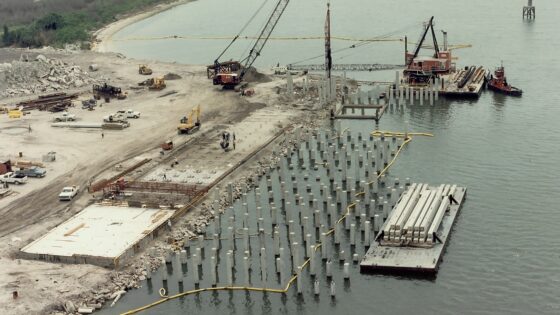
    Construction of a 6km offshore breakwater with Europe’s deepest foundations is pushing marine geotechnical limits, with caissons and foundation elements installed in exceptionally deep water using heavy-lift vessels and precision positioning systems. Complex offsite fabrication of large concrete units, likely in a dedicated casting yard with slipform or match-cast techniques, is being coordinated with narrow marine weather windows and high-capacity barges to maintain programme. For designers and contractors, the project stresses accurate seabed characterisation, robust scour protection detailing and tight control of tolerances during submerged placement.

    Long Baseline Neutrino Facility caverns: geotechnical design notes for engineers
    Geotechnical
    16 days ago

    Long Baseline Neutrino Facility caverns: geotechnical design notes for engineers

    Excavation is under way 1.5km below ground at the Long Baseline Neutrino Facility in South Dakota to create three caverns, each roughly cathedral-sized, to house the Deep Underground Neutrino Experiment’s liquid-argon detectors. The 1,300km-long beamline from Fermilab to the former Homestake gold mine demands tight control of rock mass behaviour, with extensive pre-grouting, cable bolting and shotcrete linings in complex, stressed Precambrian formations. Construction sequencing, spoil handling through deep shafts and long-term groundwater management are central geotechnical risks for the multi-year programme.

    Aging behaviour of helical anchors and piles: design and safety notes for engineers
    Geotechnical
    16 days ago

    Aging behaviour of helical anchors and piles: design and safety notes for engineers

    Immediate load capacity of helical anchors and piles at installation is being challenged by data showing significant “aging” effects, with shaft resistance and overall capacity increasing measurably over days to months in clays and some sands. The discussion contrasts torque-correlated design methods with time-dependent capacity gains, referencing field load tests where post-installation capacity growth alters factor-of-safety assumptions and serviceability performance. For practitioners, the key issue is whether to rely solely on installation torque or to incorporate waiting periods and ageing factors into design for temporary works, tiebacks and lightly loaded foundations.

    Related Industries & Products

    Construction

    Quality control software for construction companies with material testing, batch tracking, and compliance management.

    CMRR-io

    Streamline coal mine roof stability assessments with our cloud-based CMRR software featuring automated calculations, multi-scenario analysis, and collaborative workflows.

    HYDROGEO-io

    Comprehensive hydrogeological testing platform for managing, analysing, and reporting on packer tests, lugeon values, and hydraulic conductivity assessments.

    GEODB-io

    Centralised geotechnical data management solution for storing, accessing, and analysing all your site investigation and material testing data.