Geomechanics, Streamlined.
© 2026 Geomechanics.io. All rights reserved.
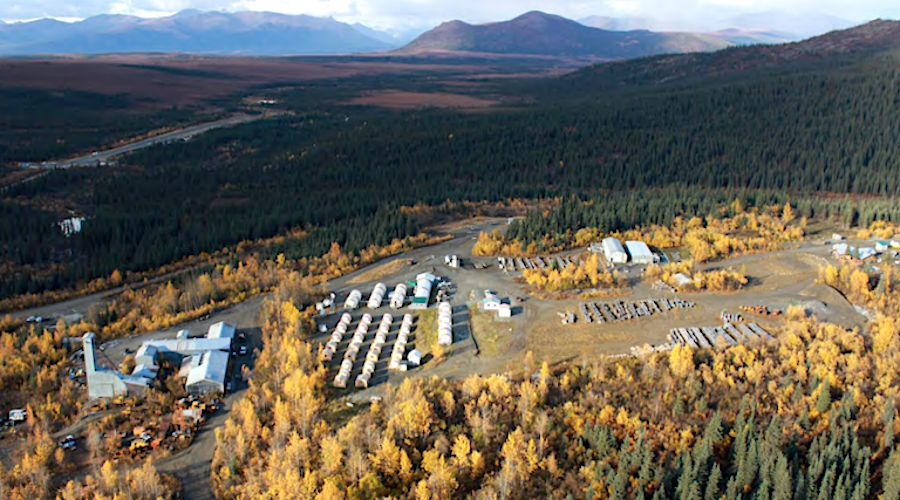
South32 is funding a US$35 million work programme at the high-grade Arctic polymetallic deposit in Alaska’s Ambler district through its 50:50 Ambler Metals joint venture with Trilogy Metals, within the 1,900 km² Upper Kobuk Mineral Projects that also host the Bornite copper deposit. The 2026 field season will focus on geotechnical and condemnation drilling at Arctic to refine mine design, infrastructure siting and long-term production planning, while upgrading the Bornite camp for multi‑year operations. South32 has also sold about US$17.8 million of Trilogy shares to the US Department of War, giving Washington a 10% stake ahead of a planned independent JV management team and intensified permitting and technical studies.
Mining’s post-2011 austerity playbook, dominated by CFO-style leaders focused on cost-cutting, dividends and buybacks, is colliding with a structurally tighter supply environment where gold trades well above $2,000/oz and permitting and reserve replacement are slower and harder than at any point in recent decades. Erik Groves, corporate strategy lead and in-house counsel at Morgan Companies, argues that companies which kept building mines through the downturn are already outperforming more cautious peers as investors rotate to visible growth. He calls for geologists and technical project builders to regain strategic authority, balancing financial discipline with long-horizon investment in new ore bodies.
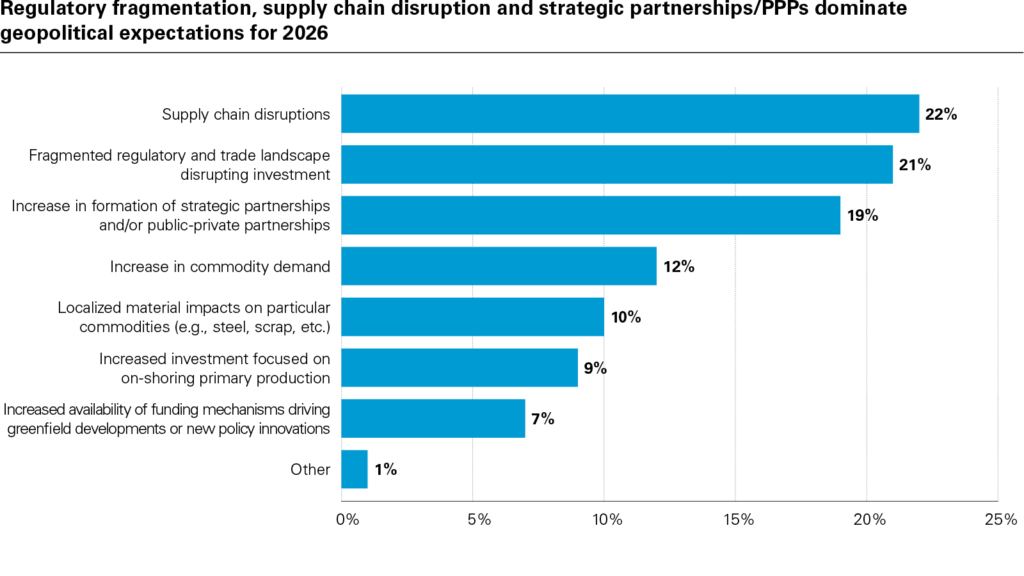
Government policy is set to dominate mining investment in 2026, with 47% of respondents to White & Case’s Mining & Metals 2026 survey citing political variables and nearly 40% expecting state‑backed financing to be the main tool in developed markets. Some 73% foresee widening divergence between US and Chinese critical minerals policy, while a funding gap between the US and Europe is seen as a key opportunity, alongside risks of over‑expansion and a two‑to‑three‑year “gold rush” bubble. Copper and gold are viewed as the “sure bet” price risers, with gold miners seen as prime consolidation targets and strategic partnerships favoured over traditional M&A.
Goldman Sachs has raised its 2026 year-end gold price forecast to $5,400/oz after bullion gained about 40% last year and a further 11% since January, with spot trading around $4,885/oz and brushing a record $4,887.19. Analysts cite sustained central bank buying of roughly 60 tonnes in 2026, led by emerging markets diversifying reserves, plus private-sector investors using gold to hedge global policy risk and not liquidating positions. The bank warns downside risk remains if long-run monetary policy risks ease sharply.
Gold prices surged nearly 2% to a record $4,923.63/oz on Thursday, with silver jumping 3% to $96.57/oz, as US data showing resilient jobs and consumer spending boosted expectations of two Federal Reserve rate cuts in H2 2026 and weakened the dollar. Safe-haven flows were already elevated after President Trump’s tariff threats against European states opposing his Greenland takeover plan, with both metals setting successive session records. Goldman Sachs has lifted its year-end gold forecast to $5,400/oz, citing intensifying central-bank and private-investor demand.
SMS Equipment has entered the European market by acquiring Suomen Rakennuskone Oy, Finland’s exclusive Komatsu dealer for mining and construction equipment, adding to its existing operations in Canada, Alaska and Mongolia. Founded in 1992 and headquartered in Pirkkala, Suomen Rakennuskone runs branches in Kempele, Kuopio, Vantaa and near the Kevitsa mine, providing sales, maintenance, parts, training and technical support. The move gives SMS direct access to Finland’s nickel- and gold-dominated mining sector, with additional exposure to cobalt and lithium projects.
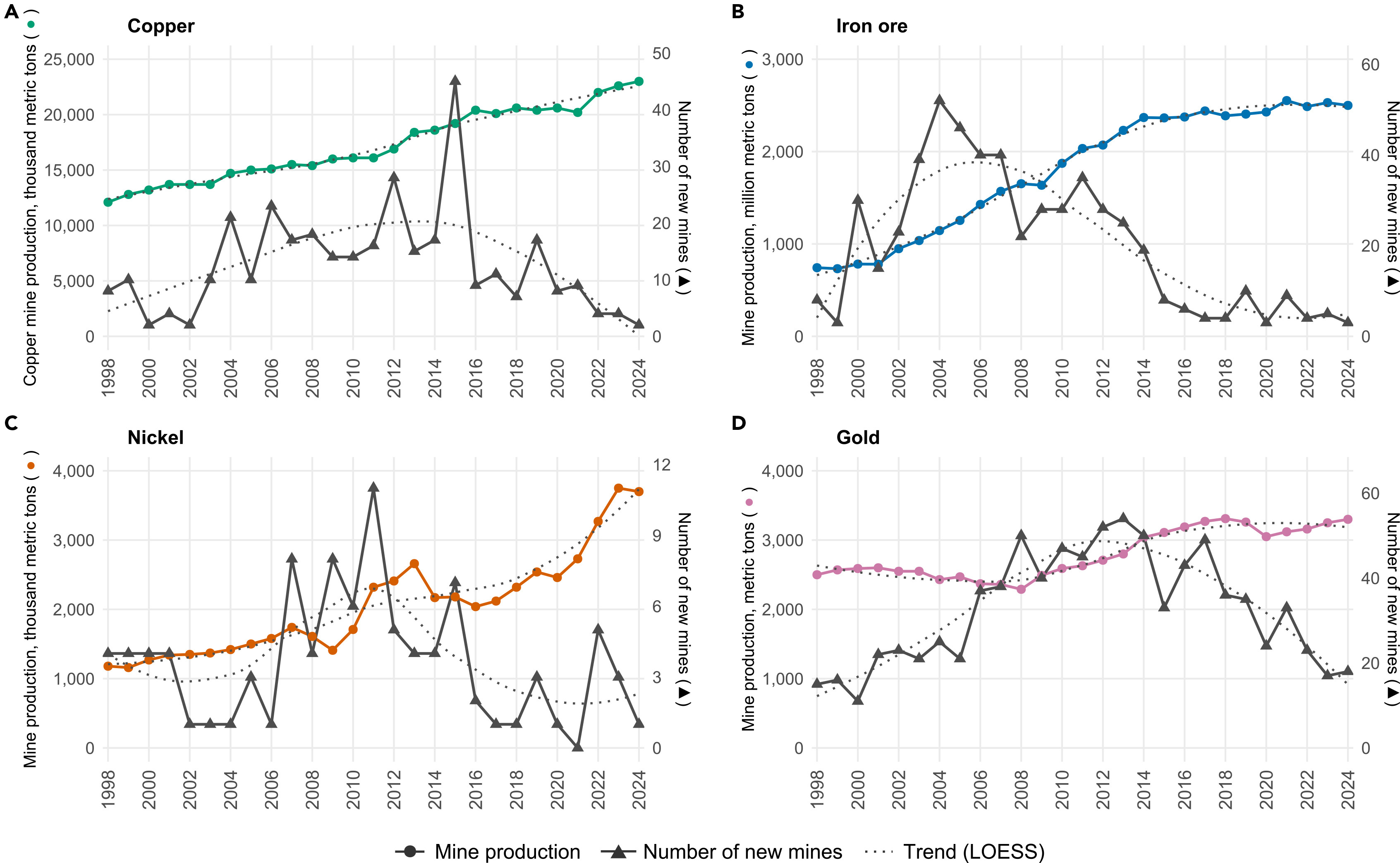
Global mine development has shifted decisively to brownfield expansion, with a University of Queensland study of 366 sites in 58 countries showing brownfield capital dominated by copper (just under 50%), followed by gold (17.5%), iron ore (14.4%) and nickel (6.3%). Chile accounts for 25.2% of global brownfield capex, ahead of the US (11.4%) and Australia (10.1%), while minesite exploration by majors in Pacific and Southeast Asia has surged from 27.3% of budgets in 2010 to 76.8% in 2024. Nearly 80% of brownfield mines assessed via satellite sit in areas with multiple high-risk conditions, and over half lie within 20 km of biodiversity hotspots or protected areas, signalling tighter geotechnical, water and permitting constraints for future expansions.
American Rare Earths’ Halleck Creek project in Wyoming has secured a Seed Translational Acceleration of Research (STAR) award via the University of Wyoming’s NSF Accelerating Research Translation programme to study byproducts and tailings from rare earth extraction. The work, led by Tyler Brown at UW’s School of Energy Resources, will assess technical viability, processing requirements and end-use applications for these materials and their impact on project economics. Halleck Creek metallurgical tests have already upgraded ore from 0.34% to 3.72% TREO, removing 93.5% of non-rare earth material early so only 6.5% requires further refining.
Dyno Nobel has launched the Navus handheld blaster, a 600 g electronic initiation device designed to trigger blasts via up to 2,500 m of harness wire anywhere on site. The unit extends the company’s electronic initiation range beyond fixed blast boxes, giving engineers more flexibility in complex pit geometries, underground headings and perimeter stand-off locations. For drill-and-blast teams, the compact form factor and long wire support enable wider separation between charge areas and firing points without adding extra infrastructure.
EnviroGold Global has reported a technical advance in its proprietary NVRO Process™ after gaining a much sharper understanding of sulphide pre-concentration behaviour within the process flowsheet. The company says the revised sulphide pre-concentration stage materially improves project economics for the NVRO Process when treating a broader range of tailings, rather than only high-grade or narrowly specified feeds. This could open commercial opportunities for reprocessing complex sulphidic tailings storage facilities, where variable mineralogy and fine particle size have previously limited viable recovery.
Mira Geoscience has acquired SRK Consulting (Canada) Inc’s HiveMap platform, a digital geological and geotechnical field mapping system designed for efficient collection, visualisation and interpretation of geoscientific data. HiveMap integrates directly with photogrammetry and LiDAR workflows, allowing structural, lithological and geotechnical observations to be tied to high-resolution 3D surfaces and point clouds. The acquisition signals tighter coupling between field mapping, 3D geomodelling and mine-scale geotechnical analysis within Mira’s existing integrated geoscience software suite.
Zenzic Capital and Jensco have launched a UK single-family rental platform by forward funding 125 new-build Vistry homes at the Great Haddon scheme in Peterborough, backed by an initial £31m investment. Construction of the purpose-built rental units is due to start later this year, with Vistry using its partnership model to deliver professionally managed, higher energy-performance homes for strong local demand. The Zenzic-Jensco venture targets a portfolio of around 1,000 homes, signalling growing institutional capital flows into single-family build-to-rent product.
Contracts signed by Southwark Council with Wates Residential and Mount Anvil will deliver at least 1,149 new homes across eight infill and estate sites in Peckham, Camberwell, Rotherhithe and Bermondsey. Wates will build a minimum of 343 homes on Gloucester Grove, Bells Gardens, Lindley Estate and Wyndham Road, all classed as affordable, including at least 131 new council units. Mount Anvil will deliver at least 786 homes at Seven Islands Leisure Centre, Red Lion Boys Club, Priter Road and Beormund School, with a minimum 50% affordable and at least 229 council homes.
Westmorland & Furness Council has appointed Muse Places, working through the ECF partnership with Homes England and Legal & General, as development partner for Barrow’s Marina Village, a waterfront neighbourhood planned for around 1,350 homes plus a nature conservation area and public open space. Phase one remediation of six hectares, funded by £5.5m from the Getting Building Fund, finished in November 2023, while phase two is remediating a further 19 hectares with £24.8m BIL funding, including realignment of Cavendish Dock Road, utilities diversion/protection and temporary relocation of a council waste depot. Planning approval for phase three, which will unlock a further 16% of the site once biodiversity net gain credits are agreed, and the new pre-development agreement will lead into a full master development agreement covering design, infrastructure phasing and funding.
JCB technical service director Phil Layton has begun a two-year term as president of the Committee for European Construction Equipment (CECE), representing the UK’s Construction Equipment Association. Layton plans to prioritise decarbonisation of construction machinery fleets, support for open global markets and a more competitive regulatory framework for European OEMs. CECE’s immediate policy push targets EU secondary legislation on road circulation of construction machinery and a guidance document for implementing the new Machinery Regulation, ahead of the CECE congress in London on 27–29 October.
Westminster City Council has agreed a £229m budget with McLaren Construction for phase two of the Ebury Bridge regeneration in Knightsbridge and Belgravia, covering three independent and two adjoined residential blocks that required four separate building safety applications to the Building Safety Regulator. The wider scheme will deliver 779 homes across three phases, including 373 for social rent, with phase two adding 334 units, 228 of them for social rent, plus reinstated Ebury Bridge Road retail frontage and new commercial premises. McLaren will use prefabricated façade elements to cut material movements, with main construction starting later in 2025 and completion scheduled for May 2029.
Civil engineering contractor Barhale has promoted southern regional director Phil Cull to national executive director, adding him to the company’s strategic board. His former southern region remit is being split, with former water director Shane Gorman becoming southern region director – infrastructure and projects director Daniel Meadowcroft moving to southern region director – projects, both joining the operations board. Gorman and Meadowcroft will report to newly appointed chief operating executive James Ingamells, signalling a tighter, board-level focus on regional delivery of Barhale’s infrastructure and project portfolios.
Homes England has signed a building lease with Vistry to redevelop Birmingham’s decommissioned City Hospital site into 750 homes, including 698 new-build units and 52 one- and two-bedroom apartments within the converted former infirmary, with 35% of the scheme designated as affordable housing. Asbestos removal began in December 2025, with major demolition of most existing hospital structures to follow and main construction scheduled for the second half of 2026. First completions are targeted for early 2027, turning a complex brownfield healthcare estate into a dense, mixed-tenure urban neighbourhood with some commercial uses.
Fortescue Metals has reported record first-half iron ore shipments from its Pilbara operations while advancing a major renewables build-out to cut diesel and gas use across mines and rail. The company is progressing large-scale solar and wind installations tied into its high-voltage transmission network and battery storage, aiming to displace fossil fuel power at processing plants and dewatering systems. For mine planners and engineers, the shift implies future pit, haul road and plant layouts will need to accommodate renewable generation footprints and grid-integration infrastructure.
The Western Australian Government has extended its coal supply agreement with Griffin Coal beyond July 2026 by up to five years to maintain fuel to the 854MW Collie power stations during the state’s staged coal-fired generation exit. The extension secures continued open-cut operations at the Collie mine, which has historically supplied several million tonnes of thermal coal per year to Synergy under long-term contracts. For geotechnical and mining teams, the decision signals ongoing pit stability management, overburden handling and progressive rehabilitation planning on a multi-year horizon rather than rapid closure.
Energy Fuels’ proposed acquisition of Australian Strategic Materials, owner of the Dubbo rare earths and critical minerals project in New South Wales, signals accelerating competition for advanced projects ahead of 2026. Iluka Resources is progressing its Eneabba rare earths refinery in Western Australia, designed to process monazite concentrate from its Eneabba mineral sands operations into separated oxides. Other 2026‑watch projects include Arafura Rare Earths’ Nolans in the NT, Hastings’ Yangibana in the Gascoyne, and Lynas’ Kalgoorlie cracking and leaching plant, all targeting neodymium–praseodymium supply.
Two major Victorian road intersection projects are advancing, with Fulton Hogan awarded the Henderson Road–Ferntree Gully Road upgrade in Knoxfield and an $83.5 million contract let for the Ballan Road intersection in Melbourne’s west. Works will reconfigure both intersections to improve traffic flow and reduce congestion while adding safer walking and cycling movements through new signalisation and layout changes. Civil contractors can expect significant pavement reconstruction, drainage adjustments and staged traffic management on constrained urban corridors.
The Worley Arcadis Joint Venture has secured the marine technical advisory contract for Western Australia’s Westport programme, one of the state’s largest infrastructure undertakings centred on a new container port and associated road and rail links in Kwinana. The JV will advise on channel alignment, berth layout, breakwaters and dredging strategies, feeding into detailed planning for deep-water access and long-term port capacity beyond Fremantle’s current constraints. Geotechnical, coastal and structural inputs from this work will strongly influence reclamation design, ground improvement requirements and future marine construction methodologies.
Versarien’s collapse puts its Cementene graphene-enhanced concrete admixture in doubt, raising questions over whether graphene additives can achieve consistent performance, certification and cost benefits in mainstream construction mixes. The UK Supreme Court’s Providence v Hexagon ruling is described as a landmark for late payment law, with implications for drafting and enforcing construction payment terms and adjudication strategies. A young plant hire firm in northeast England is reported to be achieving around 40% pre-tax margins, signalling strong demand and tight fleet management in regional equipment supply.