Geomechanics, Streamlined.
© 2026 Geomechanics.io. All rights reserved.
Consultation has opened on Hobart’s Northern Access Road, a new link from the Tasman Highway/McVilly Drive interchange curving around to serve the Macquarie Point Development Precinct as a primary transport corridor. Draft concept designs focus on separating port, freight and event traffic from city streets, with new intersections and grade changes to tie into existing Tasman Highway ramps. Geotechnical and civil inputs will be critical around waterfront ground conditions, existing bridge abutments and maintaining traffic capacity during staged construction.
Rio Tinto and Glencore have formally walked away from talks over what would have been the world’s largest mining merger, which could have combined Rio’s iron ore, bauxite and copper portfolio with Glencore’s extensive coal and trading operations. The collapsed deal would have created a diversified giant spanning Pilbara iron ore, Queensland and New South Wales coal, and major copper assets in South America and Africa. For engineers and project teams, the decision signals both companies will continue to run separate capital pipelines, procurement frameworks and technical standards rather than moving to a unified project delivery model.
MGX Resources has acquired a 50 per cent interest from Northern Star Resources in what is described as one of Australia’s highest-grade undeveloped gold projects in the Northern Territory, signalling renewed investment in brownfield hard-rock exploration. The deal pairs MGX’s growth strategy with Northern Star’s established operational expertise and processing infrastructure. For mine planners and geotechnical teams, the joint ownership structure points to potential fast-tracked drilling, resource definition and pit or underground design once development studies commence.
Australia’s first purpose-built battery-electric heavy-haul locomotives have arrived at BHP’s Pilbara iron ore operations, each carrying a seven‑megawatt‑hour onboard battery system with regenerative braking to capture energy on downhill loaded runs. Built by Progress Rail and Wabtec for the 1,435mm‑gauge network between the Pilbara mines and Port Hedland, the units will initially operate in mixed consists with diesel to validate traction power, range and charging strategies under 40,000‑tonne train loads. Results will directly influence future mainline fleet replacement, rail power supply design and braking strategies on long, 1–2 per cent ruling gradients.
CoRE Learning Foundation is partnering with Australian miners to give secondary students hands-on exposure to real mine planning, using site data, block models and basic scheduling tools rather than just classroom theory or Minecraft-style simulations. Students work on authentic design problems such as pit layouts, haul road geometry and waste dump placement, guided by practising engineers and geologists from companies like Mineral Resources. The programme is intended to build STEM capability, demystify modern mining methods and create a more work-ready pipeline of future mining professionals.
Government approval of a £112M Development Consent Order will replace the congested A46 Walsgrave roundabout near Coventry with a fully grade-separated junction on this key north–south freight corridor. National Highways plans free-flow mainline movements with local traffic diverted via new slip roads and bridges, removing the existing at-grade conflict that regularly causes long peak-hour queues. For designers and contractors, the scheme will involve complex staging to maintain A46 traffic, significant earthworks, and new structures over existing utilities and local access roads.
Campaigners have taken the flood-prone Tarka rail line in North Devon to Parliament, with Liberal Democrat MP Ian Roome presenting a petition to the House of Commons on 4 February calling for urgent resilience works. The route, which runs on low-lying floodplain sections beside the River Taw and serves Barnstaple and Exeter, has suffered repeated closures during heavy rainfall. Any upgrade programme is likely to focus on trackbed raising, improved drainage outfalls and scour protection at vulnerable embankments and bridge approaches.
Only 7% of National Highways’ 7,500km Strategic Road Network has been upgraded to the climate resilience standards the agency adopted around 2004, leaving most trunk roads and motorways still designed for historic rainfall and temperature assumptions. The adapted sections typically feature improved drainage capacity, revised pavement materials and embankment strengthening to manage more intense storms and higher groundwater levels. For designers and asset managers, this signals a large backlog of climate adaptation works on cuttings, embankments and pavement structures that will need to be integrated into future renewals and RIS programmes.
WSP and Mott MacDonald have secured a £25M contract from Great British Energy – Nuclear (GBE‑N) to deliver environmental services and permitting support for the proposed small modular reactor (SMR) development at Wylfa on Anglesey. The consultancies will lead environmental impact assessment, regulatory interface and consents strategy for the multi‑unit SMR site, a former nuclear location with complex coastal, seismic and ecological constraints. Early permitting work will be critical for geotechnical investigations, marine works and long‑lead nuclear island foundations once a reactor technology is selected.
Investment in constructing energy infrastructure delivers the largest economic growth multiplier among infrastructure classes, according to new modelling by Boston Consulting Group. The analysis compares grid and transmission upgrades with sectors such as transport, water and social infrastructure, finding that spending on energy networks generates the highest indirect gains through supply-chain activity and productivity. For civil and geotechnical engineers, the findings strengthen the case for capital programmes focused on high-voltage transmission, distribution reinforcement and grid‑connection works for renewables.
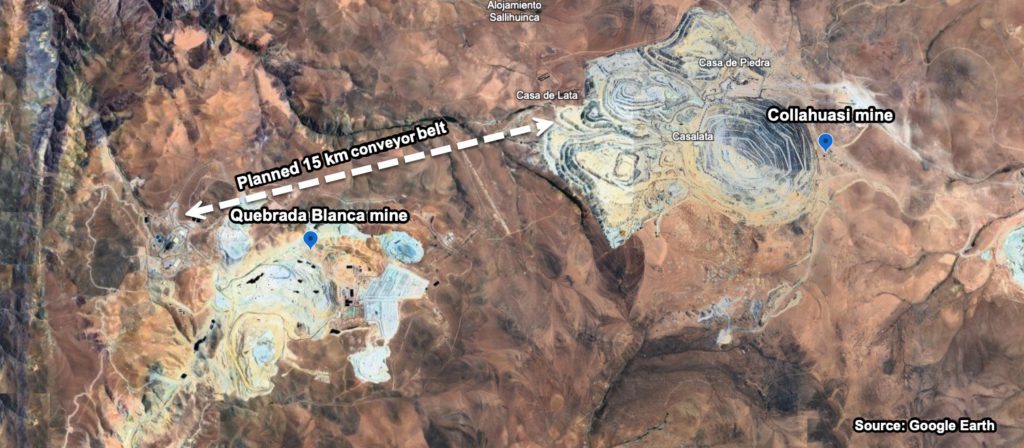
Anglo American is preparing a third impairment of De Beers in as many years, after average realised prices fell 7% to $142/ct in 2025 and an adjusted rough price index drop of 25% signalled persistent diamond market weakness, even as Q4 sales rose to 5.9 million carats and $571m revenue. The potential writedown complicates Anglo’s planned sale of its 85% De Beers stake amid competing interest from a Gareth Penny-led consortium, Botswana and Namibia, alongside stalled divestment of Australian steelmaking coal assets. In parallel, Anglo-Teck has cut 2026 copper guidance to 700,000–760,000 tonnes and plans a 15 km conveyor to integrate Collahuasi ore with Teck’s Quebrada Blanca processing facilities, tightening near-term supply expectations for copper.
Barrick Mining plans to spin off its North American gold assets, including its stake in Nevada Gold Mines, Pueblo Viejo and the 4.6 million indicated tonnes at 17.59 g/t Au Fourmile deposit, into a New York–listed “NewCo” by late 2026 while retaining a significant majority interest. Interim chief Mark Hill, a 20-year Barrick veteran involved in the original Fourmile exploration decision and the Loulo-Gounkoto permit settlement in Mali, has been confirmed as CEO. Barrick has also launched a full review of the $7.7 billion Reko Diq copper-gold project in Pakistan after security incidents, despite reporting record Q4 net income of $2.4 billion and raising its dividend to US$0.42 per share.
Resolute Mining has secured a 14‑year mining permit for the Doropo gold project in north‑eastern Côte d’Ivoire, enabling development of a multi‑pit, shallow‑dipping ore operation feeding a 4.9 Mtpa carbon‑in‑leach plant with crushing, SAG milling and gold extraction circuits. The updated definitive feasibility study outlines average output of 169,000 oz/y over 13 years at an all‑in sustaining cost of $1,406/oz, with first production targeted for 2028 after a roughly two‑year build starting in H1 2026. Total capex is estimated at 300 billion CFA francs (about $539 million), with an additional $204 million budgeted for exploration in Côte d’Ivoire.
Rio Tinto has walked away from merger talks with Glencore that would have created a $232 billion mining giant controlling about 7% of global copper output, after rejecting a structure under which Rio would hold the chair and CEO roles and pro forma control. Glencore argued the terms and proposed share-exchange ratio, reportedly targeting roughly 40% ownership, materially undervalued its copper business and overall contribution. The collapse, the third failed attempt since 2008, triggered share price falls of up to 11% for Glencore and 2.5% for Rio in London trading.
Cornish Metals has received a letter of interest from the US Export-Import Bank for up to $225 million in financing to restart the historic South Crofty tin mine in Cornwall, conditional on supplying “responsible” tin to the US electronics sector. South Crofty hosts 2.9 million indicated tonnes at 1.5% tin and 2.63 million inferred tonnes at 1.42% tin, with a PEA outlining a 14-year life, average 4,700 t/y tin output and £198 million pre-production capex. The project’s after-tax NPV6 is £180 million with a 20% IRR and 3.3-year payback, with EXIM funding potentially covering almost all initial capital.
Silver plunged more than 15% to about $75/oz on Thursday, extending last week’s record crash and leaving prices roughly 35% below the $121.64/oz all‑time high reached last month after a 130% year‑on‑year surge. Metals Daily CEO Ross Norman blames heavy speculation in China for “wreaking havoc” on bullion price discovery, with Sucden Financial’s Daria Efanova and Viktoria Kuszak describing a “flow‑driven” market dominated by CTA and speculative positioning rather than physical fundamentals. Gold also slipped about 3% to $4,800/oz, now 10% below pre‑crash levels.
A rich silver strike at the Laurion mining district in southern Attica in 483 BCE funded Athens’ decision to build roughly 200 warships and fortify the port of Piraeus instead of paying a citizen dividend. Themistocles’ push to channel mining revenue into naval infrastructure underpinned Athens’ victory over the Persian fleet at Salamis in 480 BCE and its emergence as a dominant maritime power. Adrian Pocobelli links this episode to modern resource investment, stressing how concentrated mineral wealth reshapes trade routes, alliances and geopolitical risk.
Equinox Gold plans a Canada-led production surge to 700,000–800,000 oz gold in 2026, driven by the Greenstone mine in Ontario (guidance 250,000–300,000 oz) and the Valentine mine in Newfoundland (150,000–200,000 oz) as both ramp up to design capacity. Output will be supplemented by 200,000–250,000 oz from its Nicaragua complex and 70,000–80,000 oz from the Mesquite mine in California. Following a US$1 billion divestment of three Brazilian mines and a US$1.8 billion merger with Calibre Mining, the company is targeting self-funded growth, including a potential Valentine Phase 2 and progress at Los Filos subject to long-term community agreements.
Global gold demand is shifting structurally as record-high prices coincide with unprecedented central bank buying, with reserves tracked from 1990 to Q3 2025 against the six most-held reserve currencies. World Gold Council data compare year-on-year changes in 2024–2025 across key demand segments, including central banks, investment, jewellery and technology. A price outlook through January 2027 frames planning for miners and refiners exposed to safe-haven flows and reserve-management decisions in an increasingly fractured geopolitical environment.
Utah-based Ionic Mineral Technologies is preparing a 2027 IPO for its Silicon Ridge ion-adsorption clay rare earths project, having hired Citigroup and targeted offtake agreements and scale-up funding before listing. The fully permitted, shovel-ready project near Provo will leverage an existing processing facility and hosts rare earths plus gallium, germanium and tungsten in a clay system similar to those supplying roughly 35–40% of China’s rare earth output. An economic assessment is due in H1 2026, with the US planning a $12 billion critical minerals stockpile and a preferential trade bloc with the EU, Japan and Mexico.
Caddick Construction has started work on the £20.7m Ashfield Mills later living scheme in Idle, Bradford, delivering 75 retirement apartments with communal facilities, car parking and landscaped areas for Anchor, England’s largest not-for-profit housing and care provider for older people. The project, procured via the North East Procurement Organisation (NEPO) construction works framework, is scheduled for completion in 2027. Ashfield Mills follows Caddick’s delivery of the five-storey, 56,403 sq ft One City Park office block for Muse and Bradford City Council, consolidating its workload in the city.
Builders’ merchants’ like-for-like value sales in Britain slipped 0.4% year-on-year in November 2025, with volumes down 8.5% and prices up 3.7%, while unadjusted takings fell 5.1% due to one fewer trading day. Renewables & Water Saving and Workwear & Safetywear grew by 5.1% and 4.0% respectively, but Timber & Joinery Products fell 2.4% and Heavy Building Materials dropped 8.4%, signalling continued weakness in core structural categories. Over the 12 months to November 2025, like-for-like sales edged up 1.1% as volumes rose 1.9% and prices eased 1.2%, indicating a flat but slightly cheaper materials market.
UK construction output stayed broadly flat in Q4 2025, with the RICS UK Construction Monitor showing an overall workloads net balance of -6% and respondents citing financial constraints and planning delays as key barriers, each flagged by around 60% of firms. Infrastructure is the main growth area, with current workloads at +12% and 12‑month expectations at +32%, driven by energy generation, grid distribution and water projects. Housing remains weak, with any uplift in development expected to fall well short of the 1.5 million homes target despite the forthcoming Planning and Infrastructure Bill.
Robertson Partnership Homes has installed a new five-man board – managing director John Baggley, operations director Craig Smith, commercial director Ed Parry, finance director Paul Gray and pre-construction director Andy Park – to steer its Scottish affordable and public sector housing work. The governance change follows defects identified in more than 700 Robertson-built homes across 12 Edinburgh sites, which forced residents out and raised serious safety concerns. The new board is tasked with standardising housing designs for greater consistency, reliability and quality, while supporting local authorities and registered social landlords under acute delivery pressure.