Young-Davidson mine disruptions: seismic and power impacts explained for engineers
Reviewed by Joe Ashwell
First reported on MINING.com
30 Second Briefing
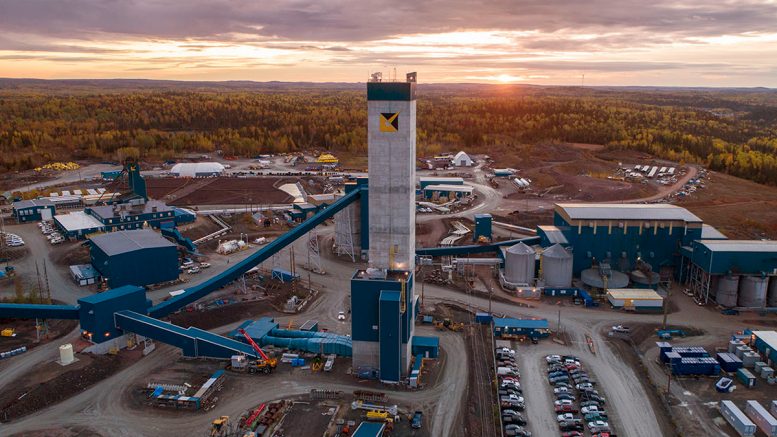
Alamos Gold expects second-quarter output from its Young-Davidson underground mine in northern Ontario to fall to 130,000–135,000 oz, about 12% below prior guidance, after two seismic events damaged infrastructure and cut access to two higher-grade stopes, compounded by a three-day storm-related power outage. Consolidated 2026 production is now projected below full-year guidance with unit costs rising, with revised figures due in July. Production stability is shifting to the Island Gold District, where underground mining rates are planned to increase from 1,500 to 2,000 t/d and the Magino mill ramp-up targets 10,000 t/d by Q3.
Technical Brief
- Seismic event at an active mining front damaged underground infrastructure, cutting physical access to two scheduled high‑grade stopes.
- Young-Davidson is an underground operation 60 km west of Kirkland Lake, with mining history since the 1930s.
- Modern large-scale underground mining at Young-Davidson commenced in 2013 under AuRico, before its merger with Alamos.
- A three-day storm-related regional power line outage in late May further constrained hoisting and development activities.
- Island Gold underground mine is planned to lift production rate from 1,500 t/d to 2,000 t/d by year-end, partially offsetting Young-Davidson constraints.
Our Take
In our database, Alamos Gold’s push to reach 1 Moz/y by 2030 is heavily anchored in the Island Gold District and Lynn Lake, so a 12% guidance hit at Young-Davidson increases reliance on those growth projects performing to schedule and budget.
The recent underground ore and waste handling contract award at Island Gold in northern Ontario suggests Alamos is already de‑risking its other Canadian operations, which may help offset investor concern after the Young-Davidson seismic events and power outage.
Among safety- and failure-tagged gold items in our coverage, unplanned outages at Canadian underground mines are more often linked to regional power and ground conditions than to plant issues, implying operators like Alamos may prioritise grid resilience and seismic monitoring upgrades over major process plant changes.
Prepared by collating external sources, AI-assisted tools, and Geomechanics.io’s proprietary mining database, then reviewed for technical accuracy & edited by our geotechnical team.
Related Articles
Related Industries & Products
Mining
Geotechnical software solutions for mining operations including CMRR analysis, hydrogeological testing, and data management.
Construction
Quality control software for construction companies with material testing, batch tracking, and compliance management.
CMRR-io
Streamline coal mine roof stability assessments with our cloud-based CMRR software featuring automated calculations, multi-scenario analysis, and collaborative workflows.
HYDROGEO-io
Comprehensive hydrogeological testing platform for managing, analysing, and reporting on packer tests, lugeon values, and hydraulic conductivity assessments.
GEODB-io
Centralised geotechnical data management solution for storing, accessing, and analysing all your site investigation and material testing data.