Turning sawdust into fire‑resistant boards: design notes for materials engineers
Reviewed by Tom Sullivan
First reported on The Construction Index
30 Second Briefing
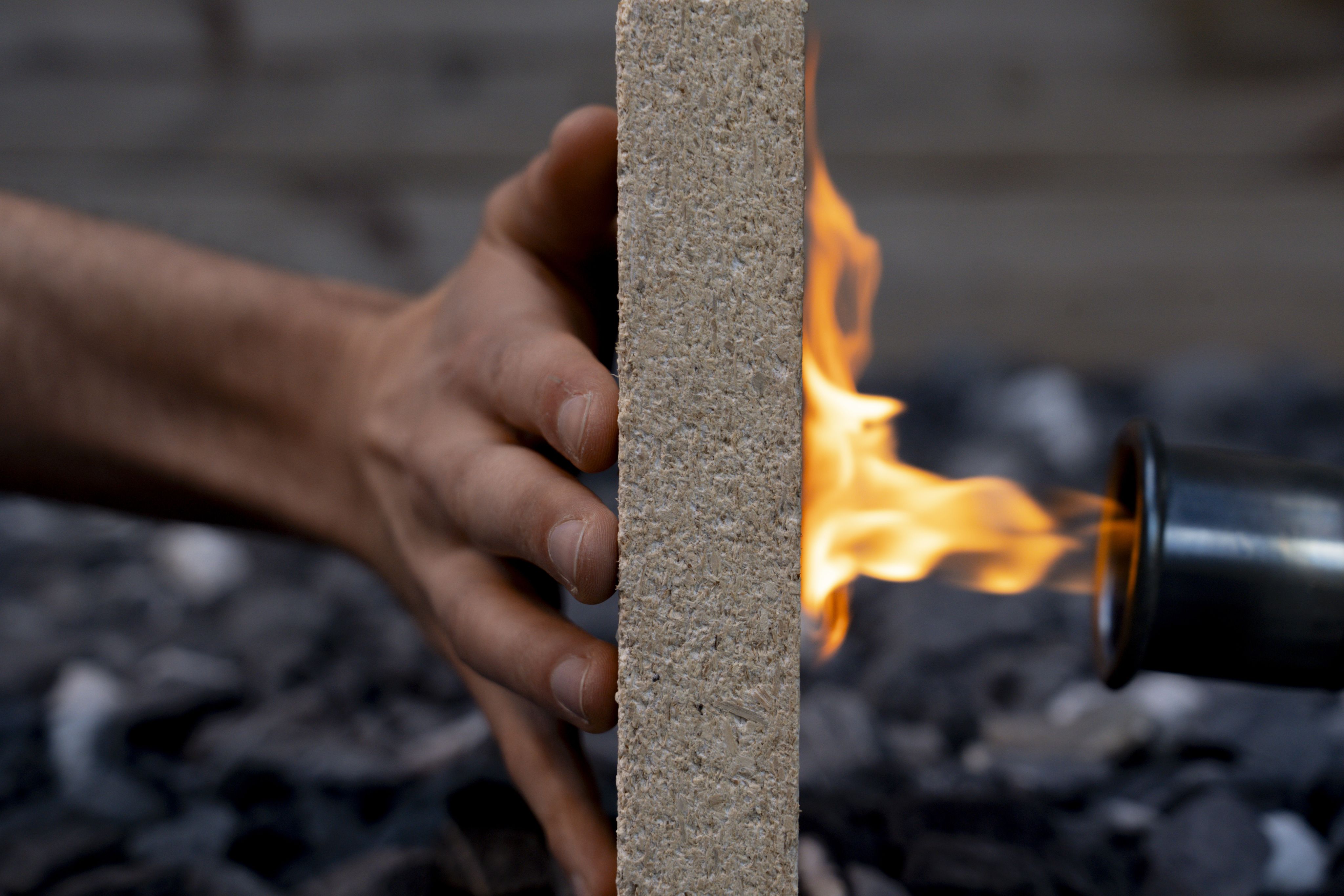
Researchers at ETH Zurich and Empa have developed a recyclable sawdust–struvite composite board that is stronger in compression perpendicular to grain than spruce and shows cone calorimeter ignition times of 45 seconds, around three times longer than untreated timber. The material uses an enzyme from watermelon seeds to control crystallisation of struvite from newberyite, forming large crystals that infill voids between sawdust particles and act as an inorganic flame retardant, potentially matching cement‑bonded particleboard fire classes with only 40% binder by weight. Panels can be mechanically ground, heated to just over 100°C to release ammonia, and fully separated for reuse or as a phosphorus fertiliser, with future cost reductions possible by sourcing struvite from sewage treatment plant deposits.
Technical Brief
- Panels are cold-pressed in moulds for two days, then dried at room temperature before testing.
- Struvite is generated in situ by enzymatically controlling crystallisation from aqueous newberyite precursor suspensions.
- Watermelon-seed enzyme regulates crystal growth so large struvite crystals bridge and lock sawdust voids.
- Internal applications are targeted, where non-combustible inorganic phases can form a protective surface crust in fire.
- End-of-life recycling uses mechanical grinding plus heating slightly above 100 °C to release ammonia and separate sawdust.
- Dissolved reclaimed solids are re-precipitated as newberyite, enabling repeated composite production and potential fertiliser use.
Our Take
Using magnesium–phosphate chemistry positions this ETH Zurich / Empa work alongside a small cluster of 16 magnesium- and phosphate-tagged items in our database that are exploring low-clinker or alternative binders, signalling that these salts are moving from niche lab curiosities towards practical cement substitutes.
The ability to thermally break down the struvite binder just above 100 °C and reclaim components is unusual among the 44 Materials stories we track, and if it scales it could materially change end-of-life strategies for wood-based boards by enabling genuine closed-loop recycling rather than downcycling or landfill.
Cutting binder content to around 40% versus the 60–70% typical of cement-bonded boards suggests a potential reduction in embodied CO₂ if magnesium and phosphate sources are responsibly produced, which could make this type of panel attractive for UK and EU green building specifications that are tightening limits on cement-intensive products.
Prepared by collating external sources, AI-assisted tools, and Geomechanics.io’s proprietary mining database, then reviewed for technical accuracy & edited by our geotechnical team.
Related Articles


Related Industries & Products
Mining
Geotechnical software solutions for mining operations including CMRR analysis, hydrogeological testing, and data management.
Construction
Quality control software for construction companies with material testing, batch tracking, and compliance management.
CMRR-io
Streamline coal mine roof stability assessments with our cloud-based CMRR software featuring automated calculations, multi-scenario analysis, and collaborative workflows.
HYDROGEO-io
Comprehensive hydrogeological testing platform for managing, analysing, and reporting on packer tests, lugeon values, and hydraulic conductivity assessments.
GEODB-io
Centralised geotechnical data management solution for storing, accessing, and analysing all your site investigation and material testing data.