Geomechanics.io

  • Free Tools
Sign UpLog In

Geomechanics.io

Geomechanics, Streamlined.

© 2026 Geomechanics.io. All rights reserved.

Geomechanics.io

CMRR-ioGEODB-ioHYDROGEO-ioQCDB-ioFree Tools & CalculatorsBlogLatest Industry News

Industries

MiningConstructionTunnelling

Company

Terms of UsePrivacy PolicyLinkedIn
    AllGeotechnicalMiningInfrastructureMaterialsHazardsEnvironmentalSoftwarePolicy
    Projects
    Contract Award

    Torngat’s Strange Lake delay: feasibility, capex and access risks for mine planners

    February 3, 2026|

    Reviewed by Tom Sullivan

    Torngat’s Strange Lake delay: feasibility, capex and access risks for mine planners

    First reported on MINING.com

    30 Second Briefing

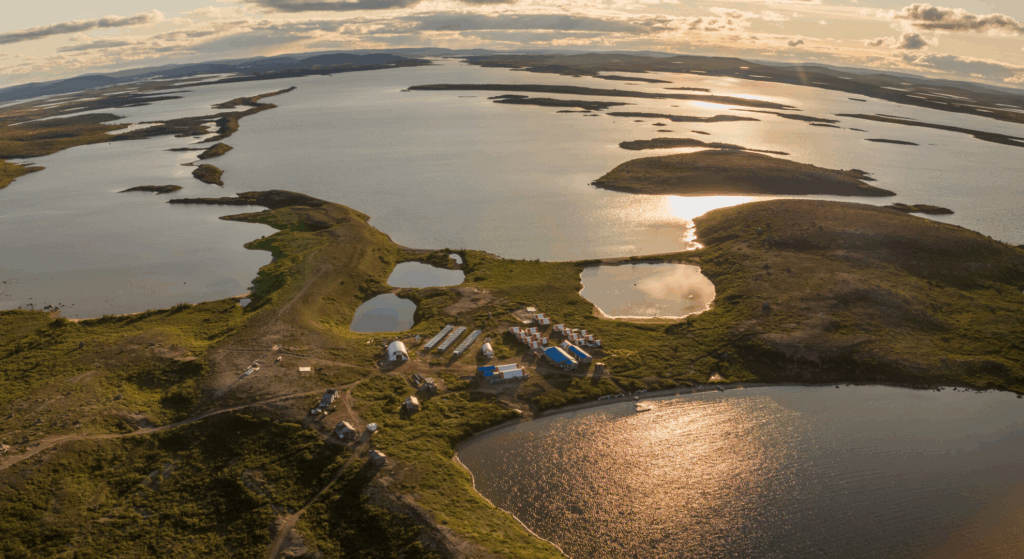
    Torngat Metals has delayed first production at its C$2‑billion Strange Lake heavy rare earths project in Nunavik to 2029–30, targeting permits in early 2027 and a bankable feasibility study in the first half of 2026. The project combines a mine and concentrator, a 180‑km access road to Voisey’s Bay, and an $800‑million separation plant at Sept‑Îles designed for 15,000 t/y of rare earth oxides, including 540 t/y dysprosium and 80 t/y terbium. Financing includes $165 million in federal loans, with Canada Infrastructure Bank considering up to $500 million for access infrastructure.

    Technical Brief

    • Separation plant capex is estimated at C$800 million within the overall C$2‑billion project budget.
    • Project layout integrates three assets: Nunavik mine/concentrator, 180‑km all‑season road, Sept‑Îles separation facility.

    Our Take

    Within our 59 keyword-matched rare earths pieces, very few Canadian projects outside Quebec show comparable heavy rare earth exposure to dysprosium and terbium, so Strange Lake’s scale positions it as one of the main North American alternatives to Chinese supply in our database.

    The C$2‑billion capex plus an C$800‑million separation plant puts Torngat Metals at the upper end of project size among recent Canadian critical minerals items, which typically rely on layered public financing similar to the Export Development Canada and Canada Infrastructure Bank loans noted here.

    Engagement with six First Nations over a >30‑year mine life in Nunavik and Labrador suggests that long-term benefit-sharing and infrastructure access (including the 180 km road link) will likely be as decisive for project risk as metallurgy or capital cost in this part of northern Quebec.

    Geotechnical Software for Modern Teams

    Centralise site data, logs, and lab results with GEODB-io, CMRR-io, and HYDROGEO-io.

    No credit card required.

    • Save and export unlimited calculations
    • Advanced data visualisation
    • Generate professional PDF reports
    • Cloud storage for all your projects

    Prepared by collating external sources, AI-assisted tools, and Geomechanics.io’s proprietary mining database, then reviewed for technical accuracy & edited by our geotechnical team.

    Related Articles

    Mining
    42 minutes ago

    Osisko–JDS Cariboo gold build: execution and EPCM takeaways for mine engineers

    Osisko Development’s Barkerville Gold Mines has signed a definitive project and construction management services agreement with JDS Energy & Mining to build the Cariboo underground gold project in British Columbia. A feasibility study completed in April 2025 outlines a “robust and scalable” underground mine, with JDS to coordinate detailed engineering, procurement and construction management across the processing plant, underground infrastructure and surface facilities. The deal signals progression from study to execution, with geotechnical design, underground access development and shaft/decline construction planning now moving onto a defined EPCM footing.

    TOMRA Mining waste sorting: design and value notes for mine project teams
    Mining
    42 minutes ago

    TOMRA Mining waste sorting: design and value notes for mine project teams

    TOMRA Mining is deploying advanced sensor-based ore sorting to convert mine waste rock and tailings into saleable aggregate for infrastructure, extending mine life and reducing primary crushing and haulage demands. By separating barren from mineralised material on conveyors using XRT and other sensors, operations can upgrade run-of-mine feed, cut energy and water use in downstream comminution, and divert clean fractions for construction uses. The approach opens a secondary revenue stream while lowering waste dump volumes and long-term rehabilitation liabilities.

    Mining
    about 4 hours ago

    Sandvik drill bit resharpening expansion: safety and productivity notes for mines

    Sandvik is adding the mid-range RG550Be drill bit resharpening machine to its portfolio, extending coverage across both top hammer (TH) and down-the-hole (DTH) drilling with a tiered line-up of high-end, mid-range and handheld units. The OEM is targeting improved safety and ergonomics in bit maintenance, moving more grinding work off manual benches and into enclosed, purpose-built machines. For mine operators, the broader range allows closer matching of resharpening capacity to fleet size and bit type, with potential gains in bit life and drilling penetration rates.

    Related Industries & Products

    Mining

    Geotechnical software solutions for mining operations including CMRR analysis, hydrogeological testing, and data management.

    Construction

    Quality control software for construction companies with material testing, batch tracking, and compliance management.

    CMRR-io

    Streamline coal mine roof stability assessments with our cloud-based CMRR software featuring automated calculations, multi-scenario analysis, and collaborative workflows.

    HYDROGEO-io

    Comprehensive hydrogeological testing platform for managing, analysing, and reporting on packer tests, lugeon values, and hydraulic conductivity assessments.

    GEODB-io

    Centralised geotechnical data management solution for storing, accessing, and analysing all your site investigation and material testing data.