Tees Transporter Bridge at risk: asset management and repair lessons for engineers
Reviewed by Joe Ashwell
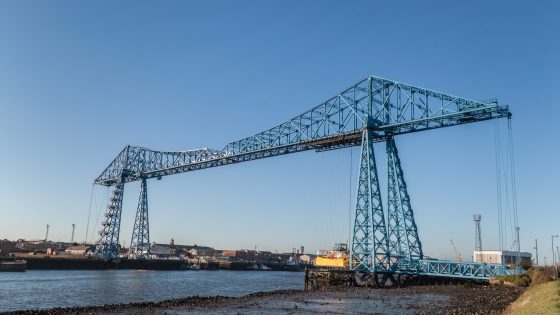
First reported on New Civil Engineer
30 Second Briefing
The 1911 Tees Transporter Bridge in Middlesbrough has been named on the Victorian Society’s 2026 Top 10 Endangered Buildings list, signalling serious deterioration in one of the UK’s last working transporter bridges. The 259m-long steel structure, which carries vehicles and pedestrians across the Tees via a suspended gondola, now faces major repair and corrosion-management challenges typical of century-old riveted trusses and mechanical lifting gear. For asset managers, the listing intensifies pressure to secure funding, define viable strengthening strategies and manage operational risk.
Technical Brief
- Failure risk is dominated by progressive section loss in riveted steelwork and fatigue in moving components, best characterised via detailed NDT (UT, MPI) and coupon testing of corroded members.
- Investigation should combine full 3D structural analysis of the truss and towers with updated dead/live load models for modern vehicle weights and wind actions.
- Continuous monitoring options include strain gauges on critical chords, vibration-based condition monitoring of the moving span, and corrosion-rate probes at splash and connection zones.
- Remediation planning must address access constraints over tidal water, likely requiring suspended scaffolds, encapsulation, and phased lane/footway closures to maintain limited operation.
- Safety management should align with current UK bridge inspection regimes (principal and general inspections) and LOLER/PUWER requirements for the lifting and hoisting systems.
- Emergency preparedness needs explicit exclusion zones beneath the moving gondola and towers, plus defined trigger levels for immediate closure based on inspection or monitoring alarms.
- Lessons for similar heritage transporter and lifting bridges include early whole-life corrosion strategies, realistic de-rating of load capacity, and ring-fenced funding for cyclical major refurbishments.
Our Take
The Victorian Society’s role in both the Tees Transporter Bridge listing and its opposition to Network Rail’s £1.2bn Liverpool Street Station redevelopment signals that UK heritage advocates are increasingly intervening on major transport assets, which can complicate upgrade or replacement strategies for ageing infrastructure.
With the Tees Transporter Bridge now flagged among the UK’s most at-risk structures, asset owners in the United Kingdom face a familiar tension seen across our 810 Infrastructure stories: safety-driven interventions on century-old structures often collide with heritage constraints, extending design and approvals timelines for remedial works.
Given New Civil Engineer’s involvement across awards and innovation challenges in our database, the bridge’s at-risk status is likely to surface as a reference case in future UK best-practice discussions on balancing structural rehabilitation, operational safety, and conservation for historic transport assets.
Prepared by collating external sources, AI-assisted tools, and Geomechanics.io’s proprietary mining database, then reviewed for technical accuracy & edited by our geotechnical team.
Related Articles


Related Industries & Products
Construction
Quality control software for construction companies with material testing, batch tracking, and compliance management.
CMRR-io
Streamline coal mine roof stability assessments with our cloud-based CMRR software featuring automated calculations, multi-scenario analysis, and collaborative workflows.
HYDROGEO-io
Comprehensive hydrogeological testing platform for managing, analysing, and reporting on packer tests, lugeon values, and hydraulic conductivity assessments.
GEODB-io
Centralised geotechnical data management solution for storing, accessing, and analysing all your site investigation and material testing data.