Geomechanics.io

  • Free Tools
Sign UpLog In

    Geomechanics.io

    Geomechanics, Streamlined.

    © 2026 Geomechanics.io. All rights reserved.

    Geomechanics.io

    CMRR-ioGEODB-ioHYDROGEO-ioQCDB-ioFree Tools & CalculatorsBlogLatest Industry News

    Industries

    MiningConstructionTunnelling

    Company

    Terms of UsePrivacy PolicyLinkedIn
    Projects
    Product
    Sustainability

    Sodium-ion batteries and lithium: system design and supply risks for engineers

    June 7, 2026|

    Reviewed by Tom Sullivan

    Sodium-ion batteries and lithium: system design and supply risks for engineers

    First reported on MINING.com

    30 Second Briefing

    Sodium-ion batteries are emerging as a mass-market option for grid-scale storage and lower-cost urban EVs, with CATL already selling sodium-ion passenger vehicles and utility systems exceeding 1 GWh, but they do not displace lithium in high-energy-density applications. Because sodium is geologically ubiquitous—essentially salt at 2.3% of the crust—the bottleneck moves from scarce deposits like Greenbushes and the Lithium Triangle to midstream processing and gigafactory-scale manufacturing. China now controls over 90% of installed and announced sodium-ion manufacturing capacity, deepening Western dependence despite abundant raw sodium.

    Technical Brief

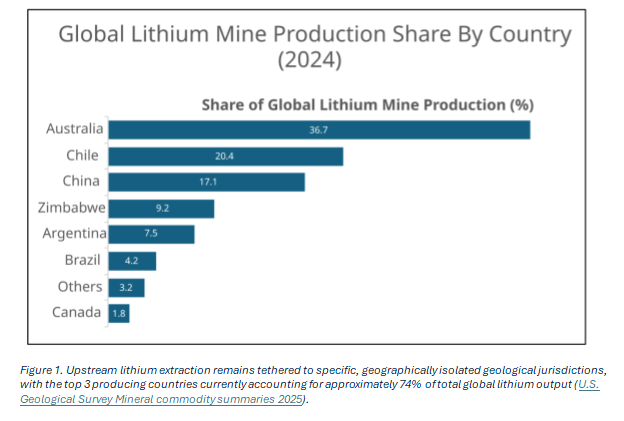
    • Hard-rock LCT pegmatites give Australia 36.7% of mine supply via Greenbushes, Pilgangoora and similar deposits.
    • Chile and Argentina’s salar brines in the “Lithium Triangle” contribute 20.4% and 7.5% of global lithium output respectively.
    • China produces only 17.1% of mined lithium yet dominates midstream refining and chemical conversion capacity.
    • Beijing’s control of conversion plants makes it the de facto gateway between remote mines and global cell factories.
    • Lithium deposits require rare fractional crystallisation of granitic melts or long-term brine enrichment in closed basins.
    • Sodium, at ~2.3% of the crust, avoids such specialised tectonic or magmatic settings, simplifying upstream sourcing.

    Our Take

    CATL’s control of over 90% of installed and announced sodium‑ion manufacturing capacity, alongside its recent 30 billion yuan commitment to upstream lithium, nickel and phosphorus projects, signals that sodium is being developed as a complementary chemistry rather than a replacement for lithium in its portfolio.

    The concentration of both lithium production (Chile, Argentina, China) and emerging sodium‑ion capacity in a small set of countries suggests that downstream OEMs such as BYD may use sodium cells tactically to reduce exposure to brine‑sourced lithium from the Lithium Triangle while still relying on Australian spodumene for higher‑performance applications.

    Geotechnical Software for Modern Teams

    Centralise site data, logs, and lab results with GEODB-io, CMRR-io, and HYDROGEO-io.

    No credit card required.

    • Save and export unlimited calculations
    • Advanced data visualisation
    • Generate professional PDF reports
    • Cloud storage for all your projects

    Prepared by collating external sources, AI-assisted tools, and Geomechanics.io’s proprietary mining database, then reviewed for technical accuracy & edited by our geotechnical team.

    Related Articles

    Materials
    4 days ago

    Kryton Hard-Cem at EXPONOR: durability and lifecycle gains for mine concrete

    Kryton International will debut at EXPONOR in Chile this month, showcasing its Hard-Cem® integral hardening technology already deployed in British Columbia mining infrastructure. Hard-Cem is added directly to concrete to improve abrasion and erosion resistance in high-wear elements such as haul road slabs, ore passes and crusher foundations, aiming to extend service life without increasing cement content. For mine operators, the pitch centres on reduced shutdowns for resurfacing, lower lifecycle concrete volumes and more predictable performance in aggressive, high-impact environments.

    Aluminium’s US comeback hinges on power: grid and smelter economics for engineers
    Materials
    9 days ago

    Aluminium’s US comeback hinges on power: grid and smelter economics for engineers

    US efforts to revive primary aluminium hinge on securing long-term, industrial-scale power contracts of 500+ MW per smelter, with advocates warning that data centres and hyperscalers are outbidding producers for grid capacity. Imports of Canadian primary aluminium fell from 2,745 kt in 2024 to 1,950 kt in 2025 after Section 232 tariffs rose to 50%, even as Century Aluminum and Emirates Global Aluminium plan the first new US smelter since 1980 in Oklahoma, still stalled pending a power deal. Rio Tinto’s $1.5 billion AP60 low-carbon smelter expansion in Quebec and EU CBAM-driven demand are meanwhile pulling more Canadian hydropower-based metal towards Europe, risking longer-term diversion of supply away from the US.

    Edinburgh GCDE e‑waste process: hydrometallurgy takeaways for materials engineers
    Materials
    9 days ago

    Edinburgh GCDE e‑waste process: hydrometallurgy takeaways for materials engineers

    Edinburgh’s Gold Copper Diamide Extraction (GCDE) process has been exclusively licensed to Lithium Universe, enabling low‑temperature hydrometallurgical recovery of gold and copper from e‑waste using small, reusable organic ligands instead of >1,200°C smelting or cyanide and mercury leaching. The diamide “molecular magnet” first targets gold, followed by a selective copper step, delivering high‑purity metals from printed circuit boards where gold and copper content can exceed US$48,000 per tonne at current prices. Lithium Universe will integrate GCDE into its Precious Metals Recycling Division and sub‑licence the technology globally.

    Related Industries & Products

    Mining

    Geotechnical software solutions for mining operations including CMRR analysis, hydrogeological testing, and data management.

    Construction

    Quality control software for construction companies with material testing, batch tracking, and compliance management.

    QCDB-io

    Comprehensive quality control database for manufacturing, tunnelling, and civil construction with UCS testing, PSD analysis, and grout mix design management.

    AllGeotechnicalInfrastructureHazardsEnvironmental