SCS fined over tipper fall: excavation ramp design lessons for engineers
Reviewed by Tom Sullivan
First reported on The Construction Index
30 Second Briefing
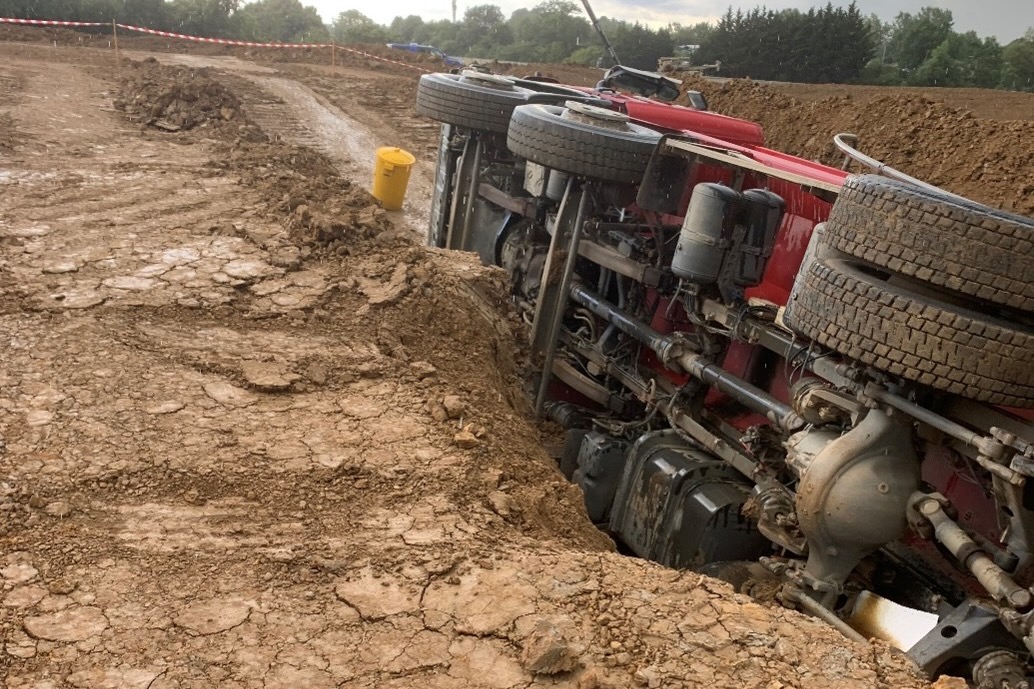
HS2 joint venture SCS, formed by Skanska Construction UK, Costain and Strabag, has been fined £400,000 after a tipper truck drove off the edge of an excavation ramp at the Copthall North site, injuring its driver. The incident involved a fully loaded tipper leaving the unprotected ramp edge during bulk earthworks, pointing to deficiencies in temporary works design and haul road edge protection. Contractors on major infrastructure schemes will likely face closer scrutiny of excavation ramp geometry, barrier systems and traffic management for heavy earthmoving plant.
Technical Brief
- Failure mechanism involved a fully laden tipper breaching the unprotected ramp edge and overturning.
- HSE investigation focused on adequacy of temporary works design, haul road layout and edge protection measures.
- Inspectors examined traffic management plans, plant risk assessments and supervision arrangements for bulk earthworks operations.
- Monitoring deficiencies included lack of effective visual demarcation, physical barriers and warning systems along ramp margins.
- Remediation on similar sites typically includes engineered bunds, crash barriers or stop blocks sized for plant mass.
- Case reinforces that principal contractors on large infrastructure schemes remain legally accountable for haul route design safety.
Our Take
Within our 875 Infrastructure stories, UK safety‑tagged items often cluster around major contractors like Skanska and Costain, so an enforcement action at Copthall North will likely be scrutinised as a benchmark for how principal contractors manage plant and temporary works risk on large projects.
The recent upgrades to CSCS Smart Check and CIC health & safety certification in the UK suggest regulators and clients now have better tools to track individual competence and dutyholder accountability, which could influence how SCS and its partners evidence training and supervision after a tipper‑related failure.
Given that several UK pieces in our database focus on shortening time to competence for site workers, this incident may reinforce arguments that accelerated training pathways must be paired with more robust on‑site supervision and plant interface controls, especially for high‑risk operations involving tippers and haul roads.
Prepared by collating external sources, AI-assisted tools, and Geomechanics.io’s proprietary mining database, then reviewed for technical accuracy & edited by our geotechnical team.
Related Articles


Related Industries & Products
Construction
Quality control software for construction companies with material testing, batch tracking, and compliance management.
Mining
Geotechnical software solutions for mining operations including CMRR analysis, hydrogeological testing, and data management.
QCDB-io
Comprehensive quality control database for manufacturing, tunnelling, and civil construction with UCS testing, PSD analysis, and grout mix design management.