Geomechanics.io

  • Free Tools
Sign UpLog In

Geomechanics.io

Geomechanics, Streamlined.

© 2026 Geomechanics.io. All rights reserved.

Geomechanics.io

CMRR-ioGEODB-ioHYDROGEO-ioQCDB-ioFree Tools & CalculatorsBlogLatest Industry News

Industries

MiningConstructionTunnelling

Company

Terms of UsePrivacy PolicyLinkedIn
    Standard/Guideline
    Product
    Safety

    RICS modernises CPD framework: AI, climate risk and competence notes for surveyors

    February 10, 2026|

    Reviewed by Tom Sullivan

    RICS modernises CPD framework: AI, climate risk and competence notes for surveyors

    First reported on The Construction Index

    30 Second Briefing

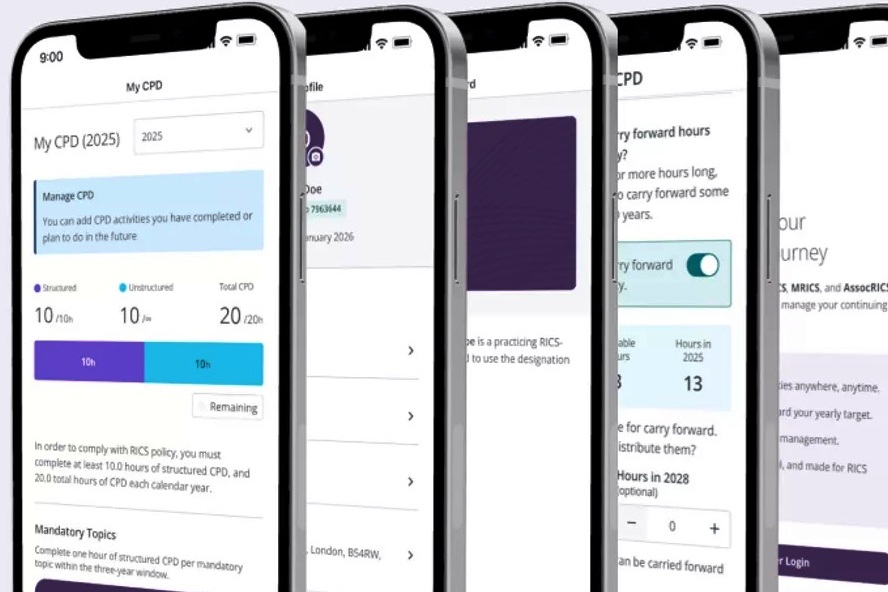
    RICS has overhauled its continuing professional development framework for 130,000 members, shifting to a flexible, outcomes-based system that explicitly covers artificial intelligence, net zero building assessments and climate risk analysis. The framework responds to feedback that many chartered surveyors qualified before exposure to AI-powered valuation tools or structured climate-related due diligence, raising concerns over competence in current regulatory and ESG contexts. A new RICS member app, now rolling out globally, logs CPD hours, issues reminders and links learning activity to demonstrable professional accountability and public-interest protection.

    Technical Brief

    • Framework is already in force, with the RICS member app rolling out globally now.
    • New CPD structure is explicitly framed as “flexible” and “outcomes-based” rather than hours-only compliance.
    • Consultation identified competence gaps around AI valuation tools, net zero assessments and climate risk analysis.
    • RICS links CPD evidence directly to demonstrable professional judgement and public-interest protection obligations.
    • App functionality includes CPD-hour logging plus automated reminders to maintain regulatory compliance status.
    • Christine O’Rourke stresses CPD as a mechanism to keep advice aligned with evolving regulations and technologies.
    • Safety relevance lies in formalising accountability: members must show how learning improves service delivery quality.

    Our Take

    RICS has featured in recent coverage of flat UK construction output, so tightening its CPD framework is likely aimed at shoring up professional standards and client confidence in a market where workloads are under pressure.

    Among the 133 Policy stories in our database, relatively few deal directly with professional upskilling, which suggests RICS’ CPD overhaul could become a reference point for other UK built-environment bodies revisiting competence and safety obligations.

    Because RICS sets benchmarks used by many UK geotechnical and infrastructure practitioners, any CPD changes that emphasise safety or digital practice will indirectly influence how risk management and new tools are adopted on civil and mining-adjacent projects in the UK.

    Geotechnical Software for Modern Teams

    Centralise site data, logs, and lab results with GEODB-io, CMRR-io, and HYDROGEO-io.

    No credit card required.

    • Save and export unlimited calculations
    • Advanced data visualisation
    • Generate professional PDF reports
    • Cloud storage for all your projects

    Prepared by collating external sources, AI-assisted tools, and Geomechanics.io’s proprietary mining database, then reviewed for technical accuracy & edited by our geotechnical team.

    Related Articles

    US scrap rules: processing bottlenecks and security ratio for engineers
    Policy
    about 7 hours ago

    US scrap rules: processing bottlenecks and security ratio for engineers

    US export restrictions taking effect later in August will force some lithium-ion battery scrap, including black mass, and tungsten scrap to be sold to US buyers, but GEM Mining Consulting’s Alina Karpunina argues supply security hinges on how much of this material is actually converted into qualified secondary minerals. DOE data show a 2023 US mismatch, with intermediate facilities able to process nearly 175,000 tons of batteries and scrap, but only about 35,500 tons of battery-material recovery capacity and 76,000 tons more merely planned. Karpunina proposes a “scrap-to-security conversion ratio” based on contained critical-mineral units recovered to customer specification, warning that export controls without robust domestic processing risk idle feedstock and continued reliance on primary mining.

    NAIA ‘Ground Truth’ survey: supply chain readiness lens for US project teams
    Policy
    2 days ago

    NAIA ‘Ground Truth’ survey: supply chain readiness lens for US project teams

    New American Industrial Alliance and supply chain AI firm Exiger have launched the “Ground Truth” Critical Minerals Readiness Survey to map gaps between US industrial demand and available domestic or allied supply, following White House Executive Order 14415 on defence supply chains. The survey drills down to unmet needs by spec, grade, alloy and purity, and contrasts reshoring goals with actual sourcing capabilities across NAIA’s member base and wider manufacturers. Results, processed via Exiger’s 1EXIGER.AI platform, will feed a policy and investment “blueprint” to be unveiled on 16 September 2026 in Washington, DC.

    Cambridge water reuse scheme delay: regulatory lessons for project engineers
    Policy
    2 days ago

    Cambridge water reuse scheme delay: regulatory lessons for project engineers

    Legislative constraints are preventing a Cambridge housing development from commissioning a greywater reuse system installed five years ago, Cambridge Water has confirmed. The scheme, designed to recycle treated wastewater from homes for non-potable uses such as toilet flushing and irrigation, remains idle despite full physical installation. The impasse signals ongoing regulatory misalignment between building-level reuse technologies and current UK water quality and adoption rules, delaying potential reductions in potable demand and wastewater discharge for new high-density schemes.

    Related Industries & Products

    Construction

    Quality control software for construction companies with material testing, batch tracking, and compliance management.

    Mining

    Geotechnical software solutions for mining operations including CMRR analysis, hydrogeological testing, and data management.

    CMRR-io

    Streamline coal mine roof stability assessments with our cloud-based CMRR software featuring automated calculations, multi-scenario analysis, and collaborative workflows.

    HYDROGEO-io

    Comprehensive hydrogeological testing platform for managing, analysing, and reporting on packer tests, lugeon values, and hydraulic conductivity assessments.

    GEODB-io

    Centralised geotechnical data management solution for storing, accessing, and analysing all your site investigation and material testing data.

    AllGeotechnicalInfrastructureHazardsEnvironmental