Recycled clothing mix for Kent park potholes: performance notes for pavement engineers
Reviewed by Tom Sullivan
First reported on New Civil Engineer
30 Second Briefing
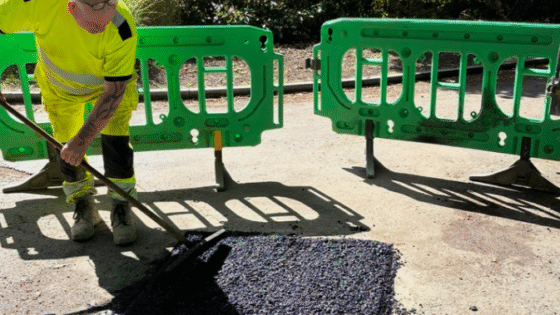
Maidstone Borough Council has started a small-scale trial in two parks using a proprietary pothole repair mix that incorporates recycled clothing fibres as a partial replacement for conventional bituminous or aggregate content. The material is being laid in localised defects rather than full-width resurfacing, targeting reduced embodied carbon and lower-temperature installation compared with standard hot asphalt. If performance on ravel resistance, adhesion and durability under light vehicular loading proves acceptable, the council may extend the approach to wider footpath and car park maintenance.
Technical Brief
- Application is restricted to discrete pothole defects, avoiding interface issues with full-depth reconstruction layers.
- Recycled clothing acts as fibrous reinforcement within the mix, potentially improving crack-bridging and ravel resistance.
- Fibre content partially displaces virgin aggregate/bitumen, reducing demand on quarried materials and petrochemical binders.
- Lower installation temperature reduces thermal damage risk to adjacent legacy surfacing and buried services.
- Park environments allow controlled observation of performance under light service vehicles, maintenance plant and pedestrian traffic.
- Data from this trial could inform future specifications for minor works in local authority asset management plans.
Our Take
Maidstone Borough Council’s trial in Kent sits within the 47 Materials stories in our database, but very few of those combine ‘Product’, ‘Sustainability’ and ‘Projects’ tags around local-authority road maintenance, signalling this as a relatively early municipal test bed for circular surfacing materials in the UK.
New Civil Engineer’s role here aligns with its wider activity in nurturing practical innovation, as seen in Heathrow Airport’s early careers competition covered in May 2026, suggesting the outlet is increasingly acting as a conduit between experimental materials solutions and large asset owners.
With no specific commodity focus, this Kent initiative highlights a strand in our Materials coverage where waste streams (such as textiles) are being treated as infrastructure inputs, which could influence procurement frameworks for UK councils looking to meet sustainability targets without major capex-heavy resurfacing programmes.
Prepared by collating external sources, AI-assisted tools, and Geomechanics.io’s proprietary mining database, then reviewed for technical accuracy & edited by our geotechnical team.