First reported on MINING.com
30 Second Briefing
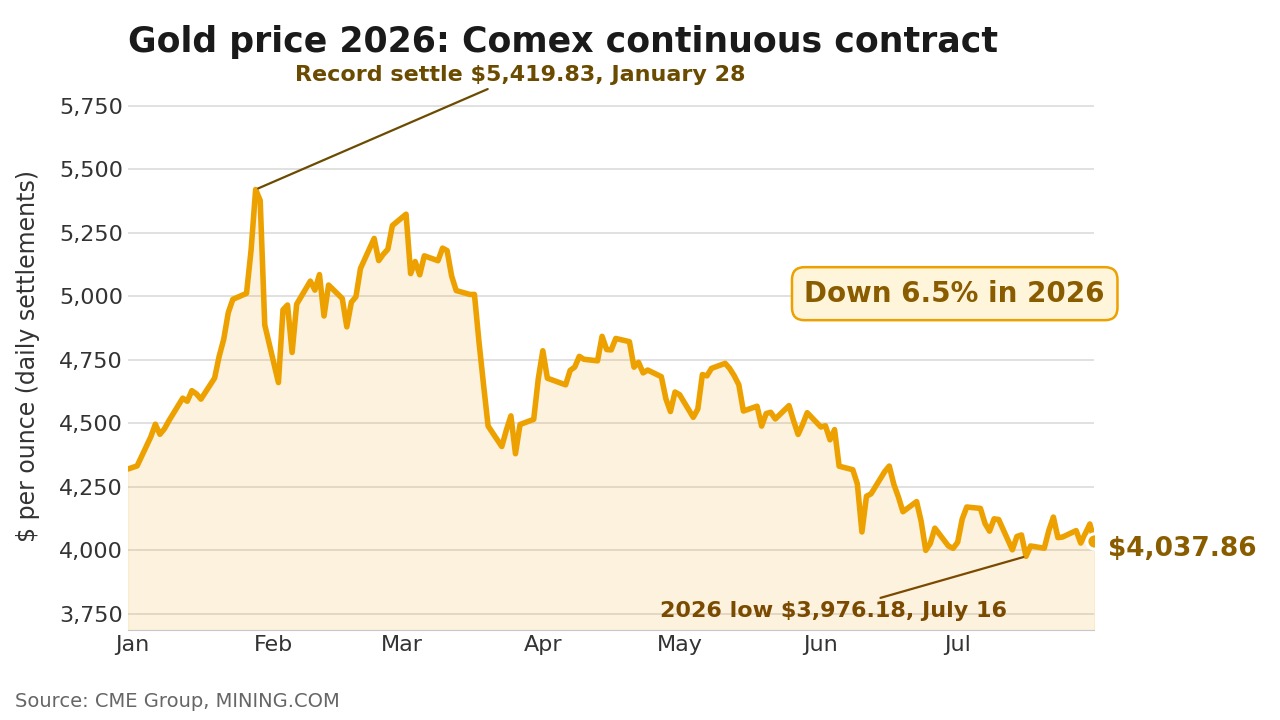
Gold gave back Thursday’s post-Fed bounce, with the Comex continuous contract down 1.6% to $4,037.86/oz and December futures at $4,099.50/oz as traders priced a 63% chance of a September US rate hike. World Gold Council data show record mine output of 966 tonnes in Q2 and 1,867 tonnes in H1, but industry all-in sustaining costs hit a record $1,785/oz in Q1, driven by higher royalties and overheads, with further energy cost pressure emerging. Production growth was concentrated in Canada, Chile, Burkina Faso and Ghana, while Mexico, Nicaragua, the US and China declined, and central banks bought a net 289 tonnes in Q2, a record for a second quarter.
Technical Brief
- Industry all-in sustaining costs reached $1,785/oz in Q1, up 5% QoQ and 16% YoY.
- Q1 average realised gold price of $4,872.90/oz implies margins near $3,100/oz despite cost inflation.
- WGC links higher AISC mainly to increased royalties and corporate overheads, directly tied to elevated gold prices.
- Early energy-cost escalation from Middle East conflict is already visible at some operations, with stronger impacts expected.
- Canada’s 29% production growth is driven by ramp-up at Agnico Eagle’s Detour Lake and other expansions.
- Chilean output rose 24% as Gold Fields’ Salares Norte reached steady state and Rio2’s Fenix came online.
- Burkina Faso production increased 17% via higher throughput at Kiaka and first full hard-rock quarter at Bomboré.
- Metals Focus revised historical mine output up by 117 tonnes since 2013, mainly from better artisanal mining data.
- Recycling supply fell 6% to 326 tonnes as quarter-on-quarter price declines discouraged scrap flows back to market.
- Industry hedge book shrank for a tenth consecutive quarter, with an estimated 23 tonnes de-hedged in Q2.
Our Take
With Canada, Chile, Burkina Faso and Ghana all showing double‑digit or high‑single‑digit mine output gains while all‑in sustaining costs are up 16% year‑on‑year, operators such as Newmont, Barrick and Gold Fields are likely relying heavily on higher‑grade phases or new assets like Detour Lake, Kiaka and Salares Norte to keep margins viable at current gold prices.
The sharp divergence between record official‑sector net purchases (notably from the People’s Bank of China and National Bank of Poland) and ETF outflows from North American funds mirrors themes in our other recent gold coverage, where physical demand in Asia and Europe is increasingly decoupled from futures‑ and ETF‑driven price swings on New York exchanges.
Mexico and Nicaragua’s steep production declines, alongside US and China losses, suggest that cost inflation and permitting or security headwinds in parts of Latin America and major mature districts are starting to bite, which could shift near‑term project capital towards lower‑risk jurisdictions like Canada and Ghana that are currently posting strong output growth.
Prepared by collating external sources, AI-assisted tools, and Geomechanics.io’s proprietary mining database, then reviewed for technical accuracy & edited by our geotechnical team.
Related Articles


Related Industries & Products
Mining
Geotechnical software solutions for mining operations including CMRR analysis, hydrogeological testing, and data management.
CMRR-io
Streamline coal mine roof stability assessments with our cloud-based CMRR software featuring automated calculations, multi-scenario analysis, and collaborative workflows.
HYDROGEO-io
Comprehensive hydrogeological testing platform for managing, analysing, and reporting on packer tests, lugeon values, and hydraulic conductivity assessments.
GEODB-io
Centralised geotechnical data management solution for storing, accessing, and analysing all your site investigation and material testing data.