PDAC: Ottawa spreads cash across 30 projects – funding signals for mine planners
Reviewed by Tom Sullivan
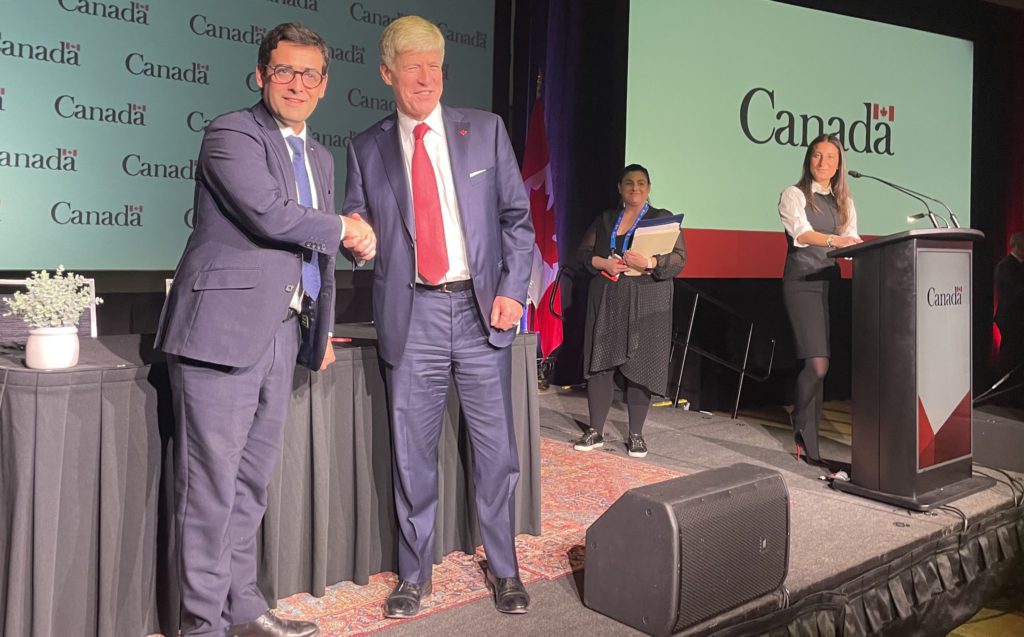
First reported on MINING.com
30 Second Briefing
Ottawa has committed up to $17 million each to 30 critical minerals projects worth a combined $12.1 billion, including $16.7 million for First Phosphate’s Bégin-Lamarche LFP cathode material project in Quebec, $2.3 million for Frontier Lithium’s proposed processing plant in northern Ontario, and $7 million for Greenland Resources’ Malmbjerg molybdenum project. Greenland Resources’ scheme is backed by a US$2‑billion, 10‑year offtake with Outokumpu plus a US$275‑million debt LOI from EDC and Nordic ECAs, while Cyclic Materials’ Kingston rare earth recycling Centre of Excellence has secured up to $9.1 million from NRCan and US$25 million from the Canada Growth Fund. Additional moves include up to $64.8 million for international R&D, a Canada–EU project co‑operation LOI with the European Investment Bank, and new raw materials and offtake MoUs involving Leonardo, Panasonic Energy, Neo Performance Materials, Apple and others, signalling strong federal backing for upstream, midstream and recycling capacity.
Technical Brief
- Federal support is capped at $17 million per project, with 30 projects selected under the G7-linked scheme.
- Aggregate project capital unlocked totals $12.1 billion, spanning upstream mining, midstream processing and recycling assets.
- The 30 new agreements across 10 allied countries and the EU build on 26 deals announced last autumn.
- Ottawa’s combined project pipeline from these two tranches now reaches $18.5 billion in critical minerals investments.
- Up to $64.8 million is earmarked for international R&D collaborations targeting supply-chain resilience and emissions reduction.
- A further $10 million is allocated to assist developing countries’ energy and digital transition participation, including minerals supply.
Our Take
The presence of the Canada Growth Fund in both this PDAC package and in other critical minerals coverage in our database suggests Ottawa is increasingly funnelling de-risking capital through this vehicle rather than traditional grants, which can change how projects like Cyclic Materials or synthetic graphite in Welland structure their financing stacks.
Linking this announcement to the recent analysis showing only 11% of more than C$700 billion in Canadian mining capex since 2000 went into critical minerals, the 30-project spread here looks more like a portfolio seeding move than a scale solution, implying that graphite and lithium proponents in Quebec and northern Ontario will still need substantial private or foreign capital to reach build-out.
The US$275-million debt financing indication for Greenland Resources’ Malmbjerg molybdenum project, alongside EU-linked institutions in the company list, underlines how Arctic and Greenland assets are being positioned as part of a Europe–North America critical minerals corridor rather than purely Canadian domestic supply plays.
Prepared by collating external sources, AI-assisted tools, and Geomechanics.io’s proprietary mining database, then reviewed for technical accuracy & edited by our geotechnical team.
Related Articles


Related Industries & Products
Mining
Geotechnical software solutions for mining operations including CMRR analysis, hydrogeological testing, and data management.
CMRR-io
Streamline coal mine roof stability assessments with our cloud-based CMRR software featuring automated calculations, multi-scenario analysis, and collaborative workflows.
HYDROGEO-io
Comprehensive hydrogeological testing platform for managing, analysing, and reporting on packer tests, lugeon values, and hydraulic conductivity assessments.
GEODB-io
Centralised geotechnical data management solution for storing, accessing, and analysing all your site investigation and material testing data.