Eriez StackCell flotation: design, retrofit and kinetics insights for plant engineers
Reviewed by Tom Sullivan
First reported on Australian Mining
30 Second Briefing
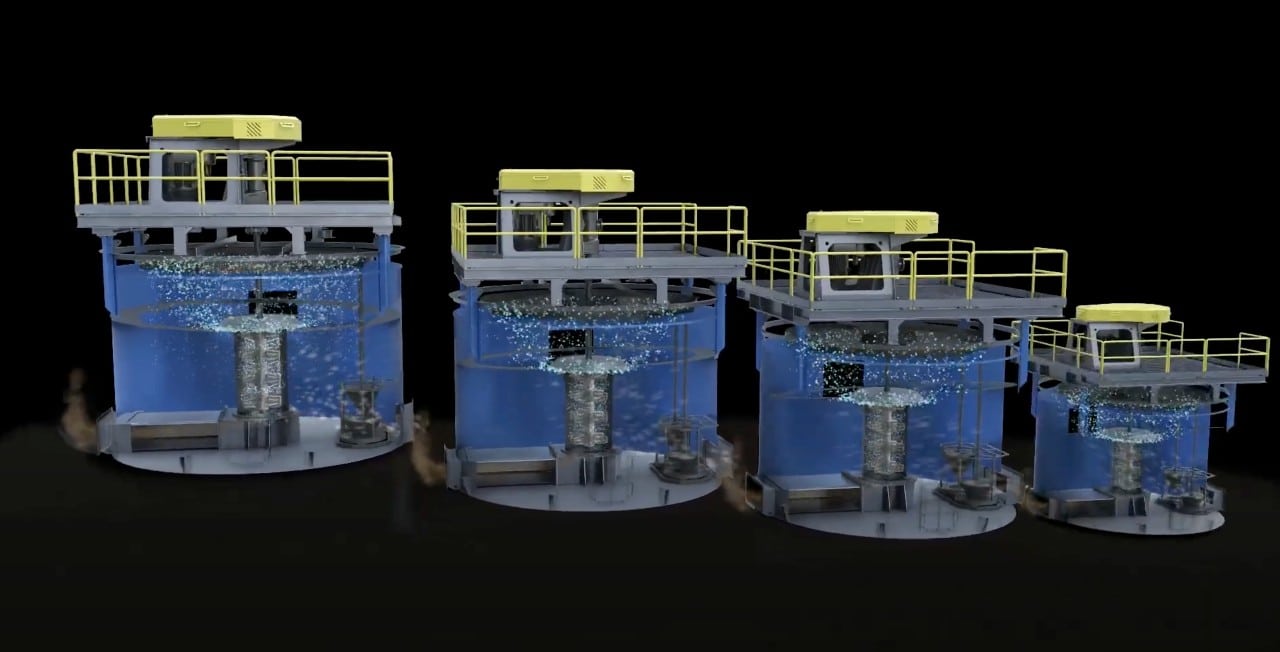
Eriez has released an educational video detailing its StackCell high-intensity flotation technology, which separates bubble-particle contacting from froth phase separation to improve kinetics and concentrate grade. The system uses a small, high-shear contacting chamber feeding into a larger, low-turbulence tank, allowing finer grind flotation and reduced residence time compared with conventional mechanical cells. For plant designers, the modular StackCell arrangement offers potential footprint reductions and retrofit options in existing rougher–scavenger circuits without major civil changes.
Technical Brief
- StackCell’s contacting chamber uses a forced-air, high-shear rotor–stator mechanism to intensify bubble generation.
- The downstream tank operates without mechanical agitation, relying on quiescent conditions for froth phase separation.
- Units are designed as vertically stackable modules, enabling multi-stage flotation within a constrained floor footprint.
- Retrofit configurations allow StackCell modules to be installed above existing mechanical cells, minimising new structural steelwork.
- The video emphasises integration with column flotation or conventional cells to form hybrid rougher–scavenger–cleaner flowsheets.
- Control philosophy focuses on air rate and feed rate adjustment rather than impeller speed, simplifying instrumentation.
- For brownfield concentrators, the stacked arrangement targets debottlenecking where mill throughput has increased without matching flotation capacity.
Our Take
Eriez’ focus on StackCell flotation in Australia aligns with its CavTube work on ultrafine phosphates and potash tailings recovery highlighted in our 13 April 2026 coverage, signalling a push to position its flotation portfolio for fine and ultrafine circuits where many brownfield plants are currently underperforming.
Across the 1199 Mining stories in our database, relatively few product pieces are tied so clearly to both plant debottlenecking and tailings re‑treatment, suggesting Eriez is targeting StackCell at operators looking to unlock incremental metal without major new mine approvals in Australia’s more constrained permitting environment.
With Australian Mining also featuring CSIRO’s lunar mining technology ambitions on 20 April 2026, this StackCell article reinforces how Australia is being framed as a testbed for advanced separation and automation technologies that can later migrate to more remote or unconventional resource settings.
Prepared by collating external sources, AI-assisted tools, and Geomechanics.io’s proprietary mining database, then reviewed for technical accuracy & edited by our geotechnical team.
Related Articles

Related Industries & Products
Mining
Geotechnical software solutions for mining operations including CMRR analysis, hydrogeological testing, and data management.
Construction
Quality control software for construction companies with material testing, batch tracking, and compliance management.
CMRR-io
Streamline coal mine roof stability assessments with our cloud-based CMRR software featuring automated calculations, multi-scenario analysis, and collaborative workflows.
HYDROGEO-io
Comprehensive hydrogeological testing platform for managing, analysing, and reporting on packer tests, lugeon values, and hydraulic conductivity assessments.
GEODB-io
Centralised geotechnical data management solution for storing, accessing, and analysing all your site investigation and material testing data.