National Highways, MJ Church M4 landslip: stabilisation and reuse notes for engineers
Reviewed by Joe Ashwell
First reported on The Construction Index
30 Second Briefing
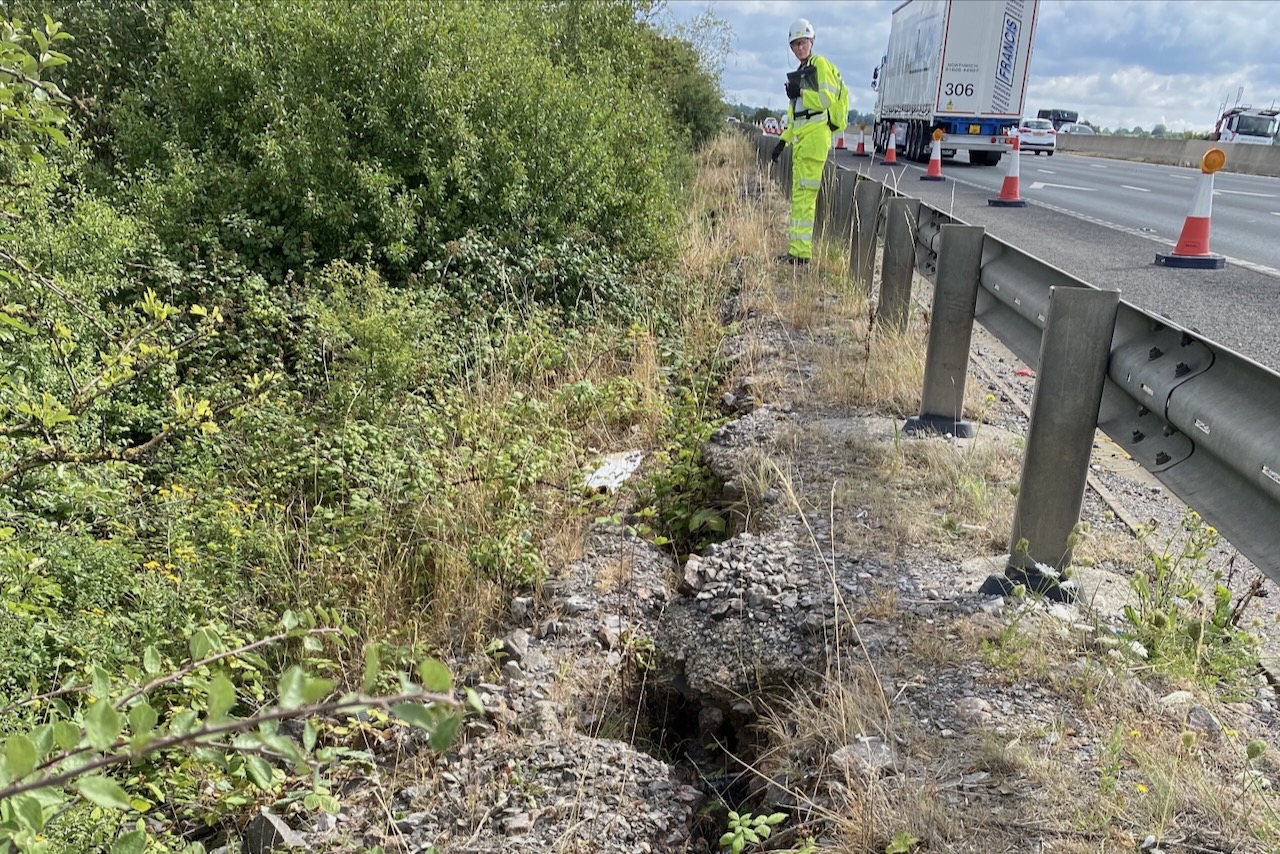
National Highways and contractor MJ Church have begun a £20m scheme to stabilise 600m of embankment on the M4 in Wiltshire between junctions 16 and 17, moving 25,000t of earth after a landslip rendered the eastbound hard shoulder unsafe. The design involves backfilling with 19,500t of locally sourced stone and reusing landslip material plus recycled concrete from MJ Church’s crushing plant near Chippenham to rebuild verges and embankments. Embankment stabilisation must be completed before refurbishment of four bridges and barrier upgrades scheduled to start in autumn 2027.
Technical Brief
- Landslip was detected during National Highways’ routine condition surveys, indicating active geotechnical monitoring of legacy assets.
- Affected section lies on the eastbound approach to Swindon between junctions 16 and 17 of the M4.
- Hard shoulder is currently withdrawn from service on safety grounds until embankment stability is restored.
- Embankment and verge stabilisation is a prerequisite enabling subsequent bridge refurbishment works programmed for autumn 2027.
- MJ Church will process and reuse landslip arisings plus recycled concrete from its Chippenham crushing facility.
- National Highways notes many structures on this corridor are ~60 years old, driving proactive renewal to avoid unplanned failures.
Our Take
National Highways appears frequently in our 915 Infrastructure stories, but most recent pieces (such as the Lower Thames Crossing hydrogen plans) focus on new-build or low-carbon operations, whereas this £20m M4 embankment and four-bridge package highlights the growing maintenance burden on a 60‑year‑old strategic network.
The M4 landslip remediation sits alongside large resurfacing and FM programmes (e.g. the M40 DBFO works with Associated Asphalt and the Amey FM extension), suggesting National Highways is clustering major renewals on key motorway corridors rather than spreading works thinly across the network.
Given recent criticism of National Highways’ road runoff design rules by drainage specialists, any redesign of the 600 m M4 embankment in Wiltshire is likely to be scrutinised for how it handles surface water and stability, especially with bridge repairs already timetabled into autumn 2027 on the same stretch.
Prepared by collating external sources, AI-assisted tools, and Geomechanics.io’s proprietary mining database, then reviewed for technical accuracy & edited by our geotechnical team.
Related Articles


Related Industries & Products
Construction
Quality control software for construction companies with material testing, batch tracking, and compliance management.
Mining
Geotechnical software solutions for mining operations including CMRR analysis, hydrogeological testing, and data management.
CMRR-io
Streamline coal mine roof stability assessments with our cloud-based CMRR software featuring automated calculations, multi-scenario analysis, and collaborative workflows.
HYDROGEO-io
Comprehensive hydrogeological testing platform for managing, analysing, and reporting on packer tests, lugeon values, and hydraulic conductivity assessments.
GEODB-io
Centralised geotechnical data management solution for storing, accessing, and analysing all your site investigation and material testing data.