Marimaca Copper acid plant acquisition: project economics and supply risk lens
Reviewed by Tom Sullivan
First reported on MINING.com
30 Second Briefing
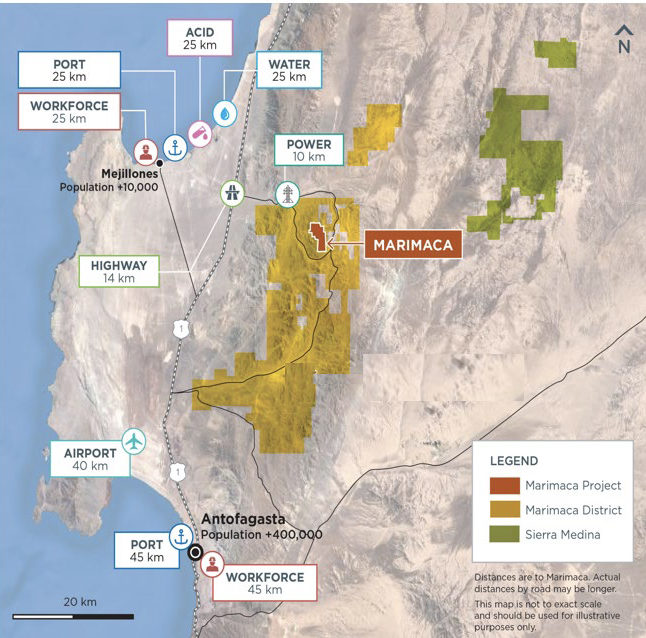
Marimaca Copper is insulating its $587 million Marimaca oxide heap-leach project in northern Chile from sulphuric acid price spikes by buying and planning to relocate the second-hand Dos Amigos acid plant from Mejillones, 25 km away, acquired for $2.5 million versus an estimated $50–70 million for a new installation. The 13-year SX-EW operation is designed to produce 50,000 t/y of copper cathode from 178.6 Mt at 0.42% Cu, with a post-tax NPV of $709 million and 31% IRR at $4.30/lb. Parallel drilling at the nearby Pampa Medina target is returning long sulphide intercepts such as 424 m at 0.58% Cu and 2.2 g/t Ag from 424 m, indicating stacked oxide–sulphide potential beyond the starter oxide phase.
Technical Brief
- Gulf sulphuric acid spot prices jumped from US$155/t (25 Feb) to US$400/t (6 May), compressing heap-leach margins.
- China’s sulphuric acid exports to Chile fell to zero in March, removing a key low-cost supply source.
- Marimaca’s six‑month MoU with a Mejillones producer covers refurbishing, relocating and integrating the Dos Amigos plant 25 km by road.
- Locke estimates a greenfield acid plant would require about US$35M for equipment and US$50–70M fully installed.
- The feasibility study explicitly identifies an owner‑operated acid plant as a lever to reduce operating costs.
- Mine permitting was filed in April, with approvals targeted by year‑end to enable early site works.
- Grid power will be sourced via a newly authorised connection to the 110‑kV El Lince line, 13 km from site.
- At Pampa Medina, drilling has defined a stacked oxide–sulphide Cu–Ag system over an initial 3 km × 1.5 km footprint.
- Key Pampa Medina intercepts include 424 m at 0.58% Cu, 2.2 g/t Ag from 424 m (SPRD‑06) and 166 m at 0.5% Cu, 3.9 g/t Ag from 222 m (SPRD‑02), supporting multi‑horizon sulphide potential beyond the oxide phase.
Our Take
The decision by Marimaca Copper to secure sulphuric acid via the Dos Amigos plant stands out in our copper project database, where most Latin American leach operations still rely on third-party supply despite similar exposure to US Gulf price swings from about $155/t to $400/t.
With a project capex of $587 million and a post-tax NPV of $709 million at $4.30/lb copper, locking in a low-cost acid solution in northern Chile likely helps keep the Marimaca oxide project in the more resilient half of the 75 ‘unicorn’ copper mines (>$1 billion valuation) tracked in our coverage.
Freeport-McMoRan’s $7.5-billion El Abra expansion, referenced alongside Marimaca in Chile, underlines how competition for sulphuric acid in the region could tighten further as large sulphide and oxide expansions advance, making early reagent self-sufficiency a strategic hedge for smaller developers.
Prepared by collating external sources, AI-assisted tools, and Geomechanics.io’s proprietary mining database, then reviewed for technical accuracy & edited by our geotechnical team.
Related Articles

Related Industries & Products
Mining
Geotechnical software solutions for mining operations including CMRR analysis, hydrogeological testing, and data management.
CMRR-io
Streamline coal mine roof stability assessments with our cloud-based CMRR software featuring automated calculations, multi-scenario analysis, and collaborative workflows.
HYDROGEO-io
Comprehensive hydrogeological testing platform for managing, analysing, and reporting on packer tests, lugeon values, and hydraulic conductivity assessments.
GEODB-io
Centralised geotechnical data management solution for storing, accessing, and analysing all your site investigation and material testing data.