M3 Junction 9 capacity upgrade: design and groundwater lessons for engineers
Reviewed by Joe Ashwell
First reported on New Civil Engineer
30 Second Briefing
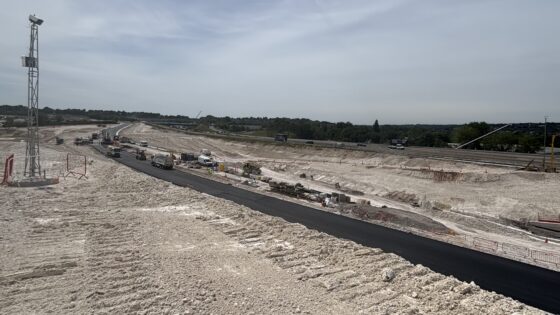
Plans to upgrade the M3 at Junction 9 near Winchester have expanded from a basic capacity scheme into one of National Highways’ most complex projects, combining free‑flow links between the M3 and A34 with major reconfiguration of the existing dumbbell junction. Designers must thread new high‑level and low‑level structures between the River Itchen, a Site of Special Scientific Interest, and the South Downs National Park, while maintaining three live lanes of traffic in each direction. The scheme demands extensive groundwater management, habitat creation and phased bridge construction to control settlement and protect chalk aquifer flows.
Technical Brief
- Design teams have had to iterate multiple junction layouts to satisfy safety audits and environmental constraints simultaneously.
- Traffic management phasing is being developed to keep hard shoulders available as incident access routes during works.
- Construction planning includes segregated plant and workforce access to avoid live‑lane interface wherever possible.
- Drainage and groundwater controls are being tied into the chalk aquifer protection strategy to prevent pollution incidents.
- Ecology mitigation zones double as exclusion areas, physically separating heavy construction from public rights of way.
- Safety risk engineers are embedded in the project team, treating buildability and staging as primary design parameters.
- Lessons on integrating safety, capacity and environmental requirements at concept stage are expected to inform future National Highways junction upgrades.
Our Take
In our database, National Highways features heavily in southern England capacity and junction upgrades, with the M25 J10 and M3 J9 schemes signalling a push to reconfigure older motorway geometry rather than just add lanes.
The mix of tags here—Projects, Sustainability, Safety—matches other recent National Highways items where complex staging and live-traffic management have driven design choices as much as the nominal capacity target.
The M3 work sits alongside the A38 viaduct refurbishments and the rapid M42 bridge demolition, suggesting National Highways is increasingly bundling major capacity schemes with life-extension and structural risk interventions on ageing assets in the region.
Prepared by collating external sources, AI-assisted tools, and Geomechanics.io’s proprietary mining database, then reviewed for technical accuracy & edited by our geotechnical team.


