Liverpool Street train hitting buffers: terminal platform risk lessons for engineers
Reviewed by Joe Ashwell
First reported on New Civil Engineer
30 Second Briefing
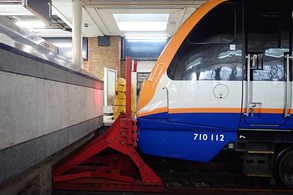
An out-of-service London Overground train struck the buffer stops at London Liverpool Street, derailing its first three carriages and sending the driver to hospital, according to an initial Rail Accident Investigation Branch update. The collision occurred on a terminal platform, with the impact severe enough to lift vehicles off the track and damage the buffer zone infrastructure. Investigators will focus on train speed on approach, buffer stop performance and any signalling or braking system issues, with implications for terminal platform risk assessments and buffer design margins on busy urban networks.
Technical Brief
- Impact energy will be back-calculated from vehicle mass, measured damage and post-incident stopping distance.
- RAIB investigation will reconstruct approach conditions using OTMR data, signalling logs and driver interviews.
- Detailed inspection of buffer stop anchorage, deformation and track fixings will assess whether capacity was exceeded.
- Track geometry, rail fastenings and switch/crossing components at the terminal end will be checked for distortion.
- Derailment pattern of the first three carriages will be mapped to infer vertical lift and yaw mechanisms.
- Structural survey of platform slab, coping stones and adjacent OLE/gantries will determine any hidden damage.
- Short-term monitoring is likely to include track twist measurements, gauge checks and repeated visual inspections under traffic.
- Findings are expected to inform updated terminal risk models, including residual risk where TPWS/ATP does not control buffer approaches.
Our Take
The Rail Accident Investigation Branch features in several recent UK incidents in our database, including the Lewes derailment and the Bedford signal-passed-at-danger collision, signalling sustained systemic scrutiny of passenger-train operations rather than isolated one-off failures.
With three carriages derailed at a constrained London terminus like Liverpool Street, RAIB’s findings are likely to feed directly into buffer-stop design, approach-speed control, and platform risk assessments at other high-density UK stations.
Earlier coverage notes that some RAIB safety recommendations dating back to 2008 remain outstanding across the national network, so any new guidance arising from this Liverpool Street failure may add to an already significant implementation backlog for operators and Network Rail.
Prepared by collating external sources, AI-assisted tools, and Geomechanics.io’s proprietary mining database, then reviewed for technical accuracy & edited by our geotechnical team.
Related Articles


Related Industries & Products
Mining
Geotechnical software solutions for mining operations including CMRR analysis, hydrogeological testing, and data management.
Construction
Quality control software for construction companies with material testing, batch tracking, and compliance management.
CMRR-io
Streamline coal mine roof stability assessments with our cloud-based CMRR software featuring automated calculations, multi-scenario analysis, and collaborative workflows.
HYDROGEO-io
Comprehensive hydrogeological testing platform for managing, analysing, and reporting on packer tests, lugeon values, and hydraulic conductivity assessments.
GEODB-io
Centralised geotechnical data management solution for storing, accessing, and analysing all your site investigation and material testing data.