Lithium price sinks to five‑month low: supply, demand and capex signals for mine planners
Reviewed by Tom Sullivan
First reported on MINING.com
30 Second Briefing
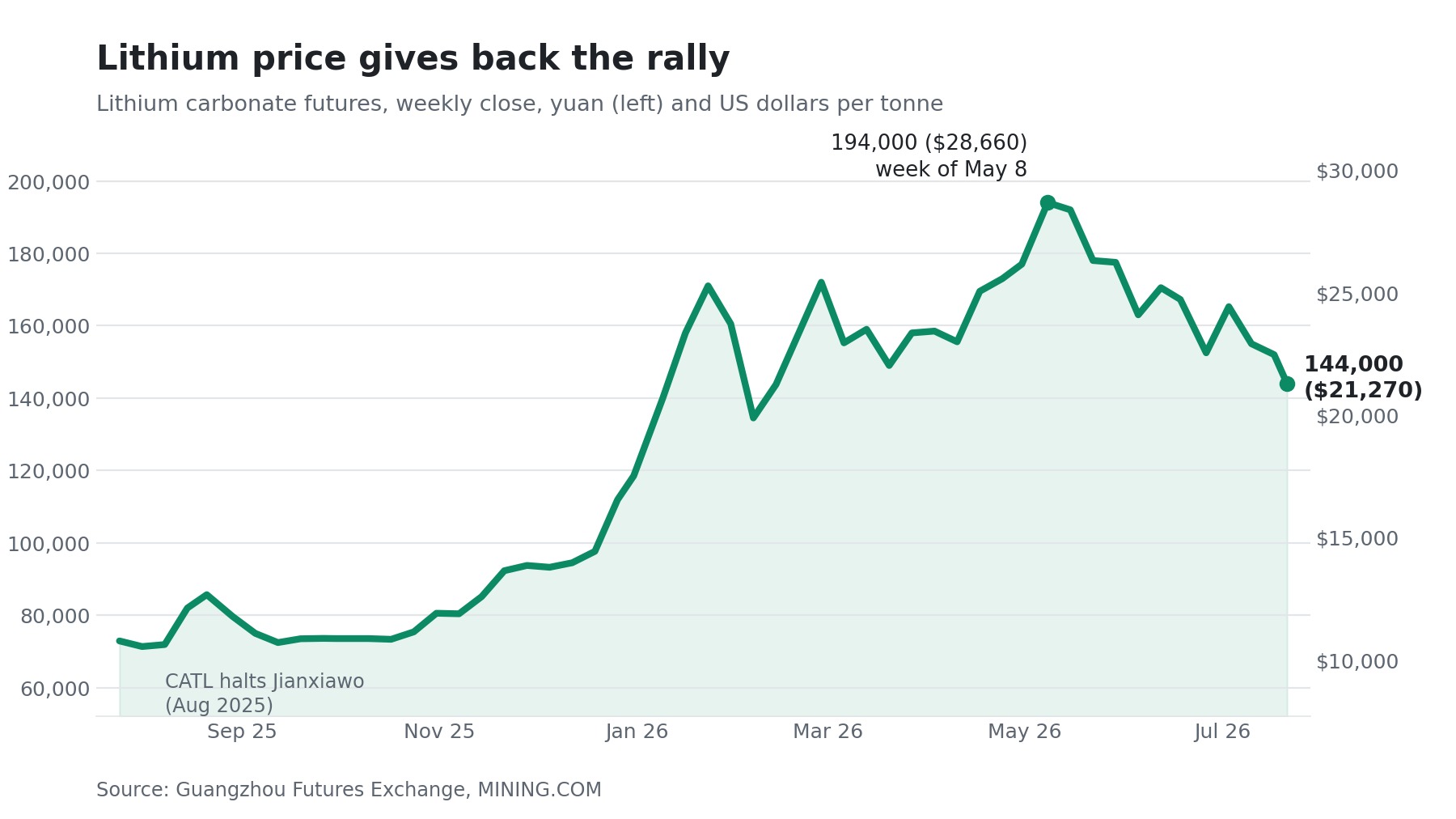
Lithium carbonate futures on the Guangzhou Futures Exchange fell 4.95% on Tuesday to 144,000 yuan/t, nearly 30% below May’s two-year high above 200,000 yuan/t, as restarts at CATL’s 46,000 t/y Jianxiawo mine and Australian operations Bald Hill, Finniss and Mt Marion raised fears of oversupply through 2027. Beijing is simultaneously pushing Guangzhou as a global pricing hub by opening lithium contracts to overseas traders and planning a lithium hydroxide future, while China’s battery output hit 191.7 GWh in May, up more than 55% year-on-year. Washington’s DLA has entered the market with a tender for 16,000 t of battery-grade lithium carbonate over five years at about $18,500/t, but the volume equates to only a few days of global consumption.
Technical Brief
- Jianxiawo’s restart adds 46,000 t/y capacity, estimated at ~3% of current global mined output.
- The most active lithium carbonate contract on the Guangzhou Futures Exchange fell to 136,800 yuan/t intraday before partial recovery.
- Despite the pullback, 2026 lithium prices remain ~22% higher year-to-date.
- US Defense Logistics Agency tender covers ~36 million lb (16,000 t) battery-grade carbonate over five years.
- DLA tender price ceiling of ~$300 million implies ~$18,500/t, below current Guangzhou futures settlements.
- Tender stipulates all processing and testing within the continental US, excluding offshore conversion capacity.
- Zimbabwe, supplying ~10% of the world’s mined lithium last year, confirmed a hard 1 January ban on concentrate exports.
- China will impose a 2% consumption tax on lithium batteries from 1 September, rising to 4% a year later.
- May Chinese power and storage battery output reached 191.7 GWh, up >55% year-on-year.
- Equity downside has exceeded metal price moves, with Liontown and Ganfeng both losing ~36% in a month.
Our Take
CATL features heavily across recent coverage, from Guangzhou lithium carbonate futures to sodium‑ion roll‑outs and biographite anode investments, signalling that price weakness in lithium carbonate directly intersects with a supplier that is simultaneously diversifying away from pure lithium chemistries.
The US Defense Logistics Agency’s plan to source up to 36 million lb of battery‑grade lithium carbonate under Project Vault contrasts with China’s fast‑growing 191.7 GWh/month battery output, implying that US stockpiling is trying to offset the pricing and supply influence of Chinese converters and cell makers such as CATL.
With Zimbabwe already accounting for about 10% of mined lithium and enforcing a concentrate export ban from 1 January, any 2027 ‘glut’ is likely to be shaped as much by where refining capacity is built as by raw ore output, which matters for Australian spodumene producers like Pilbara Minerals and Mineral Resources looking to move further downstream.
Prepared by collating external sources, AI-assisted tools, and Geomechanics.io’s proprietary mining database, then reviewed for technical accuracy & edited by our geotechnical team.
Related Articles


Related Industries & Products
Mining
Geotechnical software solutions for mining operations including CMRR analysis, hydrogeological testing, and data management.
CMRR-io
Streamline coal mine roof stability assessments with our cloud-based CMRR software featuring automated calculations, multi-scenario analysis, and collaborative workflows.
HYDROGEO-io
Comprehensive hydrogeological testing platform for managing, analysing, and reporting on packer tests, lugeon values, and hydraulic conductivity assessments.
GEODB-io
Centralised geotechnical data management solution for storing, accessing, and analysing all your site investigation and material testing data.