Liebherr 50t crawler excavators: automation and fuel‑efficiency notes for engineers
Reviewed by Tom Sullivan
First reported on The Construction Index
30 Second Briefing
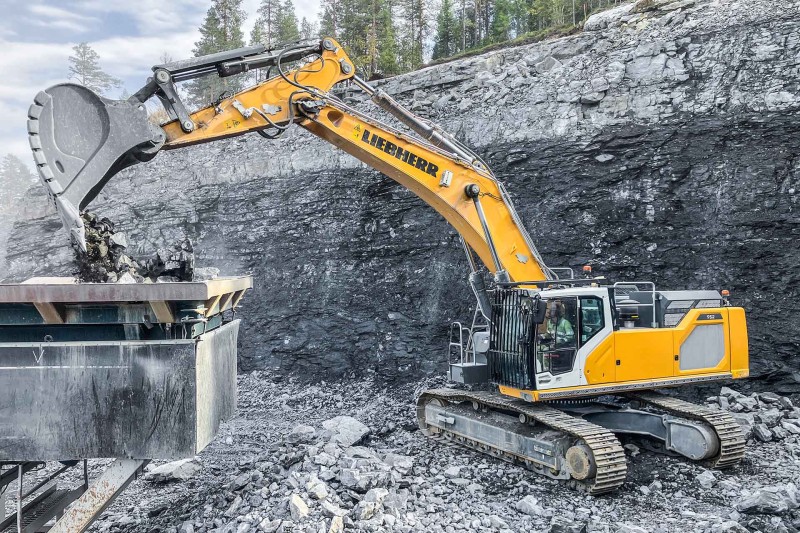
Liebherr has launched three 50‑tonne Generation 8 crawler excavators at Steinexpo – the R 948 G8 for earthmoving, the R 958 G8 for mining with an S‑HD chassis and ME equipment, and the versatile R 952 G8 with three chassis variants and higher engine power. All models feature LPE (Liebherr Power Efficiency) claiming up to 10% lower fuel use, Bucket Fill Assist automation, Modetronic adaptive machine settings, and an automatic central lubrication system. A passive 2D machine control system co‑developed with Leica Geosystems plus on‑board weighing is standard, with upgradeable 3D and semi‑automation options.
Technical Brief
- R 948 G8 uses an LC undercarriage, favouring stability and lower ground pressure on earthworks.
- R 958 G8 mining configuration combines S‑HD heavy‑duty chassis with ME boom/stick for high breakout.
- R 952 G8 offers three chassis variants, allowing tailoring to transport limits, underfoot conditions and duty cycle.
- Specialist equipment packages on R 948 G8 target reduced fuel burn through optimised engine–hydraulics matching.
- Numerous mining‑specific options on R 958 G8 enable configuration for abrasive rock, high-impact loading and long shifts.
- Maintenance access is via an elevated, easy‑reach platform with defined secure access points for servicing.
- Automatic central lubrication targets pins and bushings, reducing manual greasing and unplanned downtime on large fleets.
- Integrated dynamic weighing supports in‑situ payload control, improving truck matching and cycle-time optimisation on bulk earthworks.
Our Take
Liebherr’s focus on fuel‑efficiency in this 50‑tonne crawler excavator aligns with its recent €2.5m investment in accelerated test rigs at Colmar, signalling a push to validate lower‑consumption designs quickly for heavy earthmoving classes.
Integration of Leica Geosystems’ 2D/3D control on these UK‑market machines fits with our wider Materials coverage where digital guidance is increasingly standard on mid‑ to large‑class excavators used on infrastructure projects, rather than a premium retrofit.
Across our database, Liebherr appears both in high‑productivity mining deployments (such as the R 9600 record at Mount Pleasant) and in crane fleets for UK contractors, so adding a more efficient 50‑tonne excavator gives existing Liebherr fleets a route to standardise telematics and control systems across lifting and earthmoving plant.
Prepared by collating external sources, AI-assisted tools, and Geomechanics.io’s proprietary mining database, then reviewed for technical accuracy & edited by our geotechnical team.
Related Articles

Related Industries & Products
Mining
Geotechnical software solutions for mining operations including CMRR analysis, hydrogeological testing, and data management.
Construction
Quality control software for construction companies with material testing, batch tracking, and compliance management.
CMRR-io
Streamline coal mine roof stability assessments with our cloud-based CMRR software featuring automated calculations, multi-scenario analysis, and collaborative workflows.
HYDROGEO-io
Comprehensive hydrogeological testing platform for managing, analysing, and reporting on packer tests, lugeon values, and hydraulic conductivity assessments.
GEODB-io
Centralised geotechnical data management solution for storing, accessing, and analysing all your site investigation and material testing data.