Lewes derailment: infrastructure damage assessment and lessons for rail engineers
Reviewed by Joe Ashwell
First reported on New Civil Engineer
30 Second Briefing
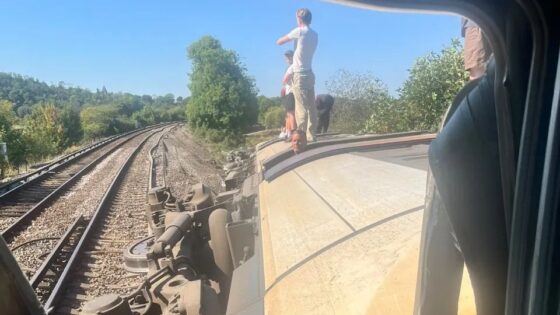
A Southern Rail passenger train derailed near Lewes, East Sussex, at about 15:55 on 13 August, prompting Network Rail to deploy specialist inspection and track engineering teams. Crews are assessing potential damage to rails, sleepers, ballast and signalling assets, and checking for any misalignment or deformation of the formation that could affect line speed and gauge. Findings will determine the extent of re-railing, tamping, ballast renewal or signalling repairs required before services can safely resume.
Technical Brief
- Failure mechanism investigation will focus on wheel–rail interaction, track geometry exceedances and potential localised ballast washout.
- Network Rail’s specialist teams are likely to deploy track geometry cars, ultrasonic rail flaw detection and visual walkouts.
- Monitoring options post-incident include short-term speed restrictions with frequent geometry runs and targeted track recording by trolley.
- Remediation design will balance spot re-railing and ballast cleaning against full panel replacement to restore long-term geometry resilience.
- Safety protocols require electrical isolation, possession limits, lookouts and strict exclusion zones around derailed rolling stock during recovery.
- Signalling and telecoms checks will extend to track circuits, axle counters and cable routes potentially disturbed by rerailing plant movements.
- Similar derailments have led to enhanced inspection frequencies at sites with known formation weaknesses, drainage issues or tight curvature.
Our Take
Network Rail’s recent completion of half a kilometre of track renewals at Alfreton Tunnel and its rapid rebuild of signalling after the Cardiff–Newport lineside fire suggest that specialist permanent-way and signalling teams are already mobilised at scale, which should shorten assessment and recovery times at Lewes compared with less active periods.
The new £113M, eight-year civils examinations framework for Wales & Western, and the associated £4.1M inspections package to Ground Control and Inspire (Structures), indicate that Network Rail is systemically ramping up asset condition intelligence; incidents like the Lewes derailment in East Sussex are likely to strengthen the case for similar long-horizon examination frameworks on the Southern route.
With this Lewes event joining other recent UK ‘Failure’ and ‘Safety’ tagged incidents in our infrastructure coverage, operators such as Southern Rail can expect closer scrutiny of interface risks between train operations and Network Rail’s asset management, especially around secondary routes where renewal and inspection cycles may historically have lagged the core main lines.
Prepared by collating external sources, AI-assisted tools, and Geomechanics.io’s proprietary mining database, then reviewed for technical accuracy & edited by our geotechnical team.
Related Articles


Related Industries & Products
Mining
Geotechnical software solutions for mining operations including CMRR analysis, hydrogeological testing, and data management.
Construction
Quality control software for construction companies with material testing, batch tracking, and compliance management.
CMRR-io
Streamline coal mine roof stability assessments with our cloud-based CMRR software featuring automated calculations, multi-scenario analysis, and collaborative workflows.
HYDROGEO-io
Comprehensive hydrogeological testing platform for managing, analysing, and reporting on packer tests, lugeon values, and hydraulic conductivity assessments.
GEODB-io
Centralised geotechnical data management solution for storing, accessing, and analysing all your site investigation and material testing data.