Government cash reshapes mining capital: risk and leverage insights for project teams
Reviewed by Joe Ashwell
First reported on MINING.com
30 Second Briefing
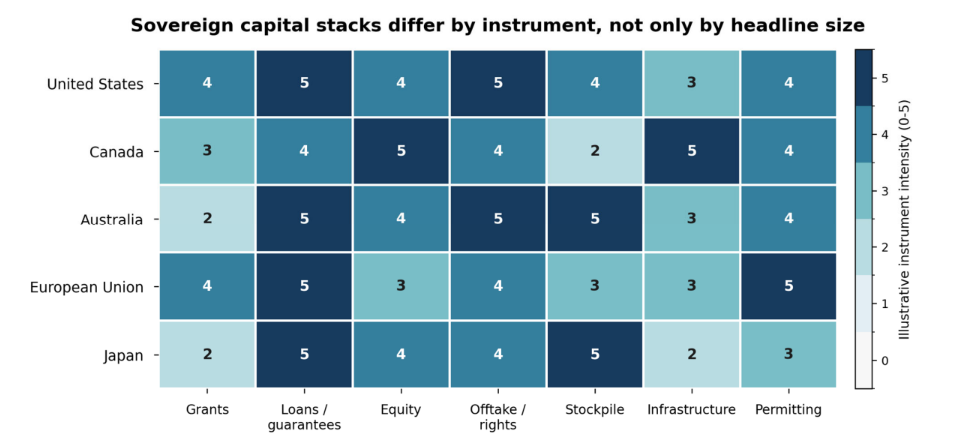
Government funding is reshaping mine finance as the US deploys nearly $2 billion in mixed instruments, including a $1.4 billion conditional loan to Sila, about $400 million to Sunrise Energy Metals, $150 million to Niron Magnetics and over $180 million for mining education. GEM Consulting’s comparative map shows the US using the widest blend of loans, equity, grants, purchase rights and stockpiles, versus Canada’s focus on infrastructure and equity, Australia’s output rights and inventories, the EU’s public credit and permitting coordination, and Japan’s offtake-linked overseas finance. The study warns that without clear disclosure of guarantees, repayments and recovered rights, and without demonstrable “additionality”, public capital risks displacing private funding while expanding state strategic control over critical-mineral projects.
Technical Brief
- Conditional US support spans commercial-scale loans, early-stage pilot grants and workforce funding, each altering project risk.
- GEM notes that identical dollar amounts can have very different leverage depending on instrument structure.
- Small qualification or pilot grants are flagged as potential catalysts for much larger private follow-on capital.
- Education allocations are framed as addressing skilled-labour bottlenecks constraining multiple mines rather than single-asset output.
- Comparative “instrument map” scores government tools on a 0–5 intensity scale as a taxonomy, not performance ranking.
- Canada is profiled as favouring remote-corridor and shared-infrastructure solutions for otherwise stranded critical-mineral deposits.
- EU schemes are characterised as better suited to integrated mine–processing hubs with defined European offtake.
- Japan’s model is described as overseas-resource finance tightly coupled to Japanese end-user offtake and stockpiling.
- GEM calls for a public database disclosing contingent guarantees, repayments, fees, equity valuations and recovered state rights.
- Portfolio-style, staged and conditional public funding is recommended to ensure genuine “additionality” rather than crowding out private capital.
Our Take
The emphasis on public funding for critical minerals in Australia, Canada and the USA echoes other recent coverage where large-scale projects like Empire Metals’ Pitfield titanium-REE asset are framed as strategic rather than purely commercial, signalling that capital access is increasingly tied to perceived geopolitical value.
The 0–5 ‘intensity’ scoring used in the comparative instrument map gives operators in regions like Ontario and the EU a way to benchmark how aggressive their subsidy or regulatory regimes are against jurisdictions backing multi‑billion‑dollar critical minerals packages, which can influence where mid-tier players such as Westwater Resources or Global Advanced Metals choose to advance projects.
Prepared by collating external sources, AI-assisted tools, and Geomechanics.io’s proprietary mining database, then reviewed for technical accuracy & edited by our geotechnical team.
Related Articles


Related Industries & Products
Mining
Geotechnical software solutions for mining operations including CMRR analysis, hydrogeological testing, and data management.
Construction
Quality control software for construction companies with material testing, batch tracking, and compliance management.
CMRR-io
Streamline coal mine roof stability assessments with our cloud-based CMRR software featuring automated calculations, multi-scenario analysis, and collaborative workflows.
HYDROGEO-io
Comprehensive hydrogeological testing platform for managing, analysing, and reporting on packer tests, lugeon values, and hydraulic conductivity assessments.
GEODB-io
Centralised geotechnical data management solution for storing, accessing, and analysing all your site investigation and material testing data.