Geology-led ore behaviour modelling: key planning insights for mine engineers
Reviewed by Tom Sullivan
First reported on Australian Mining
30 Second Briefing
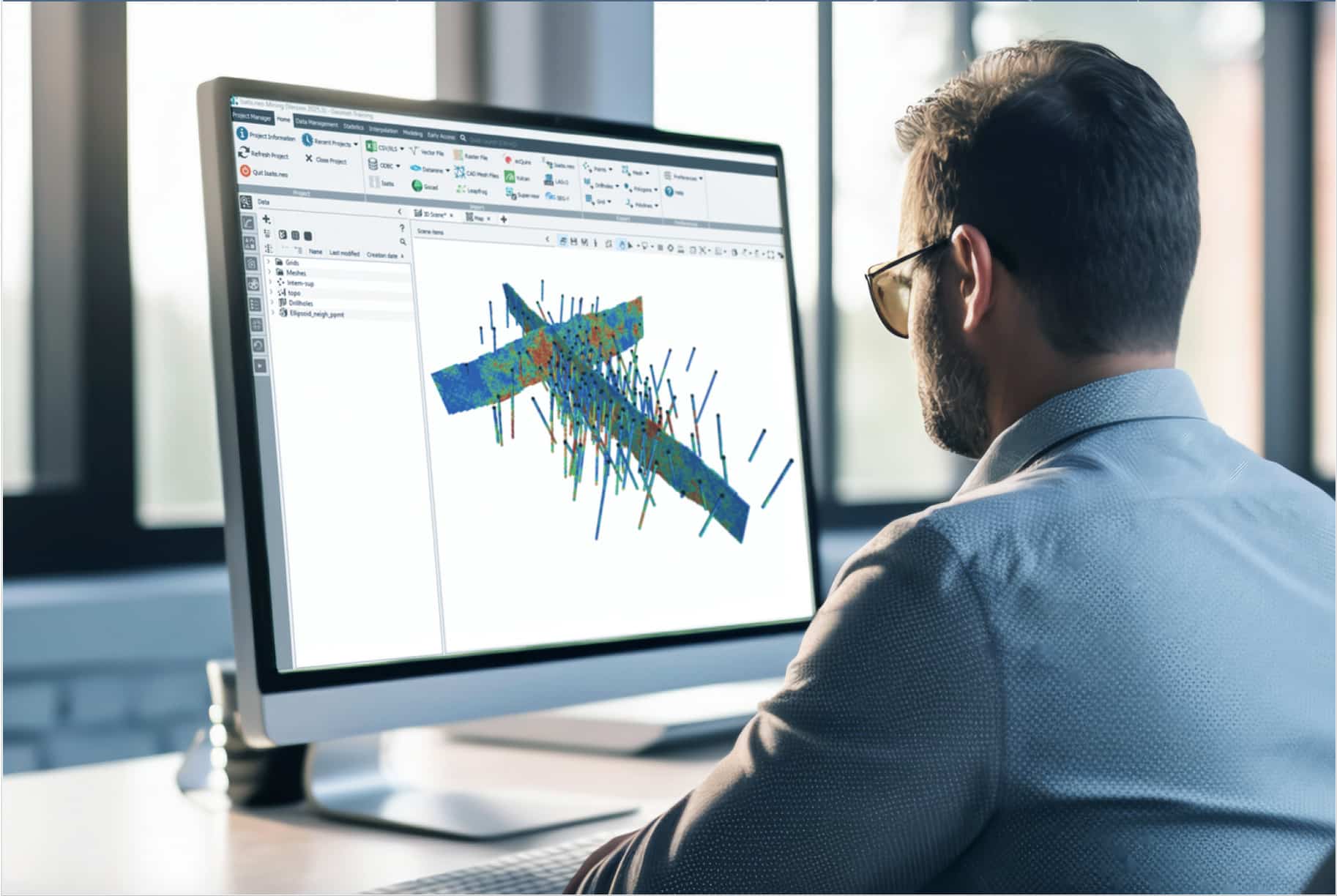
Geology-led geometallurgical modelling is being used to predict ore behaviour beyond grade by integrating limited metallurgical testwork with geological domains to estimate recovery, hardness, deleterious elements and mineralogical variability at block-model scale. Tools such as Datamine’s Studio RM and Maptek’s Vulcan are combining drillhole assays, mineralogy and comminution indices (e.g. Bond ball mill work index) to generate 3D models of processing performance rather than just metal grade. For mine planners and process engineers, this enables earlier circuit design decisions, more realistic throughput forecasts and domain-specific blending strategies.
Technical Brief
- Workflows link sample-level comminution indices and mineralogy directly to geological wireframes before interpolation.
- Geologists define geometallurgical domains first, then modellers assign recovery and hardness parameters within those domains.
- Limited metallurgical testwork is upscaled using regression and domaining rather than simple global averages.
- Spatial continuity of deleterious elements is modelled alongside grade, enabling domain-specific penalty forecasting.
- Modelling teams iterate domain boundaries when plant performance back-analysis diverges from predicted behaviour.
- Approach enables early-stage trade-offs between additional metallurgical drilling versus increased model uncertainty.
Our Take
Datamine’s recent 2026 software upgrades, highlighted in our other coverage, are aimed at tightening data flow from geology through to production, which suggests this geology-led ore behaviour work is likely being embedded into an increasingly integrated digital toolchain rather than treated as a standalone modelling exercise.
The company’s acquisitions of Mineware Africa and Mineware Consulting, together with its equity stake in Commit Works, indicate Datamine is building a full mine-management and short-interval control stack, so geology-led recovery prediction in Australia can more directly inform day-to-day scheduling and plant control decisions.
Prepared by collating external sources, AI-assisted tools, and Geomechanics.io’s proprietary mining database, then reviewed for technical accuracy & edited by our geotechnical team.
Related Articles


Related Industries & Products
Mining
Geotechnical software solutions for mining operations including CMRR analysis, hydrogeological testing, and data management.
Construction
Quality control software for construction companies with material testing, batch tracking, and compliance management.
CMRR-io
Streamline coal mine roof stability assessments with our cloud-based CMRR software featuring automated calculations, multi-scenario analysis, and collaborative workflows.
HYDROGEO-io
Comprehensive hydrogeological testing platform for managing, analysing, and reporting on packer tests, lugeon values, and hydraulic conductivity assessments.
GEODB-io
Centralised geotechnical data management solution for storing, accessing, and analysing all your site investigation and material testing data.