Geomechanics.io

  • Free Tools
Sign UpLog In

    Geomechanics.io

    Geomechanics, Streamlined.

    © 2026 Geomechanics.io. All rights reserved.

    Geomechanics.io

    CMRR-ioGEODB-ioHYDROGEO-ioQCDB-ioFree Tools & CalculatorsBlogLatest Industry News

    Industries

    MiningConstructionTunnelling

    Company

    Terms of UsePrivacy PolicyLinkedIn
    Projects
    Contract Award

    Galan’s first lithium chloride at Hombre Muerto West: project metrics for mine planners

    May 28, 2026|

    Reviewed by Tom Sullivan

    Galan’s first lithium chloride at Hombre Muerto West: project metrics for mine planners

    First reported on MINING.com

    30 Second Briefing

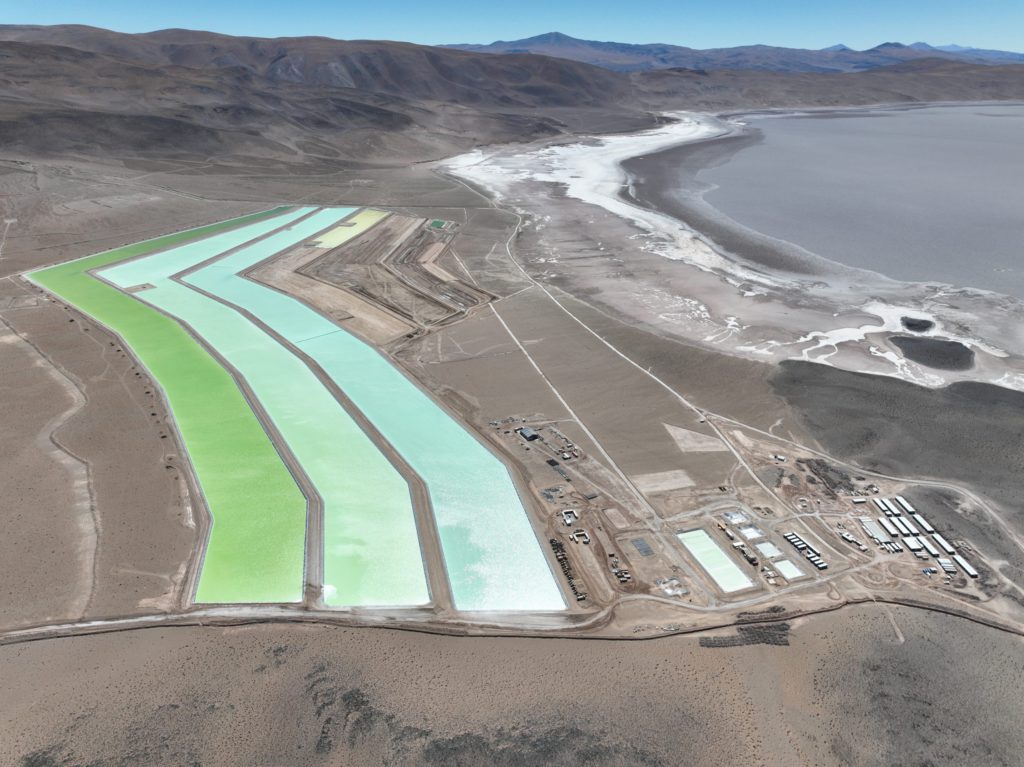
    Galan Lithium has produced its first lithium chloride at the Hombre Muerto West brine project in Catamarca, Argentina, after wet commissioning a nanofiltration plant fed with 0.5% lithium brine and discharging product to final evaporation ponds. The three‑month evaporation stage is expected to yield 6% lithium chloride concentrate, underpinning Phase 1 nameplate output of 4,000 tpa LCE, backed by a 10,000‑tonne LCE brine inventory and a 45,000‑tonne offtake with US-based Authium. Pond construction to lift capacity to 5,200 tpa LCE by H1 2027 is planned, with permits in place for a staged expansion to 60,000 tpa.

    Technical Brief

    • Nanofiltration plant, completed March 2026, is already achieving impurity separation consistent with design assays.
    • Independent laboratory chemical assays are being used to validate lithium chloride purity and impurity rejection performance.
    • Optimisation phase will initially run at variable brine throughput before stabilising at design production rates.
    • Brine inventory of ~10,000 t LCE equivalent is already stored in HMW evaporation ponds for ramp‑up.
    • Authium offtake covers 45,000 t lithium chloride concentrate over 6–12 years from Phase 1 output.
    • Nanofiltration plant has been sized to accommodate a capacity uplift to 5,200 tpa LCE by 2027 without major rework.
    • Construction permits are in place for Phase 2 at 21,000 tpa LCE, enabling a four‑phase pathway to 60,000 tpa.

    Our Take

    With Wood Mackenzie projecting China to control 39% of global lithium production by 2030, early lithium chloride output from Galan Lithium’s Hombre Muerto West project in Argentina positions a Latin American asset in a market segment where our database otherwise skews heavily towards China-backed projects in Africa and Australia.

    Argentina’s RIGI regime coming into effect in 2024 gives Galan Lithium a more predictable fiscal setting just as Phase 1 at Hombre Muerto West ramps towards a 2026 completion, which is likely to be important for securing offtake terms against Chinese converters highlighted in the Wood Mackenzie-linked coverage.

    Among recent lithium pieces in our coverage, most new production stories focus on Australian hard‑rock mines such as Mount Holland and Bald Hill, so a brine-based lithium chloride route in Catamarca province adds process diversity and may appeal to North American and European buyers looking to diversify away from Australian–China supply chains.

    Geotechnical Software for Modern Teams

    Centralise site data, logs, and lab results with GEODB-io, CMRR-io, and HYDROGEO-io.

    No credit card required.

    • Save and export unlimited calculations
    • Advanced data visualisation
    • Generate professional PDF reports
    • Cloud storage for all your projects

    Prepared by collating external sources, AI-assisted tools, and Geomechanics.io’s proprietary mining database, then reviewed for technical accuracy & edited by our geotechnical team.

    Related Articles

    Eagle Nuclear’s Aurora uranium project: permitting and PFS signals for mine planners
    Mining
    about 17 hours ago

    Eagle Nuclear’s Aurora uranium project: permitting and PFS signals for mine planners

    Eagle Nuclear Energy has completed key environmental and site-readiness work at its Aurora uranium project on the Oregon–Nevada border, including installation of a meteorological station, a wetland delineation study, and a full cultural and archaeological survey to support permitting. Aurora hosts an indicated resource of 32.75 million lb and nearly 5 million lb inferred, making it the largest conventional measured and indicated uranium deposit in the US and central to Eagle’s planned 27,000-foot pre-feasibility study. The project underpins a strategy to pair domestic uranium supply with advanced SMR technology, in a market where US reactors consume about 32 million lb of uranium annually but domestic production was only 677,000 lb in 2024.

    The Metals Company seabed licence milestone: design and ESG notes for engineers
    Mining
    about 21 hours ago

    The Metals Company seabed licence milestone: design and ESG notes for engineers

    Undersea critical minerals explorer The Metals Company has had its USA B seabed exploration licence application formally certified by NOAA, covering about 122,000 km² of eastern Clarion Clipperton Zone seafloor with an estimated 1.02 billion tonnes of polymetallic nodules containing cobalt, nickel, copper and manganese. TMC USA’s separate consolidated application for an exploration licence and commercial recovery permit in the USA A area was ruled fully compliant on 28 April, and NOAA is now expected to issue a Notice of Intent to prepare an Environmental Impact Statement and draft Terms, Conditions and Restrictions. Environmental NGOs continue to push for a blanket ban on deep-sea mining, warning of irreversible biodiversity loss from industrial-scale nodule recovery.

    Giyani Metals’ K.Hill manganese: leaner NPV, higher capex explained for mine planners
    Mining
    1 day ago

    Giyani Metals’ K.Hill manganese: leaner NPV, higher capex explained for mine planners

    Giyani Metals’ feasibility study for the K.Hill open pit manganese project in Botswana cuts post-tax NPV to US$481.5 million at 8% and trims mine life to 25 years, while initial capex jumps 88% to US$535 million and planned output falls 57% to 1.5 million tonnes. The project now carries 5.3 million tonnes of proven and probable reserves at 12% MnO (about 642,000 tonnes contained), supporting a mine-to-market route for high-purity manganese oxide and sulphate from its Johannesburg demonstration plant. Construction could start in early 2027, with commissioning in late 2028 and ramp-up in 2029.

    Related Industries & Products

    Mining

    Geotechnical software solutions for mining operations including CMRR analysis, hydrogeological testing, and data management.

    Construction

    Quality control software for construction companies with material testing, batch tracking, and compliance management.

    CMRR-io

    Streamline coal mine roof stability assessments with our cloud-based CMRR software featuring automated calculations, multi-scenario analysis, and collaborative workflows.

    HYDROGEO-io

    Comprehensive hydrogeological testing platform for managing, analysing, and reporting on packer tests, lugeon values, and hydraulic conductivity assessments.

    GEODB-io

    Centralised geotechnical data management solution for storing, accessing, and analysing all your site investigation and material testing data.

    AllGeotechnicalInfrastructureHazardsEnvironmental