Engineered transfer points: debottlenecking plant throughput for mine engineers
Reviewed by Joe Ashwell

First reported on International Mining – News
30 Second Briefing
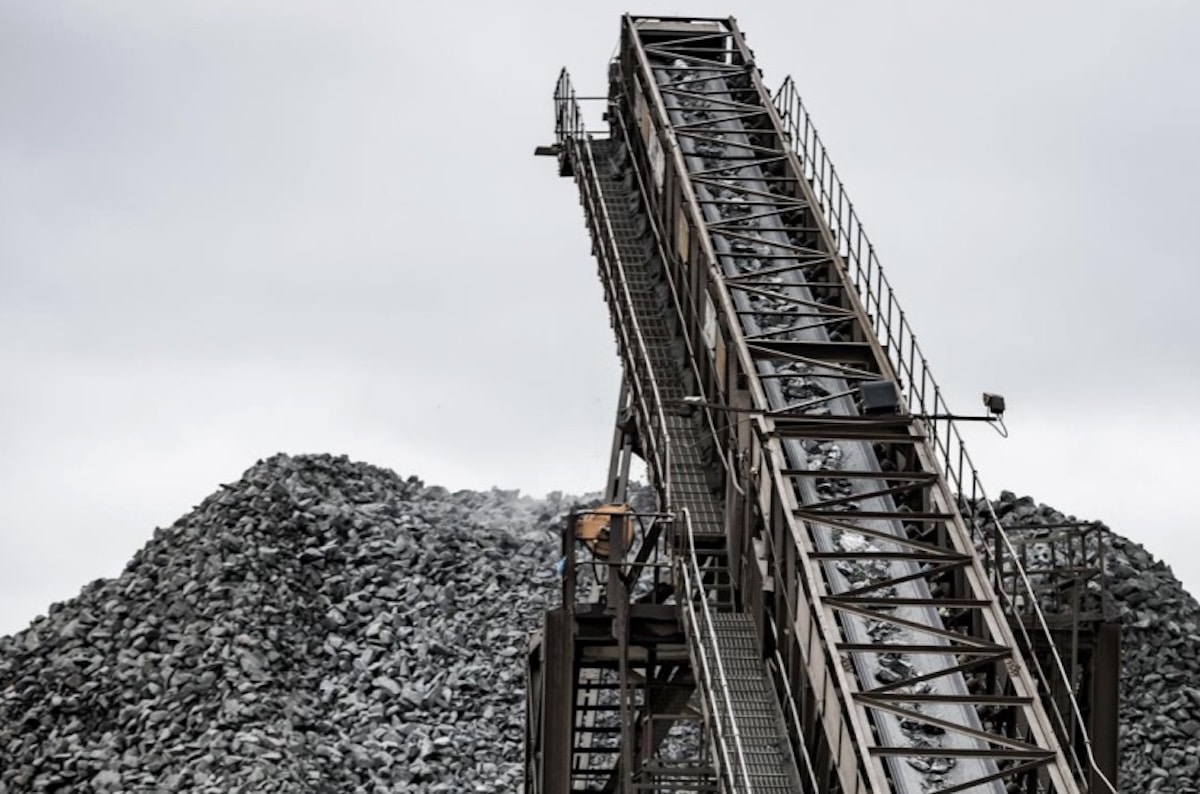
Engineered transfer points are becoming central to plant performance as mines push higher throughput, with Weba Chute Systems’ Technical Director Dewald Tintinger warning that poorly designed chutes can disproportionately constrain material flow and equipment life. Misaligned or under-designed chutes accelerate liner wear, increase blockages and spillage, and drive up dust emissions, directly affecting conveyor availability and downstream crushers and screens. Better-controlled flow paths and impact angles at transfer points are now being used as a primary lever for debottlenecking existing plants without major capital upgrades.
Technical Brief
- Weba designs chute geometries to match specific conveyor speeds, drop heights and ore characteristics.
- Tintinger stresses controlling impact angles to reduce localised liner loading and structural vibration.
- Flow-modelling (typically DEM) is used to predict particle trajectories and wall shear patterns.
- Engineered chutes are configured to centralise loading on receiving belts, limiting mistracking and edge spillage.
- Dust generation is tackled by enclosing transfer points and smoothing flow to minimise air entrainment.
- Reduced turbulence at impact zones lowers noise levels, aiding compliance with occupational exposure limits.
- Safer maintenance access is achieved by designing liner layouts and inspection doors for minimal confined entry.
- Tintinger notes that retrofitting engineered transfer points is often treated as a brownfields debottlenecking project.
Our Take
Weba Chute Systems appears repeatedly in our database as a ‘troubleshooter’ for bottlenecks when new crushers and screens are retrofitted into existing circuits, signalling that engineered transfer points are increasingly being treated as a core part of debottlenecking strategies rather than an afterthought.
The earlier Sierra Leone iron ore wet plant case involving Weba Chute Systems shows that poorly performing transfer points can directly undermine screening efficiency, so the performance-optimisation angle here is likely to resonate most with operations battling high recirculating loads and pegged screens.
Prepared by collating external sources, AI-assisted tools, and Geomechanics.io’s proprietary mining database, then reviewed for technical accuracy & edited by our geotechnical team.
Related Articles

Related Industries & Products
Mining
Geotechnical software solutions for mining operations including CMRR analysis, hydrogeological testing, and data management.
CMRR-io
Streamline coal mine roof stability assessments with our cloud-based CMRR software featuring automated calculations, multi-scenario analysis, and collaborative workflows.
HYDROGEO-io
Comprehensive hydrogeological testing platform for managing, analysing, and reporting on packer tests, lugeon values, and hydraulic conductivity assessments.
GEODB-io
Centralised geotechnical data management solution for storing, accessing, and analysing all your site investigation and material testing data.