Energy transition minerals crunch by 2035: capacity and risk notes for mine planners
Reviewed by Tom Sullivan
First reported on MINING.com
30 Second Briefing
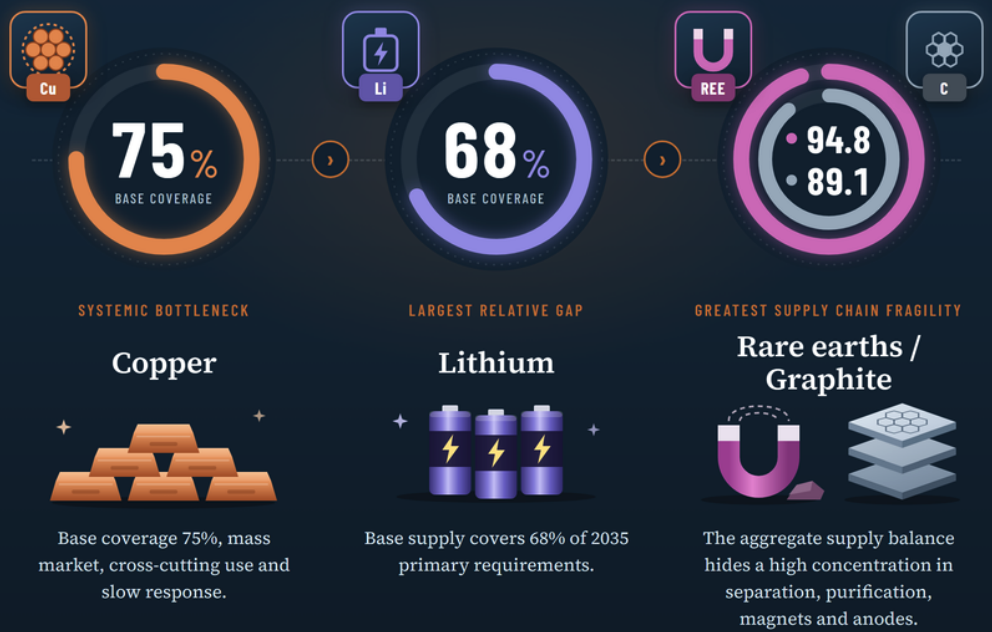
Projected mine and processing capacity will cover only 68% of lithium demand, 74% of cobalt and 75% of copper by 2035, with GEM Mining Consulting’s new Volume Scarcity Index scoring lithium at 80/100 for tightness. GEM’s parallel Supply Chain Fragility Index rates rare earth magnets at 95/100 and battery-grade graphite at 89/100 because refining and magnet production are heavily concentrated in China, with diversified rare earth magnet capacity outside China meeting just 15% of global demand. The firm estimates a nominal 100,000 t/y project typically yields only about 60,200 t/y of reliable, qualified output once permitting delays, ramp-up losses, metallurgical recoveries and customer specifications are factored in.
Technical Brief
- GEM’s “reserve relevance” chain requires deposits to be financed, permitted, extracted, processed, qualified and delivered.
- Supply Chain Fragility Index incorporates processing concentration, technological dependence and geographic risk into a single score.
- Nickel’s fragility score of 66 is linked to processing concentration in Indonesia and China.
- Copper’s relatively low fragility score of 36 contrasts with its projected physical supply deficit.
- GEM’s 100,000 t/y nameplate example falls to 60,200 t/y after cumulative development and operating losses.
- Loss drivers include permitting/financing delays, slow ramp-up to nameplate and sub‑100% metallurgical recoveries.
- Additional derating occurs where plant output fails to meet tight chemical/technical specifications of battery and magnet customers.
- GEM argues smaller deposits with proven processing routes and offtake can be strategically superior to larger, unqualified resources.
Our Take
The same GEM Mining Consulting work cited here underpins the 11 August 2026 brief in our database, which stresses that the 68–75% lithium, cobalt and copper coverage to 2035 is after factoring in typical project slippage, so planners should treat these gaps as post-risk, not optimistic, numbers.
With rare earth magnets showing 107% notional 2035 coverage but a 95/100 fragility score and only 15% diversified supply outside China, OEMs in Europe and the USA are likely to prioritise localisation of magnet manufacturing rather than raw ore projects alone.
The 20%-plus gold price drop since the start of the US–Iran war, combined with copper’s 62/100 scarcity index, reinforces a pattern in our coverage where gold-heavy portfolios are underperforming relative to copper- and battery-metal-focused miners in capital-allocation discussions.
Prepared by collating external sources, AI-assisted tools, and Geomechanics.io’s proprietary mining database, then reviewed for technical accuracy & edited by our geotechnical team.
Related Articles


Related Industries & Products
Mining
Geotechnical software solutions for mining operations including CMRR analysis, hydrogeological testing, and data management.
Construction
Quality control software for construction companies with material testing, batch tracking, and compliance management.
CMRR-io
Streamline coal mine roof stability assessments with our cloud-based CMRR software featuring automated calculations, multi-scenario analysis, and collaborative workflows.
QCDB-io
Comprehensive quality control database for manufacturing, tunnelling, and civil construction with UCS testing, PSD analysis, and grout mix design management.
HYDROGEO-io
Comprehensive hydrogeological testing platform for managing, analysing, and reporting on packer tests, lugeon values, and hydraulic conductivity assessments.