Costain’s 3D printed concrete at Teesside: design and CO₂ lessons for engineers
Reviewed by Joe Ashwell
First reported on New Civil Engineer
30 Second Briefing
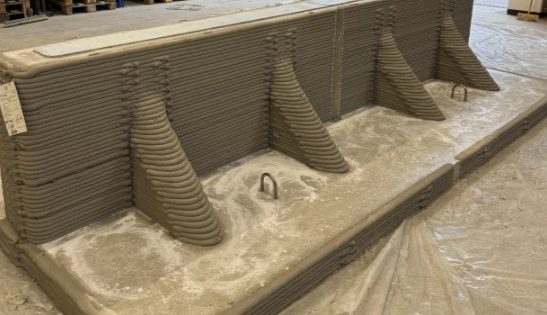
Costain and A E Yates have appointed Hyperion Robotics to 3D print low‑carbon concrete sleepers for a major East Coast Cluster carbon capture scheme on Teesside, replacing conventional precast units. Hyperion’s robotic extrusion system will optimise sleeper geometry and material placement to cut cement content and embodied CO₂ while maintaining structural performance for heavy industrial pipe and cable corridors. For geotechnical and civil teams, the move signals growing scope to integrate digitally fabricated, low‑carbon concrete elements into large linear infrastructure and energy‑transition projects.
Technical Brief
- Use on a nationally significant carbon capture scheme provides a reference case for 3D printed concrete in UK infrastructure.
Our Take
In our database of 796 Infrastructure stories, Costain increasingly appears in energy-transition and water-process work (e.g. the Severn Trent Rugby Newbold upgrade and United Utilities’ Crewe scheme), so deploying 3D printed concrete on the East Coast Cluster fits a pivot towards complex process infrastructure rather than traditional highways and rail.
Costain’s 2025 results show revenue down but profit up as road and rail volumes fell and energy and nuclear & defence grew, which suggests that proving 3D printed concrete on Teesside could help the company differentiate in higher-margin, lower-carbon industrial projects where bespoke civils elements are a cost and schedule pinch point.
For Teesside and the East Coast Cluster, using 3D printed concrete with Hyperion Robotics signals that carbon capture hubs may become early adopters of advanced construction methods, potentially setting new expectations for digital fabrication and embodied-carbon performance on UK industrial decarbonisation schemes.
Prepared by collating external sources, AI-assisted tools, and Geomechanics.io’s proprietary mining database, then reviewed for technical accuracy & edited by our geotechnical team.


