Common Lane railway bridge removal: possession and OLE design notes for engineers
Reviewed by Tom Sullivan
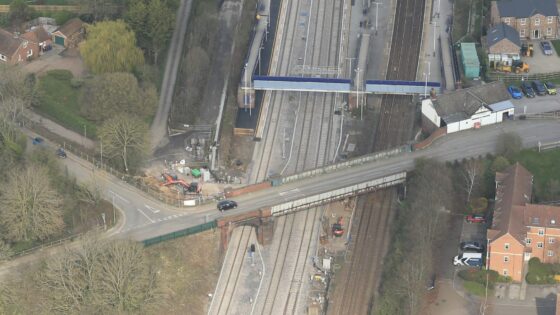
First reported on New Civil Engineer
30 Second Briefing
Replacement of the life-expired Common Lane railway bridge at Church Fenton, North Yorkshire, will proceed this weekend as part of the Transpennine Route Upgrade to create clearance for 25kV overhead line equipment for future electrification. The works will remove the existing structure over the operational railway and install a new bridge deck with increased electrical and structural clearance to modern standards. Contractors will need tight possession planning, precise lift sequencing and close coordination with track and OLE designers to manage interface risks and minimise disruption on this key trans-Pennine corridor.
Technical Brief
- Heavy crane lifts over live or recently isolated track require detailed lift planning and exclusion zones.
- Temporary works will need to maintain road approach stability and protect railway assets during deck removal.
- Interface management with adjacent TRU civils, track and systems packages is critical to avoid rework.
- Asset condition data from the “life‑expired” structure will inform residual risk and inspection regimes elsewhere.
- Safety controls must align with standards for working at height, lifting operations and electrical clearances.
- Similar bridge renewals on electrification corridors are increasingly bundled into route‑wide upgrade frameworks for capex efficiency.
Our Take
In our database, Transpennine Route Upgrade coverage has recently shifted from pure track and signalling to more asset‑specific items like the Shipley rolling stock depot and low‑carbon concrete trials, so the Church Fenton bridge removal reinforces how the programme is now tackling life‑expired civils alongside new-build facilities.
Given that Murphy has already trialled low‑carbon concrete on the Shipley Depot under the same upgrade, there is a realistic prospect that replacement structures at Common Lane and elsewhere in North Yorkshire will be expected to adopt similar lower‑clinker mixes to align with UK rail decarbonisation targets.
Prepared by collating external sources, AI-assisted tools, and Geomechanics.io’s proprietary mining database, then reviewed for technical accuracy & edited by our geotechnical team.
Related Articles


Related Industries & Products
Construction
Quality control software for construction companies with material testing, batch tracking, and compliance management.
Mining
Geotechnical software solutions for mining operations including CMRR analysis, hydrogeological testing, and data management.
CMRR-io
Streamline coal mine roof stability assessments with our cloud-based CMRR software featuring automated calculations, multi-scenario analysis, and collaborative workflows.
HYDROGEO-io
Comprehensive hydrogeological testing platform for managing, analysing, and reporting on packer tests, lugeon values, and hydraulic conductivity assessments.
GEODB-io
Centralised geotechnical data management solution for storing, accessing, and analysing all your site investigation and material testing data.