Codelco 20,000‑tonne output gap: governance and data lessons for mine teams
Reviewed by Tom Sullivan
First reported on MINING.com
30 Second Briefing
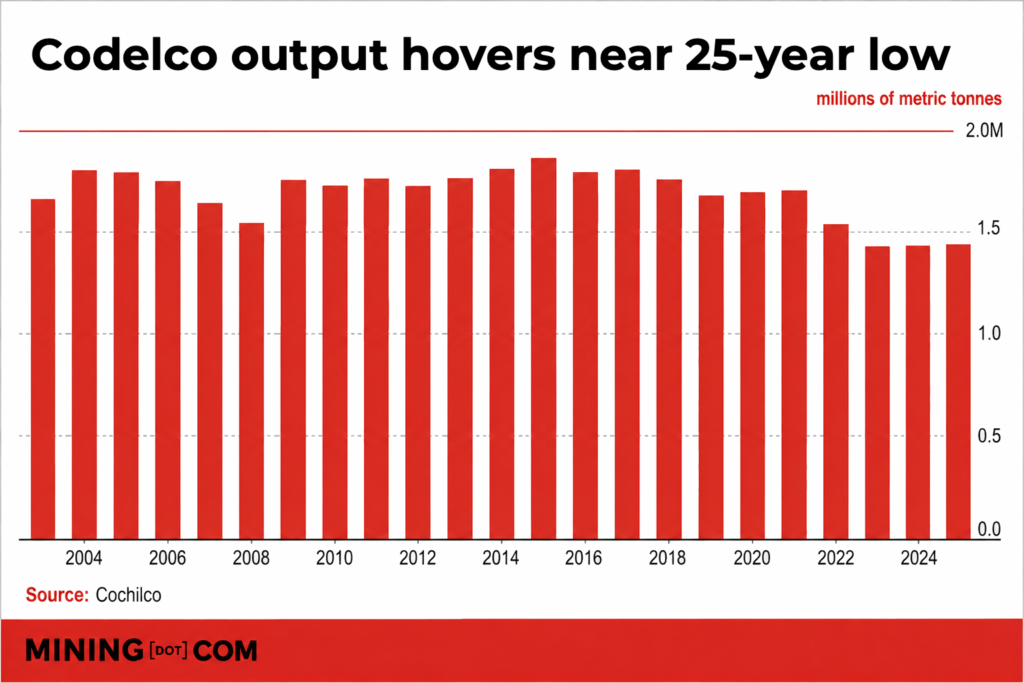
Codelco faces a preliminary internal audit finding that about 20,000 tonnes of material were wrongly counted as December 2025 finished copper, inflating reported output to 172,300 tonnes versus a January–November average of 105,600 tonnes. The disputed tonnage, allegedly authorised by a senior executive outside normal approval channels, comes amid Cochilco data showing January production slumping to 91,000 tonnes and March to 110,900 tonnes, raising doubts over any genuine recovery. Consultants Plusmining and GEM warn of serious governance, traceability and classification issues, with calls for an external audit and potential implications for executive incentives.
Technical Brief
- Preliminary internal audit reportedly flags non-compliance with Codelco’s own “finished product” classification criteria.
- Key concern is adherence to technical and accounting standards for when copper can be booked as production.
- Cochilco data show January output was Codelco’s fourth-lowest monthly figure of the decade.
- Governance questions extend to who defined/validated the production criteria and independence of oversight bodies.
- Safety culture concerns are compounded by separate accusations of concealed information on an accident at El Teniente.
- External audit is being urged to distinguish between technical misclassification, governance failure and potential fraud exposure.
Our Take
Codelco’s difficulty keeping copper output on track contrasts with Chile’s push to fast‑track more than $100 billion of mining investment, as noted in the April 2026 permitting piece, suggesting national supply growth may depend increasingly on private and foreign-led copper and lithium projects rather than the state miner alone.
Recent coverage of Codelco’s Chuquicamata and Radomiro Tomic operations shows heavy spend on underground equipment and electric haulage, which in our database typically coincides with multi‑year productivity dips before benefits materialise—making the 1.7 Mt copper target by 2030 look reliant on flawless execution of these brownfield transitions.
With copper, lithium and molybdenum all central to Chile’s portfolio in our mining coverage, any sustained underperformance at Codelco tightens the market just as Chile is positioning itself as a long‑term supplier of multiple energy‑transition commodities, giving higher‑cost producers in Canada and elsewhere more breathing room on the cost curve.
Prepared by collating external sources, AI-assisted tools, and Geomechanics.io’s proprietary mining database, then reviewed for technical accuracy & edited by our geotechnical team.
Related Articles


Related Industries & Products
Mining
Geotechnical software solutions for mining operations including CMRR analysis, hydrogeological testing, and data management.
Tunnelling
Specialised solutions for tunnelling projects including grout mix design, hydrogeological analysis, and quality control.
CMRR-io
Streamline coal mine roof stability assessments with our cloud-based CMRR software featuring automated calculations, multi-scenario analysis, and collaborative workflows.
HYDROGEO-io
Comprehensive hydrogeological testing platform for managing, analysing, and reporting on packer tests, lugeon values, and hydraulic conductivity assessments.
GEODB-io
Centralised geotechnical data management solution for storing, accessing, and analysing all your site investigation and material testing data.