Geomechanics.io

  • Free Tools
Sign UpLog In

Geomechanics.io

Geomechanics, Streamlined.

© 2026 Geomechanics.io. All rights reserved.

Geomechanics.io

CMRR-ioGEODB-ioHYDROGEO-ioQCDB-ioFree Tools & CalculatorsBlogLatest Industry News

Industries

MiningConstructionTunnelling

Company

Terms of UsePrivacy PolicyLinkedIn
    Projects
    Sustainability

    Chile’s Atacama energy storage build‑out: power contract insights for miners

    May 28, 2026|

    Reviewed by Tom Sullivan

    Chile’s Atacama energy storage build‑out: power contract insights for miners

    First reported on MINING.com

    30 Second Briefing

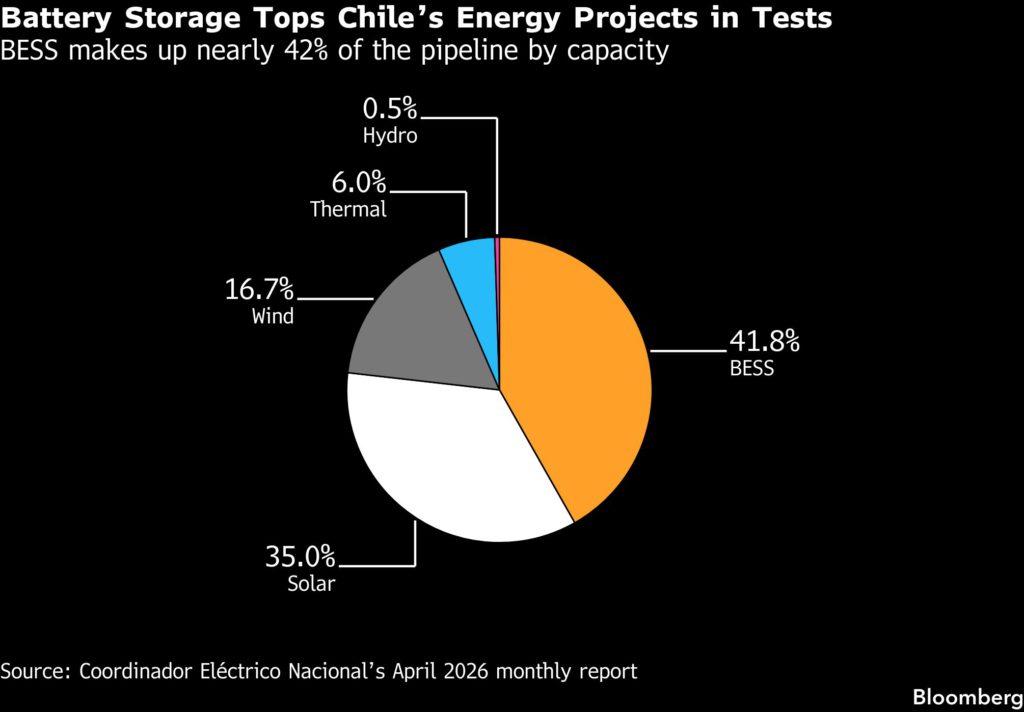
    A nearly $500 million solar‑plus‑storage plant in Chile’s Atacama Desert, ContourGlobal’s Victor Jara hybrid facility in Tarapacá, has begun operating with a 200 MW battery system capable of 6.5 hours discharge, backed by a 15‑year night‑time PPA with Copec EMOAC. Chile already has 3,072 MW of BESS operating or under test and expects a further 5,400 MW online by December, largely in the desert grid‑bottleneck zone where daytime solar is routinely curtailed. For mining and other energy‑intensive users, this rapidly expanding long‑duration storage fleet is key to securing firm, low‑carbon power contracts.

    Technical Brief

    • ContourGlobal’s Victor Jara plant is described as Latin America’s longest-duration utility-scale battery installation.
    • System configuration is solar-plus-storage, explicitly designed to shift surplus daytime PV into night-time delivery.
    • Victor Jara is ContourGlobal’s second Chilean solar‑storage asset, following the Quillagua project in Antofagasta region.
    • Atlas Renewable Energy’s Estepa hybrid project secured $510 million financing, positioning it among Chile’s largest solar‑storage builds.
    • Developers cited Chile’s regulatory framework, strong renewables pipeline and rising electricity demand as key investment drivers.
    • ContourGlobal is scoping further storage and wind projects nearer Santiago and in central–southern Chile, targeting data centre baseload demand.

    Our Take

    Within our 1189 Mining stories, Chile appears frequently in copper- and lithium-linked power deals, and the Estepa project’s 200 MW / 6.5-hour profile signals that large miners like BHP in northern Chile can now realistically substitute a significant share of thermal power with firmed solar for round-the-clock operations.

    The roughly $500 million solar-and-storage build in the Atacama Desert places Atlas Renewable Energy in the same investment scale band as AES Andes SA and Engie Energía Chile SA assets in our database, suggesting that independent power producers are now competing head-on with incumbents for long-duration supply to copper and lithium districts.

    Because the Atacama region underpins global copper and lithium supply alongside emerging cobalt and rare earth prospects, high-duration storage like Estepa reduces curtailment risk for future projects and is likely to become a de facto requirement in power tenders for new mines in northern Chile by December and beyond.

    Geotechnical Software for Modern Teams

    Centralise site data, logs, and lab results with GEODB-io, CMRR-io, and HYDROGEO-io.

    No credit card required.

    • Save and export unlimited calculations
    • Advanced data visualisation
    • Generate professional PDF reports
    • Cloud storage for all your projects

    Prepared by collating external sources, AI-assisted tools, and Geomechanics.io’s proprietary mining database, then reviewed for technical accuracy & edited by our geotechnical team.

    Related Articles

    Eagle Nuclear’s Aurora uranium project: permitting and PFS signals for mine planners
    Mining
    about 17 hours ago

    Eagle Nuclear’s Aurora uranium project: permitting and PFS signals for mine planners

    Eagle Nuclear Energy has completed key environmental and site-readiness work at its Aurora uranium project on the Oregon–Nevada border, including installation of a meteorological station, a wetland delineation study, and a full cultural and archaeological survey to support permitting. Aurora hosts an indicated resource of 32.75 million lb and nearly 5 million lb inferred, making it the largest conventional measured and indicated uranium deposit in the US and central to Eagle’s planned 27,000-foot pre-feasibility study. The project underpins a strategy to pair domestic uranium supply with advanced SMR technology, in a market where US reactors consume about 32 million lb of uranium annually but domestic production was only 677,000 lb in 2024.

    The Metals Company seabed licence milestone: design and ESG notes for engineers
    Mining
    about 21 hours ago

    The Metals Company seabed licence milestone: design and ESG notes for engineers

    Undersea critical minerals explorer The Metals Company has had its USA B seabed exploration licence application formally certified by NOAA, covering about 122,000 km² of eastern Clarion Clipperton Zone seafloor with an estimated 1.02 billion tonnes of polymetallic nodules containing cobalt, nickel, copper and manganese. TMC USA’s separate consolidated application for an exploration licence and commercial recovery permit in the USA A area was ruled fully compliant on 28 April, and NOAA is now expected to issue a Notice of Intent to prepare an Environmental Impact Statement and draft Terms, Conditions and Restrictions. Environmental NGOs continue to push for a blanket ban on deep-sea mining, warning of irreversible biodiversity loss from industrial-scale nodule recovery.

    Galan’s first lithium chloride at Hombre Muerto West: project metrics for mine planners
    Mining
    1 day ago

    Galan’s first lithium chloride at Hombre Muerto West: project metrics for mine planners

    Galan Lithium has produced its first lithium chloride at the Hombre Muerto West brine project in Catamarca, Argentina, after wet commissioning a nanofiltration plant fed with 0.5% lithium brine and discharging product to final evaporation ponds. The three‑month evaporation stage is expected to yield 6% lithium chloride concentrate, underpinning Phase 1 nameplate output of 4,000 tpa LCE, backed by a 10,000‑tonne LCE brine inventory and a 45,000‑tonne offtake with US-based Authium. Pond construction to lift capacity to 5,200 tpa LCE by H1 2027 is planned, with permits in place for a staged expansion to 60,000 tpa.

    Related Industries & Products

    Mining

    Geotechnical software solutions for mining operations including CMRR analysis, hydrogeological testing, and data management.

    CMRR-io

    Streamline coal mine roof stability assessments with our cloud-based CMRR software featuring automated calculations, multi-scenario analysis, and collaborative workflows.

    HYDROGEO-io

    Comprehensive hydrogeological testing platform for managing, analysing, and reporting on packer tests, lugeon values, and hydraulic conductivity assessments.

    GEODB-io

    Centralised geotechnical data management solution for storing, accessing, and analysing all your site investigation and material testing data.

    AllGeotechnicalInfrastructureHazardsEnvironmental