Chile copper mines disruptions: production-at-risk insights for planners
Reviewed by Tom Sullivan
First reported on MINING.com
30 Second Briefing
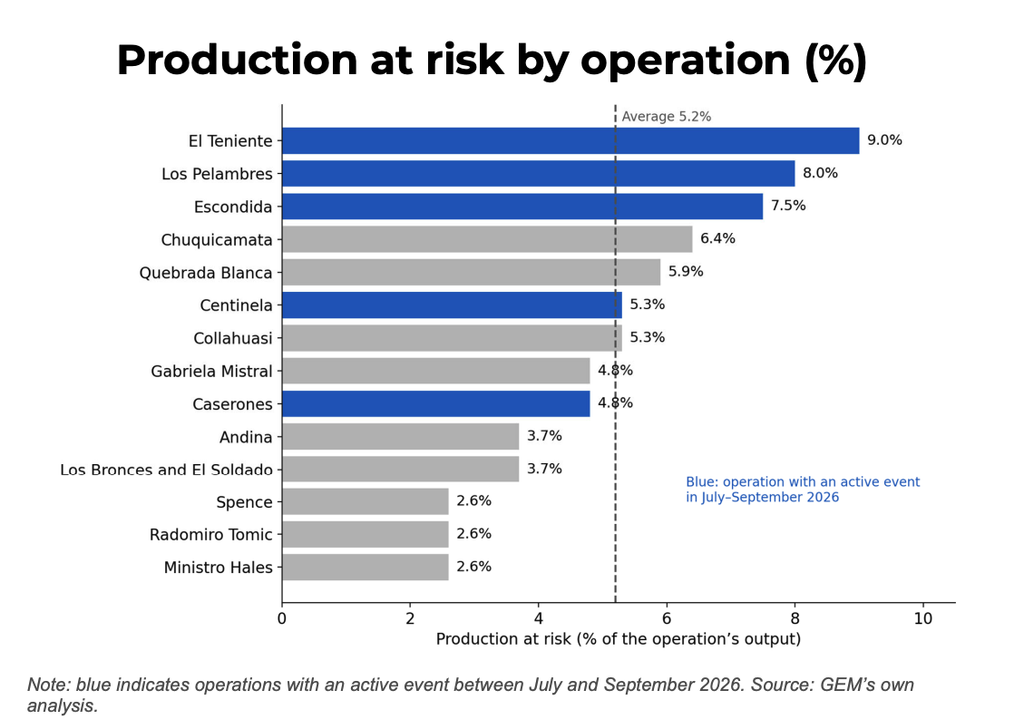
Strikes, severe weather, accidents and geotechnical issues are putting an average 5.2% of output at Chile’s 14 largest copper mines at risk, with GEM Mining Consulting’s new Production-at-Risk Index scoring El Teniente at 9%, Los Pelambres at 8% and Escondida at 7.5%. The model compounds eight disruption categories—labour, water, weather, geotechnical, metallurgy/grades, ramp-up, safety and permitting—where a single high rating equates to an expected 3% annual loss, or about 11 days of production. Current events validate the exposure, with over 700 workers on strike at Centinela, Escondida halted after a fatal accident, and storms disrupting Los Pelambres and Caserones.
Technical Brief
- GEM’s index treats a high safety or geotechnical rating as ~3% expected annual production loss (~11 days).
- Medium and low disruption ratings correspond to ~0.75% (~3 days) and 0.19% (<1 day) production loss respectively.
- Codelco suspended the Andes Norte project at El Teniente specifically due to deep seismic risk in underground workings.
- Chuquicamata’s high safety risk follows post-accident operating restrictions that coincided with a 13% production decline.
- Escondida’s safety rating is high, with labour also high, indicating compounding exposure to fatal-incident shutdowns and strikes.
- At Collahuasi, ore grade reduction from 1.15% to 0.90% drove a 27% production fall, elevating metallurgy/grades risk.
- Gabriela Mistral’s high metallurgy/grades risk is tied to geological factors that cut output by 20%.
- Chile’s copper output fell 9.3% year-on-year (Jan–Jul), with July production the lowest monthly level since 2011.
Our Take
GEM Mining Consulting’s separate 2035 outlook for critical minerals estimates only about three-quarters of required copper supply is covered under realistic disruption assumptions, so a 5.2% production-at-risk average in Chile materially tightens an already stressed balance for smelters and OEMs planning long-term offtake.
With Collahuasi’s ore grade slipping from 1.15% to 0.9% and output down 27%, the mine is moving closer to the processing-constraint scenarios GEM has flagged elsewhere, where plant throughput and reagent supply, rather than in-situ resources, become the binding limit on copper production.
Prepared by collating external sources, AI-assisted tools, and Geomechanics.io’s proprietary mining database, then reviewed for technical accuracy & edited by our geotechnical team.
Related Articles

Related Industries & Products
Mining
Geotechnical software solutions for mining operations including CMRR analysis, hydrogeological testing, and data management.
Tunnelling
Specialised solutions for tunnelling projects including grout mix design, hydrogeological analysis, and quality control.
CMRR-io
Streamline coal mine roof stability assessments with our cloud-based CMRR software featuring automated calculations, multi-scenario analysis, and collaborative workflows.
HYDROGEO-io
Comprehensive hydrogeological testing platform for managing, analysing, and reporting on packer tests, lugeon values, and hydraulic conductivity assessments.
GEODB-io
Centralised geotechnical data management solution for storing, accessing, and analysing all your site investigation and material testing data.