Bulleen Interchange beam installation: constructability lessons for road engineers
Reviewed by Joe Ashwell
First reported on Roads & Infrastructure (AU)
30 Second Briefing
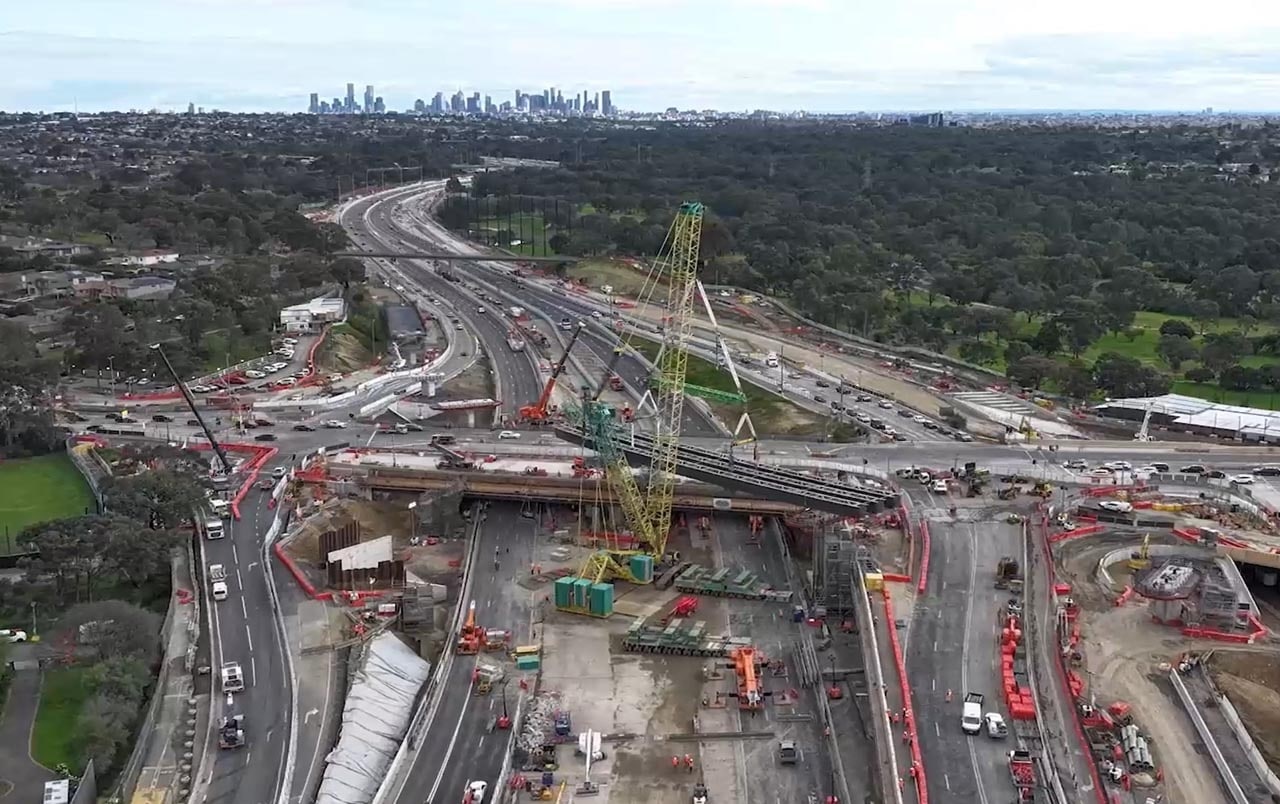
All 188 precast beams, totalling about 15,000 tonnes, have now been installed on the new multi-level Bulleen Interchange in Balwyn North, the key junction linking Melbourne’s Eastern Freeway to the North East Link tunnels. The beam placement completes the primary superstructure for the stacked ramps and connectors, allowing crews to shift focus to deck pours, barrier installation and pavement works. For designers and contractors, the milestone confirms constructability of the heavy elevated geometry over live traffic and tight urban constraints.
Technical Brief
- Multi-level geometry demands tight vertical and horizontal clearances above live carriageways and local access roads.
- Precast beam use reduces time working over traffic, lowering exposure hours for crane and rigging crews.
- Temporary works for beam erection would have included crash protection, exclusion zones and overhead shielding.
- Completion of beam placement allows removal or reconfiguration of some temporary traffic management devices.
- Safety focus now shifts to fall protection, edge barriers and access systems for deck and barrier works.
- Similar stacked-interchange builds in dense urban corridors can adopt comparable staging to limit traffic risk.
Our Take
In our database, the Bulleen Interchange works sit alongside multiple Victorian Government level crossing removals (e.g. Ruthven Street in Macleod and Diggers Rest bridges), signalling a sustained shift in Melbourne’s north‑east towards grade separation and free‑flow links between arterial roads and rail.
The concentration of Victorian Government pieces within the 921 Infrastructure stories suggests that agencies are sequencing major nodes like the Eastern Freeway–North East Link tunnels interface in parallel with suburban rail bridge upgrades, which is likely to compound short‑term traffic disruption but deliver a more resilient network once staged openings begin.
Prepared by collating external sources, AI-assisted tools, and Geomechanics.io’s proprietary mining database, then reviewed for technical accuracy & edited by our geotechnical team.
Related Articles


Related Industries & Products
Mining
Geotechnical software solutions for mining operations including CMRR analysis, hydrogeological testing, and data management.
Construction
Quality control software for construction companies with material testing, batch tracking, and compliance management.
CMRR-io
Streamline coal mine roof stability assessments with our cloud-based CMRR software featuring automated calculations, multi-scenario analysis, and collaborative workflows.
HYDROGEO-io
Comprehensive hydrogeological testing platform for managing, analysing, and reporting on packer tests, lugeon values, and hydraulic conductivity assessments.
GEODB-io
Centralised geotechnical data management solution for storing, accessing, and analysing all your site investigation and material testing data.