Bedford 79 km/h train collision: signalling and TPWS lessons for engineers
Reviewed by Tom Sullivan
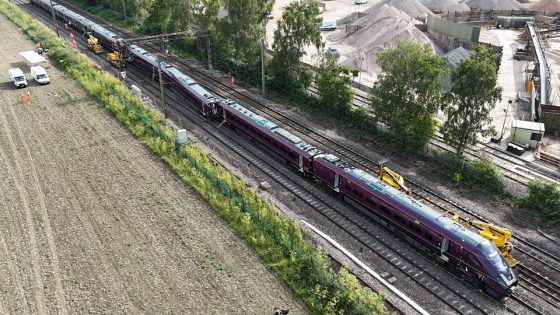
First reported on New Civil Engineer
30 Second Briefing
A preliminary Rail Accident Investigation Branch report finds East Midlands Railway service 1H46 from Corby to London St Pancras passed a red signal at Bedford and struck stationary service 1B67 from Nottingham at 79km/h. The collision occurred on the Up Slow line north of Bedford station, damaging both Class 360 EMUs and overhead line equipment but causing no fatalities. Investigators are examining signal aspect sequences, driver actions, and the performance of the Train Protection & Warning System and associated braking behaviour.
Technical Brief
- Failure mechanism under RAIB scrutiny centres on signal aspect sequence, TPWS intervention timing and actual brake performance.
- RAIB is reviewing driver route knowledge, recent driving hours and any temporary speed restrictions affecting approach behaviour.
- Post-incident monitoring will focus on track geometry, rail fastenings and slab/ballast condition in the impact zone.
Our Take
The Rail Accident Investigation Branch features repeatedly in recent safety pieces in our database, including the 2024 Wales collision and the Audenshaw freight derailment, signalling a pattern of systemic control, adhesion and asset condition issues across the national network rather than isolated events on the Corby–London St Pancras corridor.
A May 2026 article notes that some RAIB safety recommendations dating back to 2008 remain outstanding, which suggests that any findings from this Bedford incident may add to an already significant backlog of actions for operators such as East Midlands Railway and infrastructure managers to implement.
With 871 Infrastructure stories and many tagged to Safety and Failure, this Bedford near‑miss sits within a dense cluster of incident-led coverage where RAIB’s reports are increasingly being used by project teams to re‑examine signalling, driver training and operational rules on busy commuter routes like Nottingham–London.
Prepared by collating external sources, AI-assisted tools, and Geomechanics.io’s proprietary mining database, then reviewed for technical accuracy & edited by our geotechnical team.
Related Articles


Related Industries & Products
Mining
Geotechnical software solutions for mining operations including CMRR analysis, hydrogeological testing, and data management.
Construction
Quality control software for construction companies with material testing, batch tracking, and compliance management.
CMRR-io
Streamline coal mine roof stability assessments with our cloud-based CMRR software featuring automated calculations, multi-scenario analysis, and collaborative workflows.
HYDROGEO-io
Comprehensive hydrogeological testing platform for managing, analysing, and reporting on packer tests, lugeon values, and hydraulic conductivity assessments.
GEODB-io
Centralised geotechnical data management solution for storing, accessing, and analysing all your site investigation and material testing data.