WoodMac’s AI metals warning: supply–demand stress test for mine planners
Reviewed by Tom Sullivan
First reported on MINING.com
30 Second Briefing
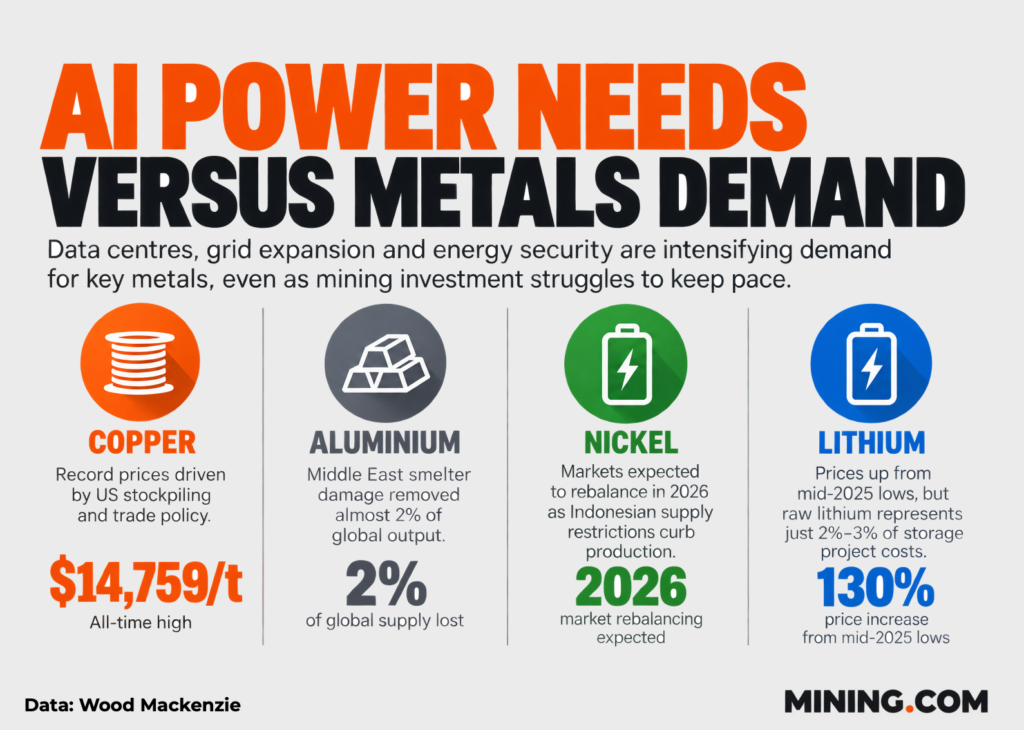
AI-driven power demand is set to push metals supply to breaking point, with Wood Mackenzie tracking over 250 GW of data centre projects and forecasting AI electricity use above 1,000 TWh by 2035, while associated grid infrastructure may need three to four times more metal than the centres themselves. Copper is already tight, with prices at $14,759/t, a 450,000 t refined deficit outside the US and a requirement for about 850,000 t/y of new greenfield capacity over the next decade. Aluminium faces a 1 Mt deficit in 2026 after Middle Eastern smelter damage, nickel is diverging by class as Indonesian quotas bite, and battery chemistries such as LFP and sodium-ion are reshaping long-term lithium and nickel demand amid a further $150–250 billion lithium investment need.
Technical Brief
- Transmission, substations and generation for AI loads are projected to consume 3–4× the metals of the data centres.
- US copper stockpiles now cover >170 days of consumption versus 48 days in the rest of world.
- Chilean copper mine output is forecast to fall 5.2% in 2026 after three years of flat global growth.
- Damage to two Middle Eastern aluminium smelters has removed almost 2% of global primary capacity.
- Chinese aluminium smelters are running at ~99% utilisation, while Indonesian output is set to reach 3 Mt by 2030.
- Global refined nickel production is expected to contract 2% in 2026, the first decline since 2015.
- Class II nickel tightness from Indonesian quotas, grade decline and drought contrasts with surpluses in Class I and chemicals.
- CATL’s third-generation Shenxing LFP battery targets 10–80% charge in under four minutes.
- A Q1 2026 lithium price rise of 83% added only ~10% to full 100 MW/4 h storage system costs.
- In Japan, data centres can be built in <5 years, but associated grid upgrades may exceed 10 years.
Our Take
Wood Mackenzie’s projection of AI‑driven copper and aluminium tightness sits alongside its separate view that China could control 39% of global lithium output by 2030, suggesting that supply risk for data‑centre metals and battery metals may increasingly be concentrated in a small group of producer countries.
The 60 GWh, three‑year sodium‑ion supply deal between CATL and HiTHIUM Energy Storage points to early commercialisation of lower‑lithium chemistries, which could blunt some of the price and availability pressure on lithium carbonate that Wood Mackenzie has flagged in its long‑term demand outlook.
With domestic US copper stocks covering roughly 170 days versus 48 days elsewhere, AI‑linked grid and data‑centre build‑outs are likely to amplify regional price spreads and give traders with offtake positions in new projects such as Smackover Lithium’s US brine operation more leverage in North American critical‑minerals supply chains.
Prepared by collating external sources, AI-assisted tools, and Geomechanics.io’s proprietary mining database, then reviewed for technical accuracy & edited by our geotechnical team.
Related Articles

Related Industries & Products
Mining
Geotechnical software solutions for mining operations including CMRR analysis, hydrogeological testing, and data management.
Construction
Quality control software for construction companies with material testing, batch tracking, and compliance management.
CMRR-io
Streamline coal mine roof stability assessments with our cloud-based CMRR software featuring automated calculations, multi-scenario analysis, and collaborative workflows.
HYDROGEO-io
Comprehensive hydrogeological testing platform for managing, analysing, and reporting on packer tests, lugeon values, and hydraulic conductivity assessments.
GEODB-io
Centralised geotechnical data management solution for storing, accessing, and analysing all your site investigation and material testing data.