VIC Gov removes 96th level crossing: underpass design notes for engineers
Reviewed by Joe Ashwell
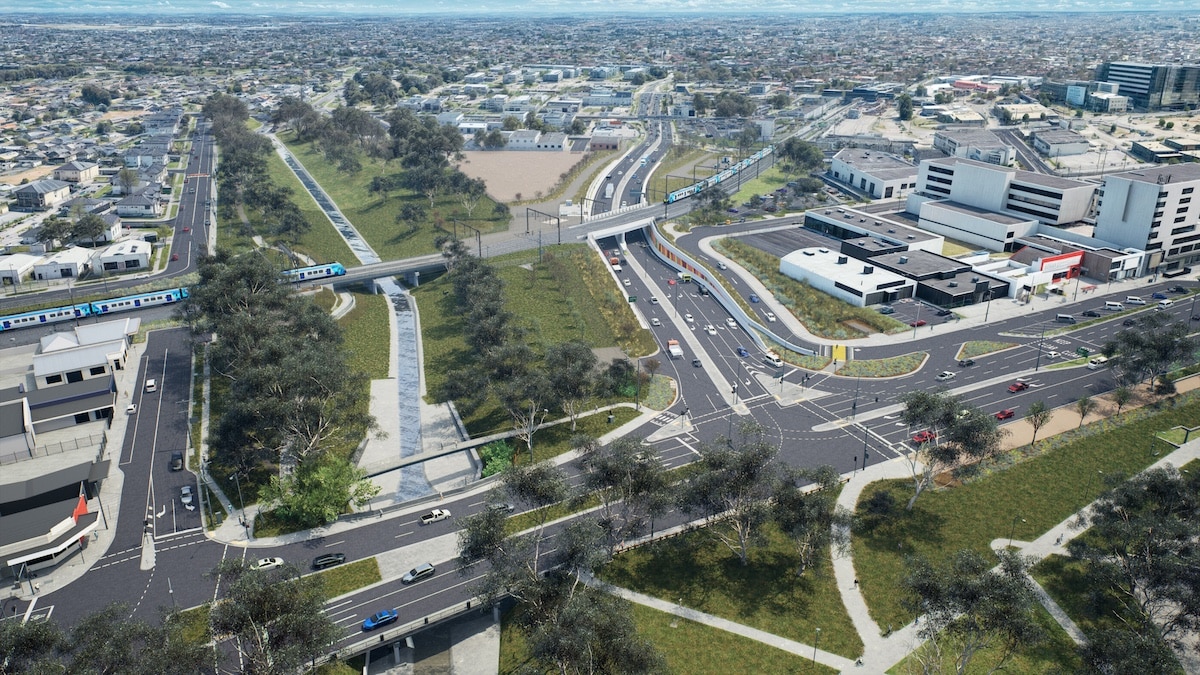
First reported on Roads & Infrastructure (AU)
30 Second Briefing
Removal of the Webster Street level crossing in Dandenong marks Victoria’s 96th level crossing removal under the State Government’s 10‑year programme to improve rail–road interfaces across greater Melbourne. The project delivers a 450‑metre road underpass extending Cheltenham Road beneath the rail corridor, eliminating at‑grade conflict and allowing Webster Street to be closed at the former crossing. For designers and contractors, the scheme adds another cut‑and‑cover underpass to Melbourne’s portfolio, with ongoing implications for groundwater control, retaining structures and long‑term settlement performance along the corridor.
Technical Brief
- Closure of the at‑grade crossing eliminates queuing across tracks, a known precursor to near‑miss and collision events.
- Rail operations now run fully grade‑separated through this section, reducing risk exposure for drivers and rail staff.
- Construction sequencing required maintaining rail services above while excavating and forming the underpass below.
- Works form part of a corridor‑wide programme, enabling consistent safety standards and design details across sites.
- For future schemes, the project reinforces cut‑and‑cover underpasses as a repeatable template for urban rail safety upgrades.
Our Take
The Victorian Government’s level crossing removals in Melbourne, including this 96th site, sit alongside other recent works such as the Old Calder Highway and Watsons Road removals at Diggers Rest, signalling a sustained corridor‑by‑corridor approach rather than isolated upgrades.
A 450‑metre road underpass in Victoria typically implies significant groundwater, drainage and retaining-structure design effort, which contractors in our database increasingly treat as reference projects when bidding for similar grade separations in dense urban rail corridors.
Within our 909 Infrastructure stories, Victoria’s level crossing program is one of the more frequently recurring state-led safety initiatives, giving local civil contractors and designers a relatively steady pipeline compared with more cyclical road-widening or greenfield highway work elsewhere in Australia.
Prepared by collating external sources, AI-assisted tools, and Geomechanics.io’s proprietary mining database, then reviewed for technical accuracy & edited by our geotechnical team.
Related Articles


Related Industries & Products
Construction
Quality control software for construction companies with material testing, batch tracking, and compliance management.
Mining
Geotechnical software solutions for mining operations including CMRR analysis, hydrogeological testing, and data management.
QCDB-io
Comprehensive quality control database for manufacturing, tunnelling, and civil construction with UCS testing, PSD analysis, and grout mix design management.