US uranium contract cuts to Canada: lessons on boom–bust risk for mine planners
Reviewed by Joe Ashwell
First reported on MINING.com
30 Second Briefing
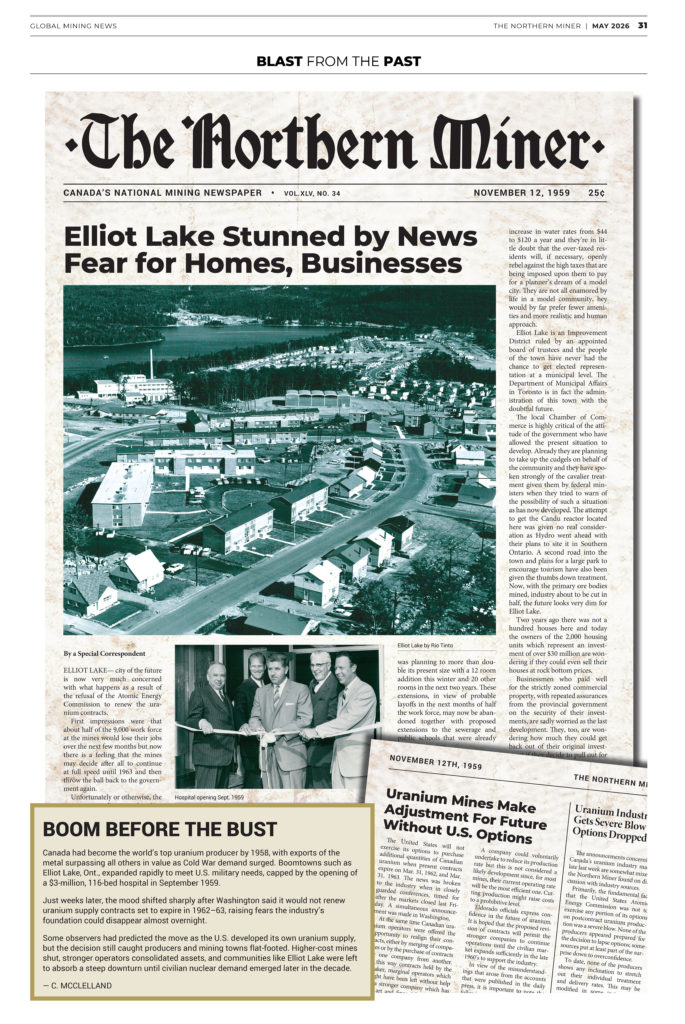
US cancellation of uranium supply contract renewals in late 1959 abruptly threatened Canada’s position as the world’s top uranium producer, just months after Elliot Lake opened a C$3-million, 116‑bed hospital built on the boom. With US military contracts due to expire in 1962–63 and domestic American uranium output rising, higher‑cost Canadian mines shut while stronger operators consolidated assets. Mining towns like Elliot Lake faced a rapid bust that lasted until civilian nuclear demand later in the 1960s stabilised the sector.
Technical Brief
- Elliot Lake’s new hospital was costed at C$3 million for 116 beds, reflecting boom-era service sizing.
- Commissioning of a 116-bed facility in September 1959 indicates planning for a long-term mining workforce presence.
- US uranium supply contracts had fixed expiries in 1962–63, creating a hard regulatory and commercial cliff-edge.
- Washington’s non-renewal decision followed expansion of domestic US uranium production capacity, displacing Canadian feed.
- Higher-cost Canadian uranium operations were first to close, effectively imposing an economic cut-off grade via contract loss.
- Asset consolidation by stronger operators suggests selective acquisition of lower-cost orebodies and existing processing infrastructure.
- Mining-dependent communities like Elliot Lake had social infrastructure sized for growth, but no diversified industrial base.
- For current uranium projects, the episode underlines contract-tenure risk: single-buyer offtake can override resource quality.
Our Take
The Elliot Lake focus in northern Ontario contrasts with more recent Canadian coverage, where permitting delays for critical minerals like copper and rare earth elements (highlighted in the Teck Resources/CIM Connect piece from May 2026) now dominate the policy discussion rather than legacy uranium districts.
Glencore’s role at Colombia’s Cerrejón coal mine, whose concession runs to 2034, sits uneasily against tightening decarbonisation narratives in our coal-tagged items, suggesting that long-dated coal licences may face growing political and ESG pressure well before contractual expiry.
Prepared by collating external sources, AI-assisted tools, and Geomechanics.io’s proprietary mining database, then reviewed for technical accuracy & edited by our geotechnical team.
Related Articles


Related Industries & Products
Mining
Geotechnical software solutions for mining operations including CMRR analysis, hydrogeological testing, and data management.
Construction
Quality control software for construction companies with material testing, batch tracking, and compliance management.
CMRR-io
Streamline coal mine roof stability assessments with our cloud-based CMRR software featuring automated calculations, multi-scenario analysis, and collaborative workflows.
HYDROGEO-io
Comprehensive hydrogeological testing platform for managing, analysing, and reporting on packer tests, lugeon values, and hydraulic conductivity assessments.
GEODB-io
Centralised geotechnical data management solution for storing, accessing, and analysing all your site investigation and material testing data.