UKAEA 12t double beam box: installation and structural notes for engineers
Reviewed by Tom Sullivan
First reported on New Civil Engineer
30 Second Briefing
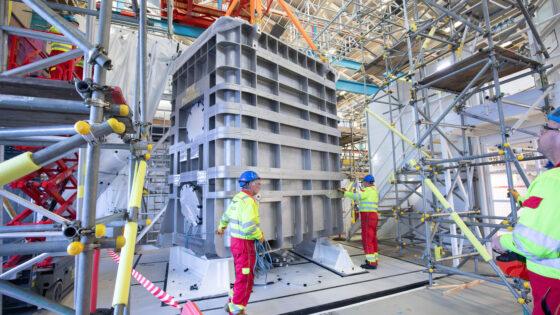
A 12t stainless-steel “double beam box” containment vessel has been craned into position at UKAEA’s Culham campus as part of the Mega Amp Spherical Tokamak (MAST) Upgrade, enabling higher neutral beam heating power for fusion experiments. The large welded vessel must interface precisely with existing vacuum systems and shielding, demanding tight tolerances on alignment and support detailing within the reactor hall. For civil and structural teams, the lift and installation constrain future maintenance access, seismic performance checks and load paths through the experimental building’s reinforced concrete frame.
Technical Brief
- Stainless-steel vessel fabrication and welding quality are critical to maintaining vacuum integrity under cyclic thermal loading.
- Temporary lifting lugs and spreader beams would have been designed to limit local shell stresses.
- Interface with existing shielding implies strict radiological zoning, access control and interlock management during installation.
- Support stools and anchors must be detailed for combined dead load, seismic and thermal expansion restraint.
- Stainless-steel selection reduces activation and corrosion risk, simplifying long-term decontamination and maintenance strategies.
- Installation sequencing has to preserve fire compartmentation, cable routing and emergency egress paths within the hall.
- Similar fusion and high-energy physics facilities can transfer lessons on heavy-lift planning inside constrained, high-hazard enclosures.
Our Take
This Mast Upgrade work at Culham sits alongside UKAEA’s STEP prototype and the Lithium Breeding Tritium Innovation (Librti) programme in our database, signalling that Culham is being treated as a full fusion engineering campus rather than a single‑experiment site.
The installation of a 12 t containment structure at the Culham campus underlines that UK fusion projects are already in the same civil/structural complexity bracket as medium‑scale nuclear refurbishments, which has implications for contractor selection on STEP and future UKAEA builds.
UKAEA’s 2025–2030 strategy flagged a shift from pure physics experiments towards commercially relevant plant engineering; heavy infrastructure upgrades on the Mast Upgrade tokamak are consistent with that, giving designers and regulators early experience with fusion‑specific safety-class components in the United Kingdom context.
Prepared by collating external sources, AI-assisted tools, and Geomechanics.io’s proprietary mining database, then reviewed for technical accuracy & edited by our geotechnical team.
Related Articles


Related Industries & Products
Construction
Quality control software for construction companies with material testing, batch tracking, and compliance management.
CMRR-io
Streamline coal mine roof stability assessments with our cloud-based CMRR software featuring automated calculations, multi-scenario analysis, and collaborative workflows.
HYDROGEO-io
Comprehensive hydrogeological testing platform for managing, analysing, and reporting on packer tests, lugeon values, and hydraulic conductivity assessments.
GEODB-io
Centralised geotechnical data management solution for storing, accessing, and analysing all your site investigation and material testing data.