Geomechanics.io

  • Free Tools
Sign UpLog In

Geomechanics.io

Geomechanics, Streamlined.

© 2026 Geomechanics.io. All rights reserved.

Geomechanics.io

CMRR-ioGEODB-ioHYDROGEO-ioQCDB-ioFree Tools & CalculatorsBlogLatest Industry News

Industries

MiningConstructionTunnelling

Company

Terms of UsePrivacy PolicyLinkedIn
    Projects
    Sustainability

    Tyne hydraulic swing bridge at 150: life‑extension and retrofit lens for engineers

    February 13, 2026|

    Reviewed by Joe Ashwell

    Tyne hydraulic swing bridge at 150: life‑extension and retrofit lens for engineers

    First reported on New Civil Engineer

    30 Second Briefing

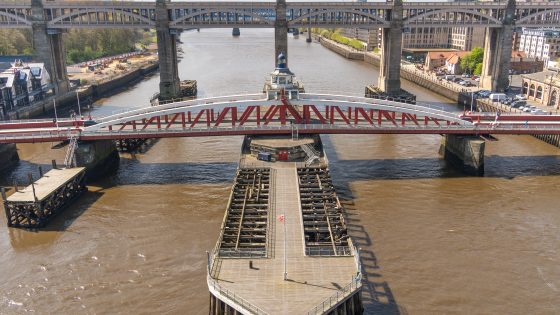
    A campaign is urging local authorities to fund remediation of the 150‑year‑old hydraulic swing bridge over the River Tyne, which has remained in a fixed, closed position since 2019. The structure, originally designed to pivot to provide a navigable channel for shipping, now requires significant mechanical and hydraulic system repairs before any reopening can be considered. For civil and structural engineers, the case raises questions over life‑extension strategies, heritage load assessments and the cost–benefit of restoring full swing functionality versus partial structural refurbishment.

    Technical Brief

    • Any remediation must address corrosion of steelwork in a saline tidal river environment.
    • Heritage status constrains replacement options for hydraulic machinery, control gear and structural elements.
    • Recommissioning would require full inspection of submerged bearings, seals and caisson or pier foundations.
    • Load rating must reconcile modern traffic actions with original design for lighter, slower vehicles.
    • Similar Victorian movable bridges in the UK face parallel challenges in balancing operability with conservation.

    Our Take

    Within the 696 Infrastructure stories in our database, very few focus on 19th‑century hydraulic assets like the Tyne swing bridge, so any remediation is likely to involve bespoke engineering rather than standardised bridge-maintenance approaches.

    The bridge’s last opening in 2019 suggests that mechanical and control systems may now be treated more as heritage machinery than operational infrastructure, which can complicate funding routes because it straddles transport, cultural and sustainability budgets.

    Given the 150‑year age of the hydraulic Tyne swing bridge, remediation will almost certainly raise questions about how far to retain original hydraulic technology versus retrofitting modern actuation and monitoring, an issue that recurs in our sustainability‑tagged coverage of ageing infrastructure assets.

    Geotechnical Software for Modern Teams

    Centralise site data, logs, and lab results with GEODB-io, CMRR-io, and HYDROGEO-io.

    No credit card required.

    • Save and export unlimited calculations
    • Advanced data visualisation
    • Generate professional PDF reports
    • Cloud storage for all your projects

    Prepared by collating external sources, AI-assisted tools, and Geomechanics.io’s proprietary mining database, then reviewed for technical accuracy & edited by our geotechnical team.

    Related Articles

    Strabag’s Pfaffensteig Tunnel contract: design and delivery notes for rail engineers
    Infrastructure
    about 1 month ago

    Strabag’s Pfaffensteig Tunnel contract: design and delivery notes for rail engineers

    Strabag and Group company Züblin have secured the design-and-build structural works for the ABS Gäubahn Nord/Pfaffensteig Tunnel in south-west Germany, centred on an 11km twin-bore rail tunnel linking Stuttgart Airport station directly to the Gäubahn line towards Switzerland. About 9.8km will be driven by two TBMs, with conventional tunnelling for the A8 motorway undercrossing and airport connection, plus a 240m cut-and-cover section, retaining structures, railway underpasses and a grade-separated crossing. A 3km surface section will be upgraded and partially realigned for 200km/h operation, delivered under an integrated project delivery model with Ed. Züblin, Wayss & Freytag and Strabag AG sharing tunnelling, structural and earthworks packages.

    National Grid TBM under the Thames: tunnelling design and risk notes for engineers
    Infrastructure
    3 months ago

    National Grid TBM under the Thames: tunnelling design and risk notes for engineers

    A 271.5‑tonne Herrenknecht Mixshield TBM, Caroline, has started driving a 2.2km electricity cable tunnel with a 4m internal diameter beneath the River Thames in Essex for National Grid’s Grain to Tilbury project, delivered by the Ferrovial BEMO joint venture. The drive will pass through variable Thames estuary ground conditions between 35m‑deep launch and reception shafts of 15m and 12m diameter, with tunnelling continuing into 2026 and overall scheme completion targeted for 2029. The new tunnel will replace the 1969 Thames Cable Tunnel and carry new high‑voltage circuits between Grain and Tilbury substations.

    Panama Canal Mixshield undercrossing: design and tunnelling lessons for engineers
    Infrastructure
    4 months ago

    Panama Canal Mixshield undercrossing: design and tunnelling lessons for engineers

    A 13.46m diameter Herrenknecht Mixshield TBM has broken through into the future Balboa station on Panama Metro Line 3 after completing the first-ever TBM undercrossing of the Panama Canal at depths exceeding 60m below sea level. The 5,600kW, 26,616kNm machine, fitted with an accessible cutterhead and more than 4,500 sensors linked via the Herrenknecht.Connected platform, has achieved peak advance of 150 segment rings (about 300m) per month through mixed sandstone, tuff, breccias and basalt. Around 1.5km of the 4.5km twin-track tunnel remains to final breakthrough.

    Related Industries & Products

    Construction

    Quality control software for construction companies with material testing, batch tracking, and compliance management.

    Mining

    Geotechnical software solutions for mining operations including CMRR analysis, hydrogeological testing, and data management.

    CMRR-io

    Streamline coal mine roof stability assessments with our cloud-based CMRR software featuring automated calculations, multi-scenario analysis, and collaborative workflows.

    HYDROGEO-io

    Comprehensive hydrogeological testing platform for managing, analysing, and reporting on packer tests, lugeon values, and hydraulic conductivity assessments.

    GEODB-io

    Centralised geotechnical data management solution for storing, accessing, and analysing all your site investigation and material testing data.

    AllGeotechnicalMiningInfrastructureMaterialsHazardsEnvironmentalSoftwarePolicy