Trump courts Brazil in rare earth supply push: project risk notes for miners
Reviewed by Tom Sullivan
First reported on MINING.com
30 Second Briefing
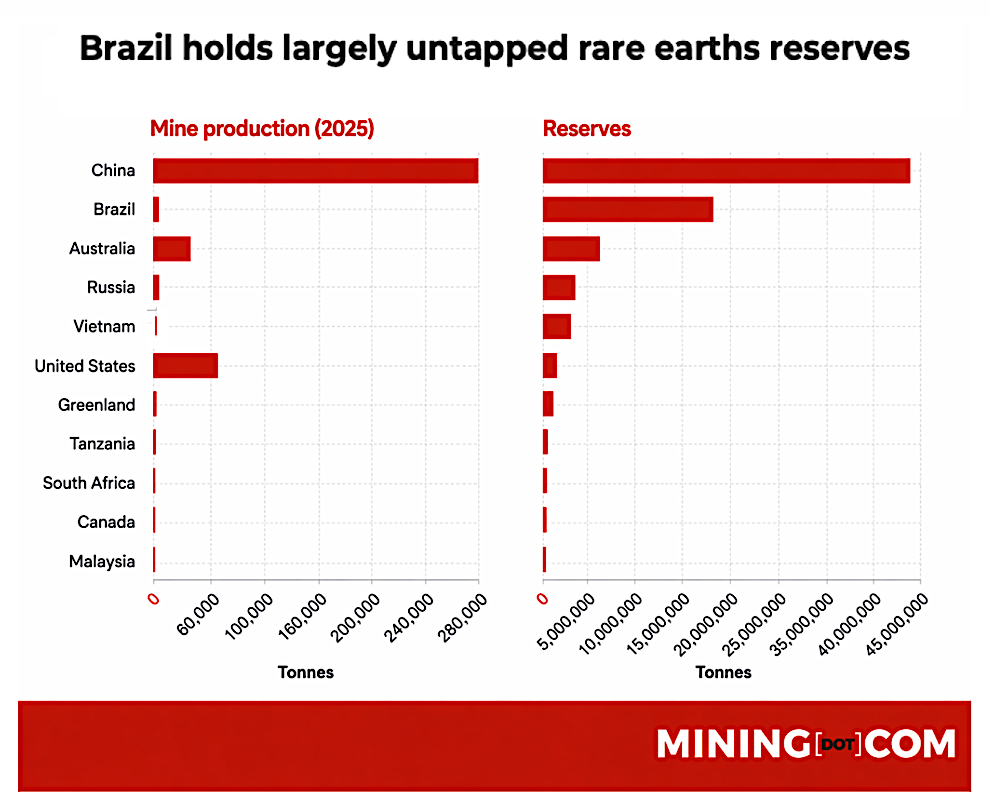
US President Donald Trump and Brazil’s Luiz Inácio Lula da Silva are using rare earths to recalibrate ties, centring talks on USA Rare Earth’s proposed $2.8 billion acquisition of Serra Verde, Brazil’s only commercial-scale rare earths operation in Goiás. Brazil, which holds about 21 million tonnes of rare-earth reserves (second only to China), is advancing legislation for a $2 billion guarantee fund and $5 billion in tax credits to anchor domestic processing and technology transfer. For miners and investors, multi‑year licensing delays, post‑Brumadinho environmental scrutiny and sovereignty debates over “preferential access” remain the key schedule and permitting risks.
Technical Brief
- Mining companies in Brazil routinely face 5–10 year timelines just to secure environmental and operational permits.
- Serra Verde in Goiás is currently Brazil’s only commercial-scale rare earths production asset under operation.
- Brazil’s critical minerals pipeline totals about $21.3 billion, with $2.4 billion earmarked for rare earths by 2030.
- Washington’s diversification push spans rare earths plus niobium, graphite, lithium, nickel and copper supply chains.
- New Brazilian legislation couples a $2 billion guarantee fund with $5 billion in tax credits for domestic processing.
- Lula has publicly committed to “no veto” on US participation but rejects any “preferential access” arrangements.
- Key project risks flagged include licensing delays, land disputes, limited processing capacity and sovereignty-driven political debates.
Our Take
Brazil’s 21 million tonnes of rare-earth reserves and the projected $2.4 billion critical-minerals investment by 2030 position it as one of the few non-Chinese jurisdictions in our database with both scale and active policy tools (guarantee fund plus tax credits) aimed at onshoring processing, which is likely to appeal to US and Canadian buyers seeking diversified supply.
The $2.8 billion M&A move by USA Rare Earth for Serra Verde in Goiás stands out against most critical-mineral items in our coverage, which more often feature smaller upstream stakes or offtakes; this signals that US-linked capital is now willing to take full-asset risk in higher-permitting-friction jurisdictions where approvals can run 5–10 years.
With copper, lithium and rare earths repeatedly co-appearing in recent power-ranking and market pieces in our database, Brazil’s push to bundle incentives across copper, niobium, graphite and lithium suggests future project clusters where multi-commodity hubs (rather than single-ore operations) could be favoured to justify local processing infrastructure.
Prepared by collating external sources, AI-assisted tools, and Geomechanics.io’s proprietary mining database, then reviewed for technical accuracy & edited by our geotechnical team.
Related Articles

Related Industries & Products
Mining
Geotechnical software solutions for mining operations including CMRR analysis, hydrogeological testing, and data management.
Construction
Quality control software for construction companies with material testing, batch tracking, and compliance management.
CMRR-io
Streamline coal mine roof stability assessments with our cloud-based CMRR software featuring automated calculations, multi-scenario analysis, and collaborative workflows.
HYDROGEO-io
Comprehensive hydrogeological testing platform for managing, analysing, and reporting on packer tests, lugeon values, and hydraulic conductivity assessments.
GEODB-io
Centralised geotechnical data management solution for storing, accessing, and analysing all your site investigation and material testing data.