The next mining supply shock: processing bottlenecks and risk mapping for engineers
Reviewed by Tom Sullivan
First reported on MINING.com
30 Second Briefing
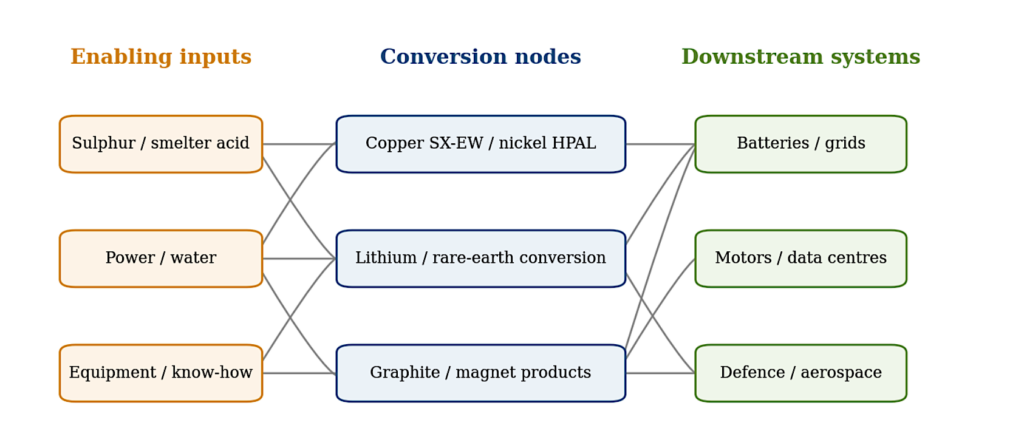
Processing plants, sulphuric acid supply and logistics, rather than ore reserves, are identified by GEM Mining Consulting as the most likely triggers of the next critical mineral supply shock, with about 3.6 Mt/y of copper produced via acid-leach routes and roughly half of seaborne sulphur trade transiting the Strait of Hormuz. Stress tests suggest a 90‑day sulphuric acid disruption could expose 111,000 t of copper output and a one‑year disruption up to 947,000 t, while a 28% N‑1 inventory buffer would still leave about 60% of ex‑China battery‑grade graphite demand uncovered after 60 days. Planned diversification of rare-earth magnet capacity is also vulnerable, with one‑ to two‑year delays on 25–50% of an 18,000 t pipeline potentially deferring 4,500–18,000 capacity‑years, pointing operators towards route‑specific risk mapping of processing, chemical and infrastructure nodes rather than mine sites alone.
Technical Brief
- GEM flags sulphuric acid as a shared input for copper SX-EW, HPAL nickel, cobalt, lithium, rare earths and battery precursors, creating multi-commodity coupling at the reagent tank.
- Roughly half of global seaborne sulphur flows through the Strait of Hormuz, concentrating physical and geopolitical transit risk into a single maritime corridor.
- China’s halt of sulphuric acid exports in May 2026 is cited as evidence that domestic sulphur tightness can quickly remove a major swing supplier from global markets.
- GEM recommends treating acid as a hard production constraint, with separate monitoring of sulphur feedstock, burner-acid capacity and smelter by-product acid in mine planning models.
- For graphite and rare-earth magnets, the bottleneck is qualification and processing (purification, graphitisation, coating, separation, metallisation), not ore availability or short-term stock levels.
- Route-level chokepoint mapping in selected Latin American mineral chains shows exposure varying by processing pathway and infrastructure node, not simply by country or orebody.
Our Take
The stress on sulphuric acid-dependent copper output (3.6 Mt/y, over 15% of primary supply) lines up with other GEM Mining Consulting work in our database arguing that logistics and reagents, not ore bodies, are now the main bottleneck for new copper and graphite projects in Canada, Latin America and Africa.
The 72% supply gap and thin 60‑day inventory buffer for battery-grade graphite outside the dominant producer mean that even modest export or processing curbs could derail the diversified rare earth and battery metals district concepts highlighted in GEM’s July 7 district-ranking piece.
One- to two-year delays affecting up to half of the planned 18,000 t rare-earth magnet pipeline suggest OEMs relying on non-Chinese rare earths, tungsten and cobalt will need to design for chemistry and supplier flexibility, echoing GEM’s June 9 analysis that substitution will cap lithium’s pricing power rather than fully displace it.
Prepared by collating external sources, AI-assisted tools, and Geomechanics.io’s proprietary mining database, then reviewed for technical accuracy & edited by our geotechnical team.
Related Articles

Related Industries & Products
Mining
Geotechnical software solutions for mining operations including CMRR analysis, hydrogeological testing, and data management.
Construction
Quality control software for construction companies with material testing, batch tracking, and compliance management.
CMRR-io
Streamline coal mine roof stability assessments with our cloud-based CMRR software featuring automated calculations, multi-scenario analysis, and collaborative workflows.
HYDROGEO-io
Comprehensive hydrogeological testing platform for managing, analysing, and reporting on packer tests, lugeon values, and hydraulic conductivity assessments.
GEODB-io
Centralised geotechnical data management solution for storing, accessing, and analysing all your site investigation and material testing data.