Geomechanics.io

  • Free Tools
Sign UpLog In

    Geomechanics.io

    Geomechanics, Streamlined.

    © 2026 Geomechanics.io. All rights reserved.

    Geomechanics.io

    CMRR-ioGEODB-ioHYDROGEO-ioQCDB-ioFree Tools & CalculatorsBlogLatest Industry News

    Industries

    MiningConstructionTunnelling

    Company

    Terms of UsePrivacy PolicyLinkedIn
    Projects
    Safety

    Temporary works across UK schemes: sequencing and safety lessons for engineers

    April 29, 2026|

    Reviewed by Tom Sullivan

    Temporary works across UK schemes: sequencing and safety lessons for engineers

    First reported on New Civil Engineer

    30 Second Briefing

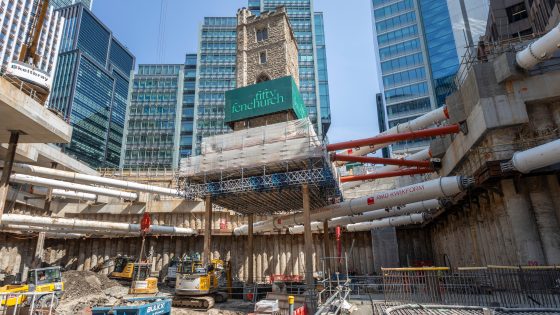
    Temporary works on current UK schemes range from heavy propping towers and modular aluminium access platforms to sheet-piled cofferdams supporting deep excavations in constrained urban sites. Photos shared by the Temporary Works Forum show complex façade retention frames braced back to steel grillages, crane bases founded on high-capacity spread mats, and temporary bridges spanning live rail and highway corridors. For designers and contractors, the examples stress rigorous sequencing, load path verification and early coordination between permanent and temporary works to control movement and maintain programme.

    Technical Brief

    • Temporary Works Forum imagery is being used as a peer-review tool to scrutinise stability, access and edge protection arrangements.
    • Photos allow cross-checking of compliance with BS 5975 temporary works procedures, including category 2 and 3 design checks.
    • Visual records of schemes near live rail and highways support briefing on exclusion zones and lifting plans.
    • Forum members are using shared examples to challenge adequacy of inspection regimes and sign-off before load transfer.
    • Image-based discussion is informing safer sequencing around façade retention, including when to remove props and ties.
    • For deep excavations, shared details are prompting debate on emergency egress routes and temporary ventilation provision.
    • More systematic sharing of temporary works photographs is emerging as an informal industry learning and hazard-spotting mechanism.

    Our Take

    Temporary works guidance from the Temporary Works Forum sits within a large body of our infrastructure coverage, but relatively few of the 2,308 safety‑tagged pieces focus on this niche, suggesting practitioners still have limited cross‑project benchmarking for temporary works risk management.

    New Civil Engineer’s role in initiatives like the British Construction & Infrastructure Awards 2026 and Heathrow Airport’s Early Careers Innovation Challenge indicates that case studies of temporary works from this article are likely to feed into both awards criteria and innovation challenges around safer construction staging.

    Because temporary works failures often drive disproportionate incident severity compared with their cost share on projects, structured learning captured here can be particularly valuable for early‑career engineers highlighted in New Civil Engineer’s programmes, where temporary works competence is frequently under‑emphasised in formal training.

    Geotechnical Software for Modern Teams

    Centralise site data, logs, and lab results with GEODB-io, CMRR-io, and HYDROGEO-io.

    No credit card required.

    • Save and export unlimited calculations
    • Advanced data visualisation
    • Generate professional PDF reports
    • Cloud storage for all your projects

    Prepared by collating external sources, AI-assisted tools, and Geomechanics.io’s proprietary mining database, then reviewed for technical accuracy & edited by our geotechnical team.

    Related Articles

    National Grid TBM under the Thames: tunnelling design and risk notes for engineers
    Infrastructure
    in 7 months

    National Grid TBM under the Thames: tunnelling design and risk notes for engineers

    A 271.5‑tonne Herrenknecht Mixshield TBM, Caroline, has started driving a 2.2km electricity cable tunnel with a 4m internal diameter beneath the River Thames in Essex for National Grid’s Grain to Tilbury project, delivered by the Ferrovial BEMO joint venture. The drive will pass through variable Thames estuary ground conditions between 35m‑deep launch and reception shafts of 15m and 12m diameter, with tunnelling continuing into 2026 and overall scheme completion targeted for 2029. The new tunnel will replace the 1969 Thames Cable Tunnel and carry new high‑voltage circuits between Grain and Tilbury substations.

    Panama Canal Mixshield undercrossing: design and tunnelling lessons for engineers
    Infrastructure
    in 7 months

    Panama Canal Mixshield undercrossing: design and tunnelling lessons for engineers

    A 13.46m diameter Herrenknecht Mixshield TBM has broken through into the future Balboa station on Panama Metro Line 3 after completing the first-ever TBM undercrossing of the Panama Canal at depths exceeding 60m below sea level. The 5,600kW, 26,616kNm machine, fitted with an accessible cutterhead and more than 4,500 sensors linked via the Herrenknecht.Connected platform, has achieved peak advance of 150 segment rings (about 300m) per month through mixed sandstone, tuff, breccias and basalt. Around 1.5km of the 4.5km twin-track tunnel remains to final breakthrough.

    Hudson Tunnel funding deadline: schedule and risk takeaways for project teams
    Infrastructure
    in 6 months

    Hudson Tunnel funding deadline: schedule and risk takeaways for project teams

    Federal funding for New York’s US$16bn Hudson Tunnel Project has been frozen, forcing the Gateway Development Commission to suspend works from 6 February after spending over US$1bn and employing about 1,000 site workers. A Manhattan federal judge has issued a temporary restraining order, giving the administration until 5 p.m. on 12 February to restore reimbursements or appeal, while contractors warn that demobilisation, resequencing and remobilisation will add cost and delay. Sites are now in “safe-pause” mode, with dewatering, ground support and environmental monitoring maintained, and assembly of two Herrenknecht TBMs in New Jersey likely to slip beyond the planned spring 2026 launch without funding certainty.

    Related Industries & Products

    Construction

    Quality control software for construction companies with material testing, batch tracking, and compliance management.

    Mining

    Geotechnical software solutions for mining operations including CMRR analysis, hydrogeological testing, and data management.

    QCDB-io

    Comprehensive quality control database for manufacturing, tunnelling, and civil construction with UCS testing, PSD analysis, and grout mix design management.

    AllGeotechnicalInfrastructureHazardsEnvironmental