Sulphuric acid crunch and battery metals: cost and supply risks for mine planners
Reviewed by Joe Ashwell
First reported on MINING.com
30 Second Briefing
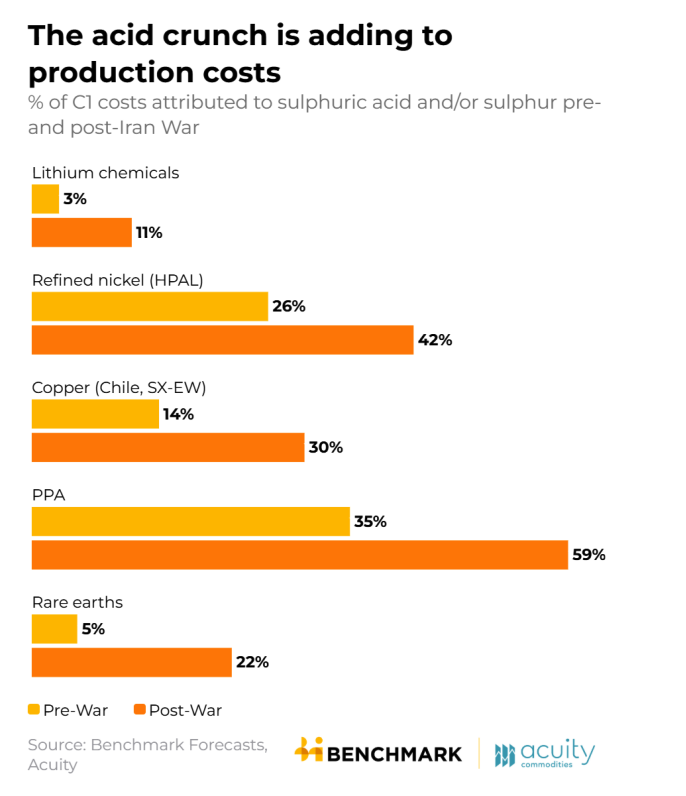
Conflict-driven disruption of sulphur flows through the Strait of Hormuz has pushed sulphur prices up more than 50% and more than doubled sulphuric acid prices in some regions, turning a low-profile reagent into a dominant cost driver for battery metals. Benchmark Mineral Intelligence reports sulphuric acid’s share of hard-rock lithium chemical C1 costs has jumped from 3% to 11%, while sulphur now accounts for 42% of HPAL nickel costs (up from 26%), with Indonesia sourcing 76% of its sulphur imports from the Middle East and needing over 10 tonnes of sulphur per tonne of HPAL nickel. Spot acid above $380/t in Indonesia and $440/t in Chile, China’s informal export curbs, and physical shortages now threaten curtailments or shutdowns at lithium, nickel, cobalt and manganese sulphate plants, even as copper smelters gain from higher acid byproduct revenues and falling treatment and refining charges.
Technical Brief
- At least 50% of global seaborne sulphur trade transits the Strait of Hormuz, creating a single-point vulnerability.
- More than half of global lithium, cobalt, rare earth and purified phosphoric acid output (2026 forecast) is sulphur-dependent.
- High-purity manganese sulphate monohydrate for EV cathodes is described as 100% reliant on sulphuric acid availability.
- HPAL circuits require over 10 tonnes of elemental sulphur per tonne of nickel, magnifying logistics and storage hazards.
- Spot sulphuric acid has exceeded $380/t in Indonesia and $440/t in Chile as converters chase alternative supply.
- Copper solvent extraction–electrowinning, responsible for ~22% of global mined copper, is directly exposed to acid shortages.
- Benchmark warns damaged Gulf refining assets could need substantial time and capex to restore, prolonging reagent risk exposure.
Our Take
With at least half of global seaborne sulphur trade moving through the Strait of Hormuz and 76% of Indonesia’s sulphur imports coming from the Middle East, HPAL nickel projects there are structurally more exposed to geopolitical chokepoints than sulphur-dependent copper SX-EW operations in Chile or the USA.
Benchmark Mineral Intelligence’s work on copper guidance misses and overperformance suggests that cost shocks in inputs like sulphuric acid can translate quickly into production surprises, especially for marginal SX-EW and high-acid leach assets that already sit higher on the cost curve.
Prepared by collating external sources, AI-assisted tools, and Geomechanics.io’s proprietary mining database, then reviewed for technical accuracy & edited by our geotechnical team.
Related Articles

Related Industries & Products
Mining
Geotechnical software solutions for mining operations including CMRR analysis, hydrogeological testing, and data management.
CMRR-io
Streamline coal mine roof stability assessments with our cloud-based CMRR software featuring automated calculations, multi-scenario analysis, and collaborative workflows.
HYDROGEO-io
Comprehensive hydrogeological testing platform for managing, analysing, and reporting on packer tests, lugeon values, and hydraulic conductivity assessments.
GEODB-io
Centralised geotechnical data management solution for storing, accessing, and analysing all your site investigation and material testing data.