Geomechanics.io

  • Free Tools
Sign UpLog In

    Geomechanics.io

    Geomechanics, Streamlined.

    © 2026 Geomechanics.io. All rights reserved.

    Geomechanics.io

    CMRR-ioGEODB-ioHYDROGEO-ioQCDB-ioFree Tools & CalculatorsBlogLatest Industry News

    Industries

    MiningConstructionTunnelling

    Company

    Terms of UsePrivacy PolicyLinkedIn
    Projects
    Sustainability

    Story Camelot revitalisation: brownfield design and SUDS notes for engineers

    June 29, 2026|

    Reviewed by Tom Sullivan

    Story Camelot revitalisation: brownfield design and SUDS notes for engineers

    First reported on The Construction Index

    30 Second Briefing

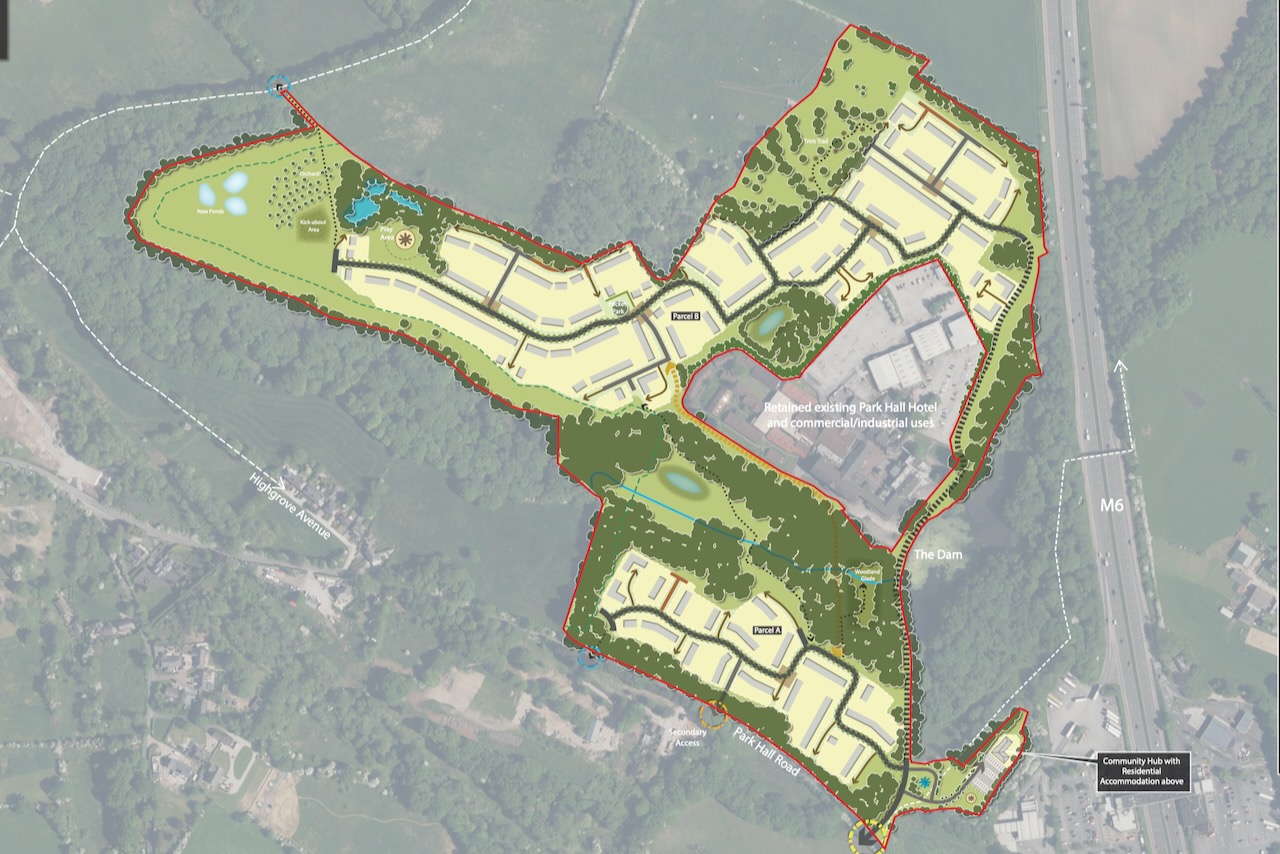
    Story Homes has secured outline planning permission on appeal for up to 350 homes on the long-derelict Camelot Theme Park brownfield site at Charnock Richard, Chorley, with 50% of units designated as affordable housing for local residents. The scheme includes a community hub for co-working and local groups, a targeted 10% biodiversity net gain achieved partly by de-culverting a section of Syd Brook, and on-site habitat enhancement. Funding commitments comprise about £3m in Community Infrastructure Levy and £1.85m in Section 106 for playing pitches, public rights of way, public transport and green space maintenance, with construction expected to support roughly 240 jobs.

    Technical Brief

    • Appeal decision by the Planning Inspectorate overturns earlier refusal, unlocking redevelopment of the derelict grey-belt site.
    • Brownfield reuse of the former Camelot Theme Park avoids greenfield take and associated new-service corridors.
    • Masterplan is framed as a “thriving new community”, implying mixed-use layout and internal movement network design.
    • Community hub is specified as flexible space, allowing adaptation for co-working, meetings and local group activities.
    • On-site biodiversity net gain is tied to habitat enhancement, requiring long-term ecological management and monitoring regimes.
    • De-culverting Syd Brook reinstates open-channel hydraulics, improving conveyance, habitat complexity and inspection access.
    • Section 106 funding earmarked for public rights of way upgrades will influence off-site path surfacing and drainage details.
    • Construction supply chain is expected to support around 240 jobs, favouring staged earthworks and utilities mobilisation.
    • Scheme illustrates how grey-belt leisure sites can be re-purposed into housing-led communities with integrated green infrastructure.

    Our Take

    Story Homes already features in other large residential schemes in our database, such as the 330-home Hazelhurst Farm project with Taylor Wimpey, signalling that the Camelot site is part of a wider, multi-site pipeline rather than a one-off development.

    A 50% affordable housing component on the Camelot site is at the upper end of what we see across recent UK Infrastructure coverage, which is likely to strengthen the scheme’s resilience against future policy shifts or local political pushback.

    The combination of on-site biodiversity net gain and multi-million-pound CIL and Section 106 contributions aligns this Chorley scheme with the more demanding sustainability and planning obligations seen in other Planning Inspectorate-backed projects, such as the Grove House retrofit in Hammersmith.

    Geotechnical Software for Modern Teams

    Centralise site data, logs, and lab results with GEODB-io, CMRR-io, and HYDROGEO-io.

    No credit card required.

    • Save and export unlimited calculations
    • Advanced data visualisation
    • Generate professional PDF reports
    • Cloud storage for all your projects

    Prepared by collating external sources, AI-assisted tools, and Geomechanics.io’s proprietary mining database, then reviewed for technical accuracy & edited by our geotechnical team.

    Related Articles

    Strabag’s Pfaffensteig Tunnel contract: design and delivery notes for rail engineers
    Infrastructure
    about 2 months ago

    Strabag’s Pfaffensteig Tunnel contract: design and delivery notes for rail engineers

    Strabag and Group company Züblin have secured the design-and-build structural works for the ABS Gäubahn Nord/Pfaffensteig Tunnel in south-west Germany, centred on an 11km twin-bore rail tunnel linking Stuttgart Airport station directly to the Gäubahn line towards Switzerland. About 9.8km will be driven by two TBMs, with conventional tunnelling for the A8 motorway undercrossing and airport connection, plus a 240m cut-and-cover section, retaining structures, railway underpasses and a grade-separated crossing. A 3km surface section will be upgraded and partially realigned for 200km/h operation, delivered under an integrated project delivery model with Ed. Züblin, Wayss & Freytag and Strabag AG sharing tunnelling, structural and earthworks packages.

    National Grid TBM under the Thames: tunnelling design and risk notes for engineers
    Infrastructure
    4 months ago

    National Grid TBM under the Thames: tunnelling design and risk notes for engineers

    A 271.5‑tonne Herrenknecht Mixshield TBM, Caroline, has started driving a 2.2km electricity cable tunnel with a 4m internal diameter beneath the River Thames in Essex for National Grid’s Grain to Tilbury project, delivered by the Ferrovial BEMO joint venture. The drive will pass through variable Thames estuary ground conditions between 35m‑deep launch and reception shafts of 15m and 12m diameter, with tunnelling continuing into 2026 and overall scheme completion targeted for 2029. The new tunnel will replace the 1969 Thames Cable Tunnel and carry new high‑voltage circuits between Grain and Tilbury substations.

    Panama Canal Mixshield undercrossing: design and tunnelling lessons for engineers
    Infrastructure
    5 months ago

    Panama Canal Mixshield undercrossing: design and tunnelling lessons for engineers

    A 13.46m diameter Herrenknecht Mixshield TBM has broken through into the future Balboa station on Panama Metro Line 3 after completing the first-ever TBM undercrossing of the Panama Canal at depths exceeding 60m below sea level. The 5,600kW, 26,616kNm machine, fitted with an accessible cutterhead and more than 4,500 sensors linked via the Herrenknecht.Connected platform, has achieved peak advance of 150 segment rings (about 300m) per month through mixed sandstone, tuff, breccias and basalt. Around 1.5km of the 4.5km twin-track tunnel remains to final breakthrough.

    Related Industries & Products

    Construction

    Quality control software for construction companies with material testing, batch tracking, and compliance management.

    Mining

    Geotechnical software solutions for mining operations including CMRR analysis, hydrogeological testing, and data management.

    QCDB-io

    Comprehensive quality control database for manufacturing, tunnelling, and civil construction with UCS testing, PSD analysis, and grout mix design management.

    AllGeotechnicalMiningInfrastructureMaterialsHazardsEnvironmentalSoftwarePolicy