Staffordshire-built EGL1 transformer: onshore works outlook for civil engineers
Reviewed by Joe Ashwell
First reported on New Civil Engineer
30 Second Briefing
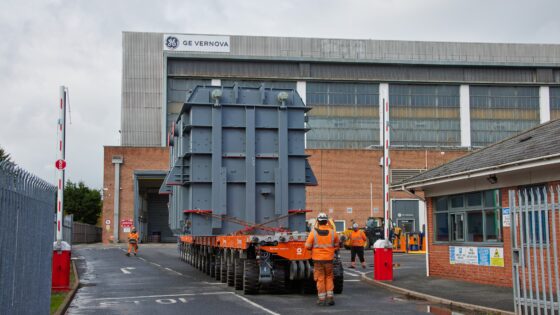
A transformer built by GE Vernova in Staffordshire for the Eastern Green Link 1 (EGL1) subsea electricity transmission project has completed production and been loaded out for transport. The unit will form part of the EGL1 high-voltage link, scheduled for installation from July 2027, which is designed to move large volumes of offshore wind power between Scotland and England via subsea cables. For civil and geotechnical teams, the milestone signals approaching onshore works for foundations, heavy-lift logistics and grid-connection infrastructure at the landfall substations.
Technical Brief
- Load-out of the completed unit implies transport-sized modularisation, influencing abnormal load routing and temporary works.
- Movement from Staffordshire to the onshore substation will require bridge checks, haul road strengthening and escort planning.
- Substation civil works must accommodate transformer dead load, oil containment bunds and blast/clearance stand-off distances.
- Heavy-lift cranage or self-propelled modular transporters will dictate foundation bearing pressures and hardstanding design at the receiving site.
- Coordination between transformer delivery and cable termination works will drive sequencing of GIS halls, cable basements and trenches.
- For geotechnical teams, early transformer readiness compresses timeframes for ground improvement and piling at the onshore substation.
Our Take
GE Vernova’s role on Eastern Green Link 1 sits alongside its involvement in Net Zero Teesside’s gas-plus-CCS power scheme, signalling that UK regulators and project sponsors are repeatedly turning to the same OEM for grid‑critical and decarbonisation infrastructure.
With installation on EGL1 not due to start until July 2027, the long lead time mirrors other large UK energy projects in our infrastructure coverage, implying contractors will need robust inflation and supply‑chain risk allowances for high‑spec electrical equipment.
GE Vernova’s parallel push into UK nuclear via the Hitachi BWRX‑300 small modular reactor design suggests that the Staffordshire-built transformer is part of a broader UK-facing grid and generation portfolio, which could give the company leverage in future transmission and interconnector tenders.
Prepared by collating external sources, AI-assisted tools, and Geomechanics.io’s proprietary mining database, then reviewed for technical accuracy & edited by our geotechnical team.
Related Articles


Related Industries & Products
Construction
Quality control software for construction companies with material testing, batch tracking, and compliance management.
Mining
Geotechnical software solutions for mining operations including CMRR analysis, hydrogeological testing, and data management.
CMRR-io
Streamline coal mine roof stability assessments with our cloud-based CMRR software featuring automated calculations, multi-scenario analysis, and collaborative workflows.
HYDROGEO-io
Comprehensive hydrogeological testing platform for managing, analysing, and reporting on packer tests, lugeon values, and hydraulic conductivity assessments.
GEODB-io
Centralised geotechnical data management solution for storing, accessing, and analysing all your site investigation and material testing data.