Specifying helical piles: torque, geometry and testing essentials for engineers
Reviewed by Joe Ashwell
First reported on Geoengineer.org – News
30 Second Briefing
Helical piles and anchors are presented as displacement deep foundations whose performance depends on correctly specifying helix geometry (diameter, pitch, spacing), shaft type (solid square vs hollow round), and corrosion protection for the design life. The guide stresses matching installation torque to required axial capacity, using torque correlation factors (Kt) appropriate to soil type, and defining minimum embedment depth and number of helices rather than leaving these to contractors. Engineers are urged to state load cases (tension, compression, lateral), serviceability criteria, and testing requirements such as proof and pre-production load tests.
Technical Brief
- Helical pile design is framed within load combinations and limit states, not contractor rules-of-thumb.
- Service life is treated explicitly as a design parameter, with higher corrosion allowances for longer design lives.
- Safety factors differ for tension, compression and lateral actions, with higher factors recommended for uplift-critical structures.
- Proof and pre-production tests are distinguished, with guidance on minimum test numbers per project and per soil profile.
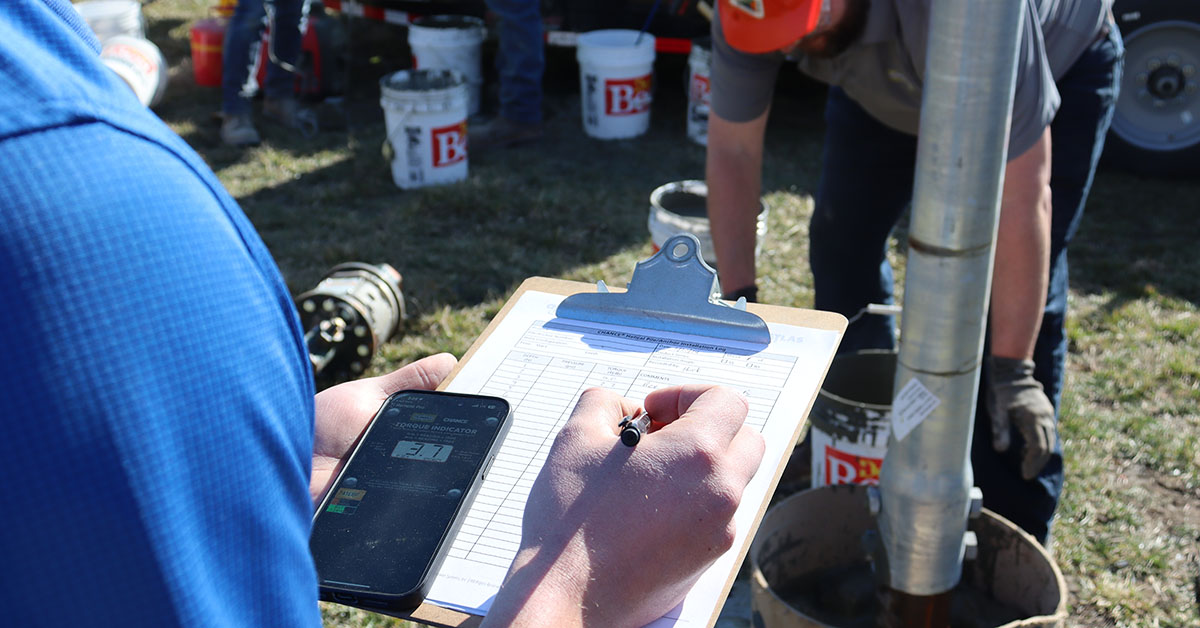
- Installation records (torque vs depth, refusal criteria, obstructions) are required as quality and safety documentation, not optional contractor data.
- For industry practice, the guide pushes engineers to own all safety-critical decisions (geometry, corrosion, testing) rather than delegating to suppliers.
Prepared by collating external sources, AI-assisted tools, and Geomechanics.io’s proprietary mining database, then reviewed for technical accuracy & edited by our geotechnical team.
Related Articles

Related Industries & Products
Construction
Quality control software for construction companies with material testing, batch tracking, and compliance management.
CMRR-io
Streamline coal mine roof stability assessments with our cloud-based CMRR software featuring automated calculations, multi-scenario analysis, and collaborative workflows.
HYDROGEO-io
Comprehensive hydrogeological testing platform for managing, analysing, and reporting on packer tests, lugeon values, and hydraulic conductivity assessments.
GEODB-io
Centralised geotechnical data management solution for storing, accessing, and analysing all your site investigation and material testing data.