Skinningrove Flood Alleviation Scheme: design and risk notes for bridge engineers
Reviewed by Tom Sullivan
First reported on New Civil Engineer
30 Second Briefing
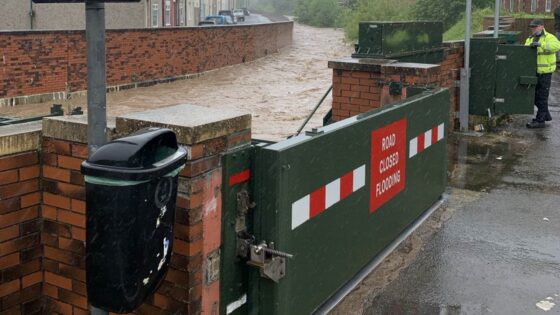
Bam has begun construction of the £13M Skinningrove Flood Alleviation Scheme in North Yorkshire for the Environment Agency, centred on replacing Stone Row Bridge and removing the village’s reliance on manually operated flood gates. The works will modernise flood defence infrastructure on this tidal beck, where existing gates currently require on-site deployment during storm events, exposing operators and creating response delays. For civil and geotechnical teams, key issues will include bridge hydraulic capacity, scour protection and maintaining access while upgrading a constrained coastal channel.
Technical Brief
- Design must satisfy tidal beck hydraulic modelling, including freeboard and afflux limits under EA standards.
- Scour countermeasures around the new Stone Row Bridge will be critical for foundation stability in tidal flows.
- Construction sequencing has to maintain village access while working in a narrow, tidally influenced channel.
- Temporary works will need robust cofferdam and dewatering design to manage tidal groundwater and soft alluvium.
- Safety planning removes the need for staff deployment during storm surges, reducing exposure to fast‑rising water.
- EA flood‑risk design checks will likely include climate‑change uplift scenarios for future tidal levels and flows.
- Similar UK coastal becks with legacy manual gates could adopt bridge‑based conveyance upgrades to eliminate on‑site gate operation.
Our Take
BAM’s role at Skinningrove sits alongside its recent UK infrastructure work such as the Baker Viaduct on the Transpennine Route Upgrade and the Forest Gate bridge replacements, signalling that the contractor is consolidating a niche in technically complex, rail- and water-adjacent structures where hydraulic and structural interfaces are critical.
Within our 915-item Infrastructure corpus, relatively few pieces combine the Projects and Safety tags around flood risk in smaller North Yorkshire communities, so this scheme is likely to be a reference point for future Environment Agency designs that remove manual interventions at pinch points like Stone Row Bridge.
Prepared by collating external sources, AI-assisted tools, and Geomechanics.io’s proprietary mining database, then reviewed for technical accuracy & edited by our geotechnical team.
Related Articles


Related Industries & Products
Construction
Quality control software for construction companies with material testing, batch tracking, and compliance management.
Mining
Geotechnical software solutions for mining operations including CMRR analysis, hydrogeological testing, and data management.
QCDB-io
Comprehensive quality control database for manufacturing, tunnelling, and civil construction with UCS testing, PSD analysis, and grout mix design management.